
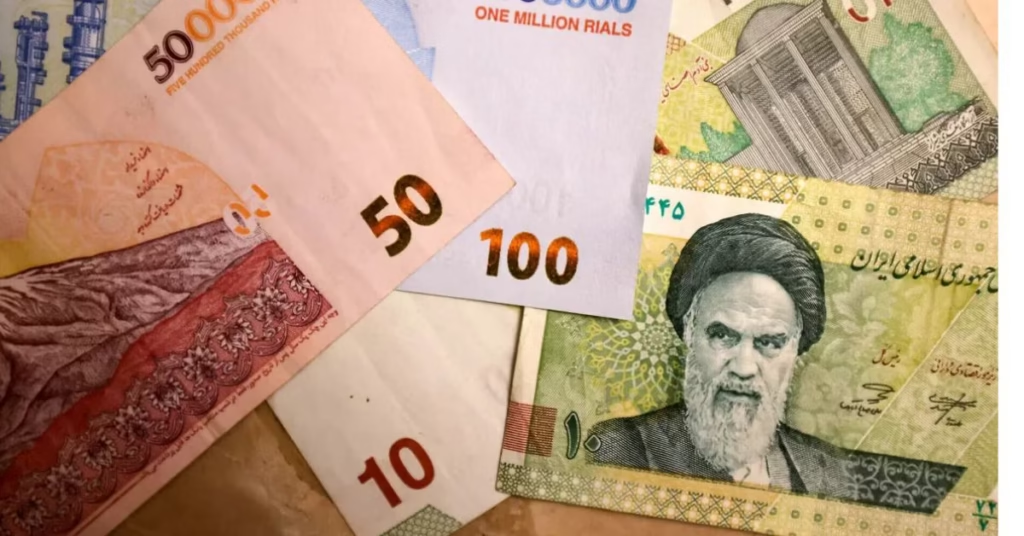
Iranian Currency Sees Unusual Surge Against Rupee in Pakistan Informal Markets
The Iranian rial to Pakistani rupee rate has shown unusual movement in Pakistan’s informal currency markets, with dealers reporting significantly higher exchange values in major cities including Karachi, Quetta, and Lahore. Market data suggests strong demand linked to cross border trade and speculative activity. According to verified open market quotations, one crore Iranian rials, equal to 10,000,000 IRR, is being traded between 8,000 PKR and 10,000 PKR in licensed dealer networks. This reflects a notable premium compared to global reference rates. Informal Market Shows Strong Demand Currency dealers say the Iranian rial to Pakistani rupee rate is being driven by consistent demand in border regions. Traders involved in cross border settlements along the Balochistan and Iran corridor are actively participating in these transactions. The informal market is also seeing participation from retail speculators. This combination of trade needs and short term positioning has created strong upward pressure on rial prices in Pakistan’s informal channels. Gap Between Local and Global Rates Widens Market analysis shows a significant gap between informal and international rates. In Pakistan’s open market, the estimated exchange value stands at around 1 PKR equals 1,000 IRR. However, the international mid market benchmark places the rate at approximately 1 PKR equals 4,738 IRR. This means the informal Pakistani market is trading at nearly 4.7 times higher than global reference levels. Experts say this divergence highlights the impact of local demand conditions and restricted financial channels between the two countries. Cross Border Trade Drives Currency Movement A key factor behind the rising Iranian rial to Pakistani rupee rate is informal trade activity. The Balochistan Iran border region plays a central role in goods exchange, where formal banking channels are limited. Because of these restrictions, traders often rely on cash based or informal settlement systems. This increases demand for physical currency and pushes local exchange rates away from global benchmarks. Dealers also point to liquidity shortages and uneven supply of foreign currency as contributing factors. Weekly Increase Shows Strong Momentum Market data indicates that the value of one crore Iranian rials has increased sharply over the past week. Earlier, the range was between 6,500 PKR and 8,500 PKR. It has now moved to 8,000 PKR to 10,000 PKR. This represents a weekly rise of around 15 percent to 25 percent in informal trading circles. Such movement is considered significant for currency markets operating outside formal banking systems. Traders say the rapid change reflects shifting demand patterns and short term speculation. Daily Activity Estimated in Millions Currency experts estimate that daily transactions involving the Iranian rial to Pakistani rupee rate are worth around 4 to 6 million dollars equivalent. Most of this activity is driven by border trade facilitation, small scale remittance flows, and speculative buying. Retail participants also contribute to short term volatility in pricing. However, analysts caution that informal market data can fluctuate rapidly throughout the day, making real time verification essential before any transaction. Role of Currency Systems in Iran and Pakistan The Iranian rial, issued by the Central Bank of Iran, has faced long term pressure due to inflation, sanctions, and geopolitical tensions. These factors have contributed to its reduced international value over time. On the other hand, the Pakistani rupee is issued by the State Bank of Pakistan. Its performance depends on inflation, trade balance, remittance inflows, and broader economic conditions. Both currencies operate under different economic pressures, which often influence their exchange behavior in informal markets. Advisory for Market Participants Dealers recommend that individuals verify live exchange rates before engaging in any currency transactions. Official exchange companies and ECAP member dealers provide more regulated pricing compared to informal channels. Experts warn that informal markets carry additional risks due to lack of oversight and sudden price fluctuations. Structural Market Reality The current Iranian rial to Pakistani rupee rate highlights how informal financial systems operate alongside formal markets. Trade needs, liquidity gaps, and regional demand continue to shape currency behavior outside official frameworks. As cross border economic activity continues, such divergences may persist unless formal banking channels expand between neighboring countries.