
Pakistan’s liquid foreign exchange reserves recorded a strong weekly increase in December 2025, driven primarily by fresh inflows from the International Monetary Fund (IMF). The latest data released by the State Bank of Pakistan (SBP) highlights improving external liquidity conditions and renewed confidence in Pakistan’s macroeconomic stabilization efforts.
This business blog breaks down the current foreign reserves position, compares it with the previous week, and explains why the IMF disbursement is significant for Pakistan’s economy.
Pakistan’s Current Foreign Exchange Reserves Position (as of 12 December 2025)
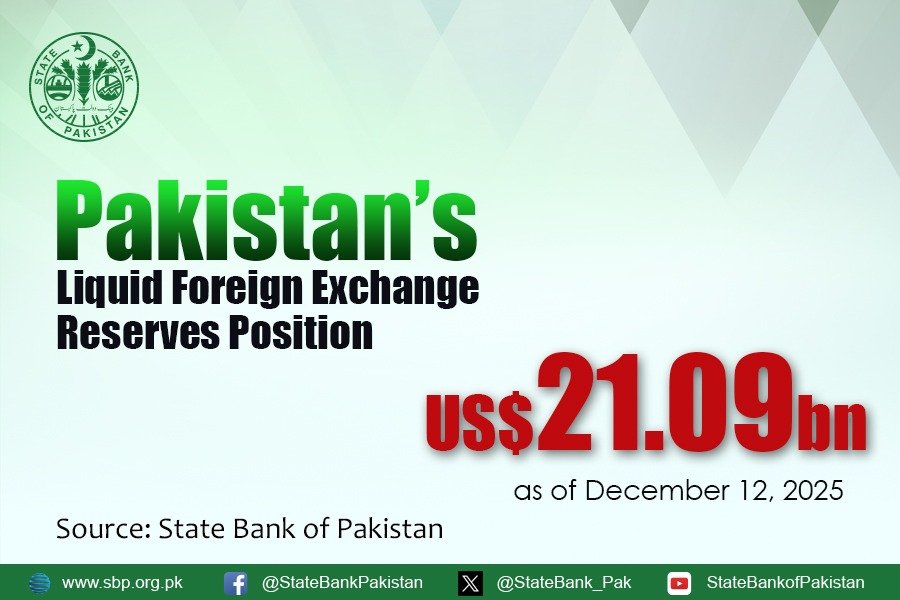
As of 12 December 2025, Pakistan’s total liquid foreign reserves stood at USD 21.09 billion, marking a notable week-on-week increase.
In text form, the reserves position is as follows:
• Foreign exchange reserves held by the State Bank of Pakistan (SBP): USD 15.89 billion
• Net foreign reservesiled exchange reserves held by commercial banks: USD 5.20 billion
• Total liquid foreign exchange reserves: USD 21.09 billion
Weekly Increase in SBP Reserves
During the week ended 12 December 2025, SBP’s foreign exchange reserves rose by USD 1.3 billion, increasing from USD 14.59 billion to USD 15.89 billion.
According to SBP, this sharp rise was mainly due to the receipt of SDR 914 million (approximately USD 1.2 billion) from the IMF under:
• The Extended Fund Facility (EFF), and
• The Resilience and Sustainability Facility (RSF).
This inflow significantly strengthened Pakistan’s reserve buffers and improved short-term external financing comfort.
Foreign Exchange Reserves Position: Previous Week (as of 5 December 2025)
For comparison, Pakistan’s liquid foreign reserves position one week earlier, on 5 December 2025, was as follows:
• SBP-held foreign exchange reserves: USD 14.59 billion
• Net foreign exchange reserves held by commercial banks: USD 5.03 billion
• Total liquid foreign exchange reserves: USD 19.61 billion
During that week, SBP’s reserves increased only marginally by USD 12 million, reflecting relatively stable inflows before the IMF tranche was formally accounted for.
SBP had already confirmed that the SDR 914 million IMF disbursement was received during that period, with its impact scheduled to appear in the reserves data for the week ending 12 December 2025 which is now fully reflected in the latest figures.
Why the IMF Inflow Matters for Pakistan’s Economy
The IMF-linked increase in foreign exchange reserves carries several positive implications for Pakistan’s economy, including:
• Improved external sector stability, reducing immediate balance-of-payments pressure
• Greater confidence in the Pakistani rupee, supporting exchange rate stability
• Enhanced investor sentiment, particularly among foreign portfolio and direct investors
• Stronger import cover, improving Pakistan’s ability to finance essential imports
The rise in reserves also signals continued policy alignment with IMF reform commitments, a key factor closely watched by global financial markets and rating agencies.
Outlook: What to Watch Next
Going forward, market participants will closely monitor:
• Further IMF-related inflows or program reviews
• Export performance and remittance trends
• SBP’s monetary and exchange rate policy stance
• External debt repayments and rollover plans
Sustaining reserve accumulation will be critical for Pakistan as it navigates global economic uncertainty and domestic fiscal challenges in 2026.