
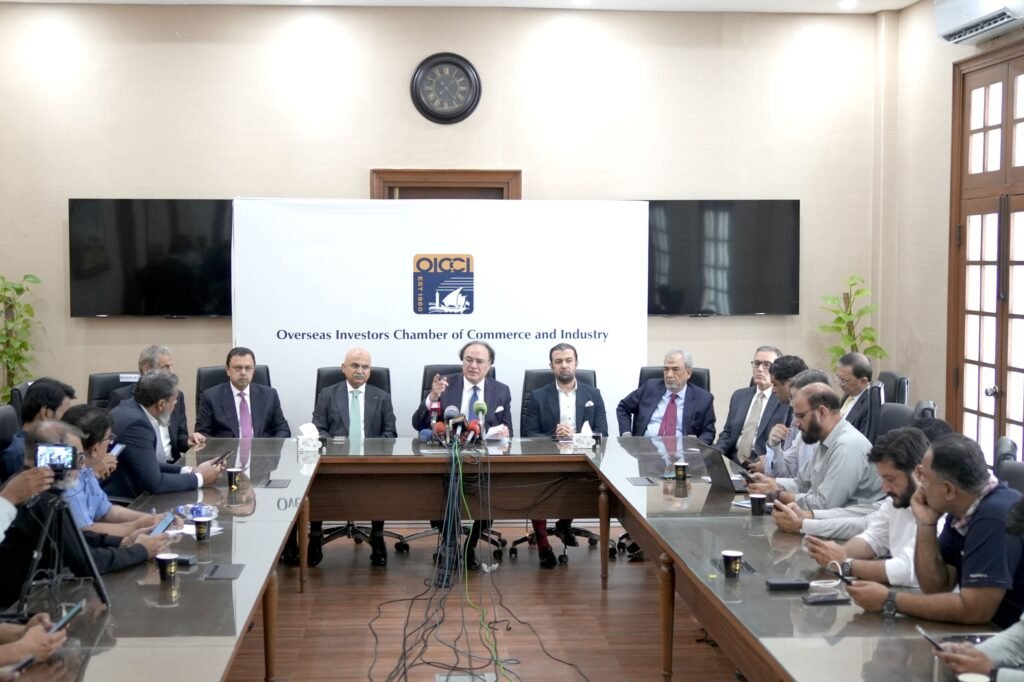
Finance Minister Says Pakistan Moving From Stabilization Toward Growth
KARACHI: Federal Minister for Finance and Revenue Senator Muhammad Aurangzeb has said Pakistan’s economy is moving in the right direction, with the country transitioning from stabilization towards growth.
Addressing members and stakeholders of the Overseas Investors Chamber of Commerce and Industry (OICCI) during his visit to Karachi, the Finance Minister said sustainable economic growth would need to be led by the private sector, while the Government would focus on providing a conducive business environment, policy framework and investment ecosystem.
He stressed that the country must consolidate recent economic gains and avoid returning to the boom-and-bust cycle.
Government Outlines Six Economic Priorities
Senator Muhammad Aurangzeb outlined six key economic priorities for the Government.
These include making macroeconomic stability permanent through stronger fiscal and external resilience, shifting towards sustainable and inclusive growth driven by productivity, investment, exports and employment, and continuing structural reforms.
The Government also aims to shift Pakistan’s international economic engagement from aid towards trade and investment, expand access to finance for SMEs, agriculture, housing and underserved segments, and position the country for the New Economy through digitalisation, blockchain, Web 3.0 and emerging technologies.
Private Sector Expected to Drive Investment and Growth
The Finance Minister emphasized the importance of domestic investment and capital formation in supporting long-term economic growth.
Referring to the PIA transaction, he said major Pakistani business groups had demonstrated their ability to collaborate and mobilize nearly US$1.2 billion collectively.
According to the Finance Minister, such participation reflects the growing capacity of domestic investors to create scale and pursue larger investment opportunities.
He said the Government’s role was to provide an enabling environment, while the private sector would need to lead economic growth through investment, innovation, employment creation and expansion of productive capacity.
Government Seeks Greater Foreign Investment
Senator Muhammad Aurangzeb also highlighted measures aimed at attracting greater international investment into Pakistan.
He identified mining and minerals, technology, agriculture, oil and gas, refinery upgrades and other sectors as areas where investor interest is emerging.
The Finance Minister also referred to interest from Turkish investors in the privatisation of electricity distribution companies, as well as interest from Saudi and other international investors across multiple sectors.
He stressed that foreign investment takes time to materialize and depends on policy continuity, effective facilitation and a conducive investment environment.
Structural Reforms Move Into Implementation
The Finance Minister said Pakistan’s structural reform agenda had moved beyond the design stage and into execution.
The reforms cover taxation, energy, State-Owned Enterprises, privatisation and public finance.
He noted that the number of tax filers had increased to more than 5.7 million, compared with around 3.9 million last year and approximately 1.8 to 1.9 million in 2022.
Revenue mobilization, he said, would continue alongside taxpayer facilitation and efforts to strengthen trust in the tax system.
Digitalisation and data are expected to play a growing role in improving tax administration and revenue collection.
Focus on Expanding Access to Finance
Senator Muhammad Aurangzeb highlighted efforts to increase financing opportunities for SMEs, agriculture, housing and underserved segments of the economy.
Referring to the Prime Minister’s Apna Ghar Programme, he said around Rs60 billion had already been financed, while banks had approved a substantial additional financing pipeline.
He said the challenge was increasingly shifting from the availability of financing towards strengthening the supply side and ensuring that credit translates into construction, investment, employment and wider economic activity.
Capital Markets Seen as Key to Capital Formation
The Finance Minister also stressed the importance of deepening Pakistan’s capital markets so domestic savings can be directed towards productive investment.
Potential areas include infrastructure, housing, privatisation and private-sector expansion.
He said the Government was working to strengthen the broader capital-market ecosystem and create additional avenues for capital formation and investment.
Pakistan Seeks Shift From Aid to Trade and Investment
Senator Muhammad Aurangzeb reiterated the Government’s objective of shifting Pakistan’s bilateral economic relationships from aid towards trade and investment flows.
He also highlighted the opportunities presented by digitalisation, blockchain, Web 3.0 and other emerging technologies.
According to the Finance Minister, these areas could support investment, innovation, exports and employment as Pakistan positions itself for the New Economy.
OICCI Discusses Business and Investment Environment
During the interaction, OICCI representatives shared their perspectives on Pakistan’s business and investment environment.
The discussion covered opportunities for greater participation by international investors, measures to improve the business climate and ways to facilitate investment and strengthen private-sector-led growth.
Concluding the meeting, Senator Muhammad Aurangzeb said Pakistan’s economic trajectory would increasingly depend on the private sector’s ability to invest, innovate, create employment and expand productive capacity.
He reaffirmed the Government’s focus on policy continuity, investment facilitation, sound economic governance and maintaining macroeconomic stability to support sustainable and inclusive growth.