
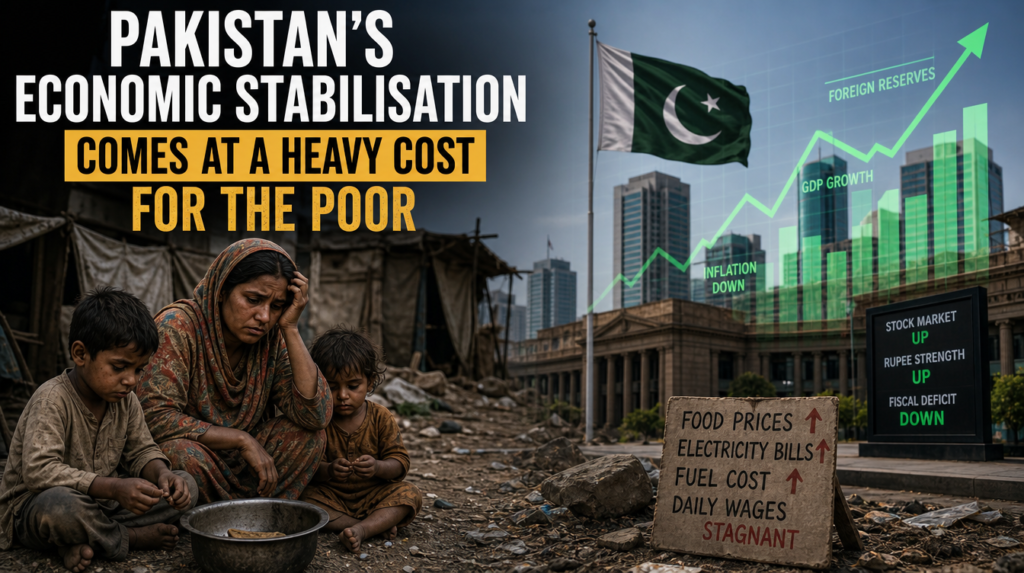
Pakistan’s repeated efforts to stabilise its economy have significantly changed the country’s economic landscape, but experts warn that the adjustment process has also increased pressure on vulnerable households.
Speaking at the opening of the 8th International Conference on Applied Development Economics in Lahore, economists highlighted the difficult balance between macroeconomic stability, economic growth and social welfare.
Economic Growth Remains Constrained by Weak Exports
Lahore School of Economics Professor and Dean of the Economics Faculty Dr Azam Chaudhry said Pakistan’s economic growth has reached a ceiling because of the country’s limited export performance.
He identified weak investment by domestic firms as a major factor behind the prolonged stagnation. Businesses face information gaps, limited access to credit and coordination problems that make it difficult for them to expand operations and compete in international markets.
Without stronger private-sector investment and export capacity, stabilisation alone may not be enough to place Pakistan on a sustainable higher-growth path.
Stabilisation Has Changed the Economic Landscape
Pakistan has repeatedly relied on measures such as exchange-rate adjustments, privatisation and economic liberalisation to address persistent financial pressures.
While these measures have contributed to changes in the structure of the economy, experts at the conference noted that their social consequences cannot be ignored.
Higher adjustment costs can disproportionately affect lower-income households, particularly when economic reforms coincide with pressure on household incomes and limited employment opportunities.
Government Spending Remains Important for Social Protection
Lahore School of Economics Rector Dr Shahid Chaudhry stressed that national development requires substantial government spending.
He pointed to publicly supported healthcare and social protection programmes as examples of the challenges involved in developing stronger welfare systems.
The issue highlights the need to balance fiscal discipline with adequate protection for households that are most vulnerable during periods of economic adjustment.
Remittances Provide a Safety Net for Vulnerable Families
University of Michigan Professor Dean Yang highlighted the role of migrant remittances as a form of income insurance for vulnerable households.
According to the research presented at the conference, families with members working abroad can use remittances to cope with economic shocks. Some households may also view overseas migration as a deliberate strategy to diversify family income and reduce financial vulnerability.
This makes remittances an important source of resilience for Pakistani households facing economic uncertainty.
Digital Land Records Improve Women’s Inheritance
World Bank economist Kate Vyborny presented evidence showing that the digitisation and centralisation of land records in Punjab had a positive impact on women’s inheritance of parental property.
The research found that women’s share of inherited parental land increased from 13 percent to 22 percent following improvements in land-record systems.
The finding suggests that administrative and digital reforms can produce meaningful social benefits when they improve access to property rights and reduce barriers faced by vulnerable groups.
Early-Life Shocks Can Have Lasting Consequences
Researchers at the conference also examined the long-term impact of childhood exposure to economic and environmental shocks.
Studies presented at the event found that exposure to the devastating 2010 floods during early childhood resulted in lasting effects on children’s health and cognitive development.
At the same time, researchers highlighted positive outcomes from educational interventions. Child-marriage edutainment programmes and greater access to local higher education were associated with improvements in female enrolment, grade progression and longer-term educational outcomes.
Pakistan Needs More Inclusive Economic Growth
The discussions underline a central challenge for Pakistan: achieving macroeconomic stability while ensuring that the benefits of economic development reach vulnerable communities.
Stabilisation measures can address immediate financial pressures, but stronger exports, greater private investment, better access to credit and effective social protection are needed to create sustainable growth.
The three-day conference, being held from August 17 to 19, is organised by the Centre for Research in Economics and Business and the Innovation and Technology Centre at Lahore School of Economics, in collaboration with the International Growth Centre and the Consortium for Development Policy Research.
The discussions demonstrate the importance of research and evidence in designing policies that can support economic stability without leaving vulnerable segments of society behind.