
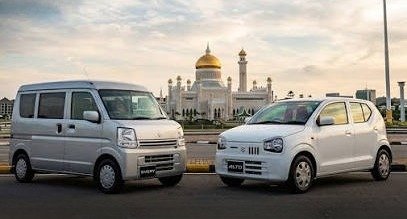
Pakistan’s auto industry has secured a notable export breakthrough as Pak Suzuki Motor Company begins supplying Suzuki Alto and Every models to Brunei, giving Pakistan a rare opportunity to strengthen its position in the regional automotive supply chain.
The development was announced by Suzuki on August 27, with the Japanese automaker describing the launch as the first time it has exported vehicles from an overseas production base that match the body size and engine displacement specifications of Japanese mini-vehicles.
For Pakistan, the move is more than another overseas vehicle shipment. It offers evidence that locally assembled Suzuki vehicles can meet the requirements of an international market. However, the real test will be whether this development can develop into sustained exports rather than remaining a limited market initiative.
Pak Suzuki Exports Alto and Every to Brunei
Suzuki has introduced the Alto and Every in Brunei as part of an expansion of its vehicle lineup in the Southeast Asian market. Boustead, Suzuki’s local partner in Brunei, will also begin handling Suzuki motorcycles, with sales expected to start in autumn 2026.
The introduction gives Pak Suzuki exports greater significance because the vehicles are being sourced from Pakistan rather than directly from Japan.
The Alto and Every are particularly important because of their compact dimensions and small-engine characteristics. Such vehicles have traditionally been strongly associated with Japan’s domestic mini-vehicle market. Their export from Pakistan therefore highlights the possibility of using Pakistan as a manufacturing and export base for compact automobiles.
Can Pak Suzuki Turn One Export Deal Into a Larger Business?
The biggest question is whether the Brunei launch can become the beginning of a broader export strategy.
Pakistan has a large automotive market, but its industry has historically remained heavily dependent on domestic demand. Local manufacturers have faced challenges involving imported components, foreign exchange shortages, production costs, taxation and inconsistent economic policies.
The Brunei development could help demonstrate that Pakistani automotive production has export potential. But one market launch should not be treated as proof that Pakistan has suddenly become a major automobile exporter.
For Pak Suzuki, sustained exports would require competitive pricing, reliable production, consistent quality and a dependable supply chain. These factors will determine whether the company can move beyond occasional shipments and establish a meaningful export business.
Pak Suzuki Faces a Complicated Domestic History
The export development comes against the backdrop of significant difficulties for Pak Suzuki Motor Company.
Established in Pakistan in August 1983 as a joint venture between Pakistan Automobile Corporation Limited and Suzuki Motor Corporation of Japan, the company has become one of the country’s most recognizable automobile manufacturers.
Pak Suzuki has traditionally maintained a dominant position in Pakistan’s passenger car market and operates an extensive dealership network covering more than 100 cities.
However, the company experienced severe operational disruption in 2023 after import restrictions affected the opening of Letters of Credit. Shortages of imported components forced repeated production shutdowns at its automobile and motorcycle plants.
These disruptions exposed a major weakness in Pakistan’s automotive model: despite having local assembly operations, manufacturers remain vulnerable to restrictions on imported parts and foreign exchange availability.
Pak Suzuki Delisting Raises Bigger Questions
Another major development in Pak Suzuki’s recent history was its decision to voluntarily delist from the Pakistan Stock Exchange in 2023.
The company cited recurring losses, limited dividend payments and historically weak share performance among the factors behind the decision.
This makes the Brunei export development particularly interesting. International sales could provide manufacturers with an additional source of revenue and foreign exchange while reducing excessive dependence on Pakistan’s domestic market.
Yet exports alone cannot solve structural problems. Pakistan’s automotive sector still needs deeper localization, stronger supplier capabilities, predictable policies and improved cost competitiveness.
Pakistan Auto Industry Needs More Than Headlines
The Brunei launch is undoubtedly a positive development for Pak Suzuki exports, but it should also trigger a wider debate about Pakistan’s automobile industry.
Pakistan has spent decades building an automotive assembly ecosystem, yet its export footprint remains relatively modest compared with major automobile-producing countries in Asia.
The challenge now is to convert isolated export successes into a sustainable strategy.
If Pak Suzuki can expand shipments to other markets, increase local value addition and use Pakistan as a competitive production base, the Brunei launch could eventually become an important milestone.
For now, however, it is best viewed as a promising signal rather than a transformation of Pakistan’s auto industry. The real success will be measured by what happens after the first shipment.
The launch of Suzuki Alto and Every in Brunei represents an important milestone for Pak Suzuki exports and Pakistan’s automotive ambitions.
The development demonstrates that vehicles produced by Suzuki’s Pakistani subsidiary can potentially serve markets beyond Pakistan. But the industry must avoid celebrating a single export development as a complete turnaround.
Pakistan needs a broader automotive export strategy built around competitive manufacturing, local parts production, policy stability and access to international markets. Without these reforms, individual export successes may remain isolated achievements rather than the foundation of a globally competitive Pakistani automobile industry.