
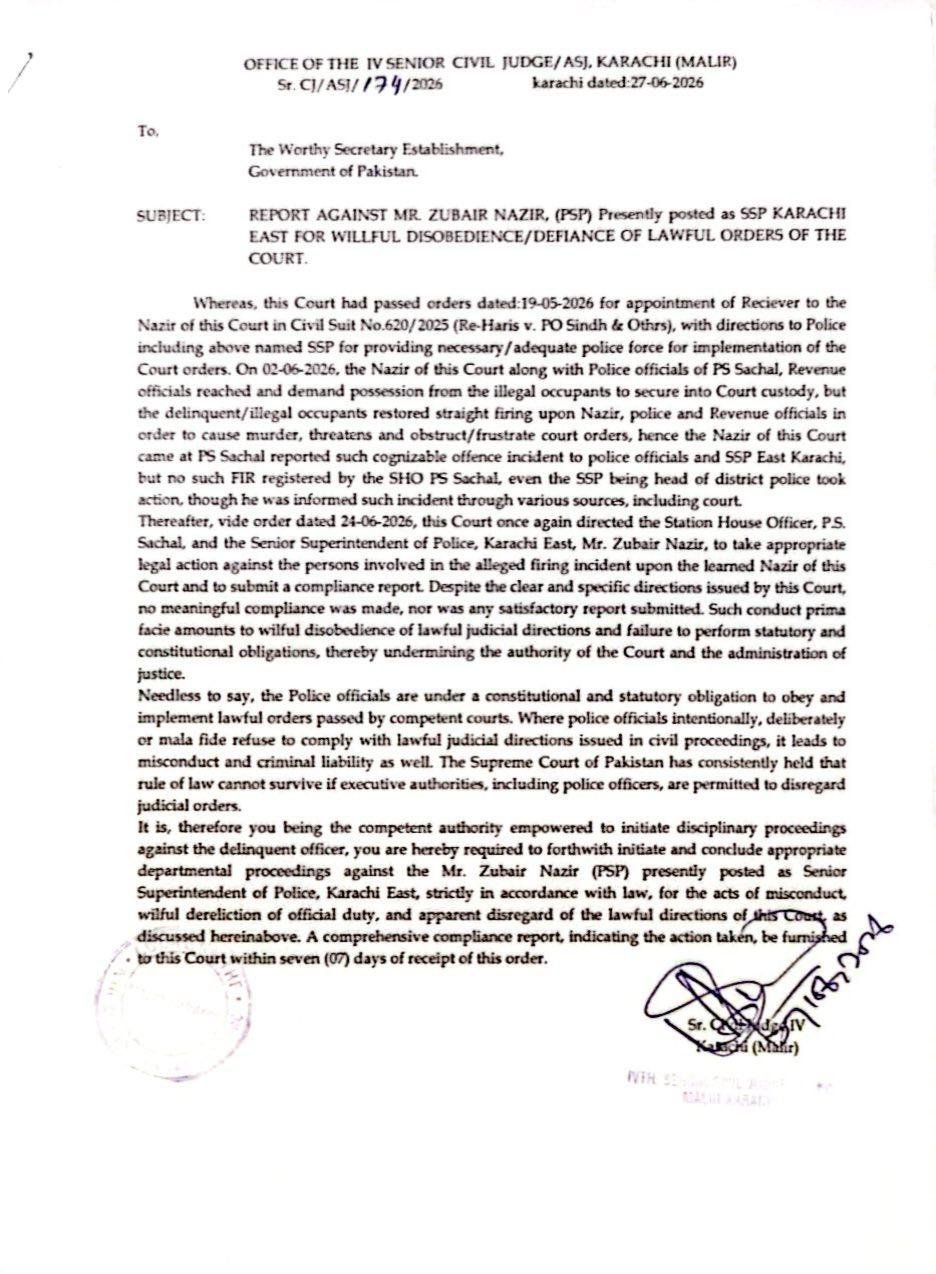
The Karachi Land Dispute involving an allegedly occupied eight-acre property in Scheme 33 has taken a dramatic legal turn after a senior civil court recommended departmental action against the Senior Superintendent of Police (SSP) Karachi East for allegedly failing to implement judicial orders.
The recommendation follows allegations that police authorities ignored court directives despite repeated instructions to assist in recovering the disputed land. The latest development has intensified public attention on the growing concerns surrounding land encroachment, enforcement failures, and the rule of law in Karachi.
Court Finds Alleged Non-Compliance with Judicial Orders
According to a report submitted by the Senior Civil Judge of Malir Court, judicial orders issued on May 19, 2026, directed authorities to recover the disputed eight-acre property located in Scheme 33, Sector 17-B, which reportedly belongs to a member of Abad.
The court had instructed police officials to provide full security during the recovery operation. However, the report states that effective implementation did not take place despite clear legal directions.
The court has now formally recommended departmental proceedings against the SSP Karachi East and forwarded its findings to the Establishment Secretary for further action.
Recovery Operation Met With Armed Resistance
The Karachi Land Dispute escalated further on June 2, 2026, when the court-appointed bailiff, accompanied by police and revenue officials, arrived at the site to execute the court’s order.
According to the judicial report, the operation was met with alleged armed resistance from occupants of the disputed land. The report claims that firing occurred during the operation, preventing officials from successfully reclaiming the property.
Despite the seriousness of the incident, the report alleges that no criminal case was registered at Sachal Police Station, even after a formal complaint was submitted by the court-appointed bailiff.
Court Questions Police Performance
The court observed that police authorities neither ensured effective enforcement of judicial orders nor presented a satisfactory explanation before the court regarding their failure to execute the recovery operation.
The report specifically states that the SSP Karachi East allegedly demonstrated negligence in the performance of official duties and failed to comply with binding court directions.
Such observations have raised fresh questions regarding institutional accountability in cases involving high-value urban land disputes.
Fresh Directions Issued for Property Recovery
The court has once again directed the SSP Karachi East and the Station House Officer (SHO) of Sachal Police Station to take immediate legal measures to recover the disputed property in accordance with the earlier judicial orders.
In addition, the court has ordered that action be initiated against SSP Zubair Nazir over the alleged violation of court directives. Authorities have been instructed to submit a compliance report within seven days detailing the steps taken following the court’s recommendations.
Why the Karachi Land Dispute Matters
The case highlights broader concerns surrounding illegal land occupation in Karachi, where valuable urban properties frequently become the subject of prolonged legal battles. Courts have repeatedly emphasized that judicial decisions must be enforced promptly to maintain public confidence in the legal system.
Legal experts note that when court orders remain unimplemented, it not only delays justice for affected property owners but also undermines the credibility of law enforcement institutions responsible for executing judicial directives.
With the court now recommending disciplinary proceedings against a senior police official, the Karachi Land Dispute is expected to remain under close public and legal scrutiny in the coming days as authorities prepare their compliance report.