
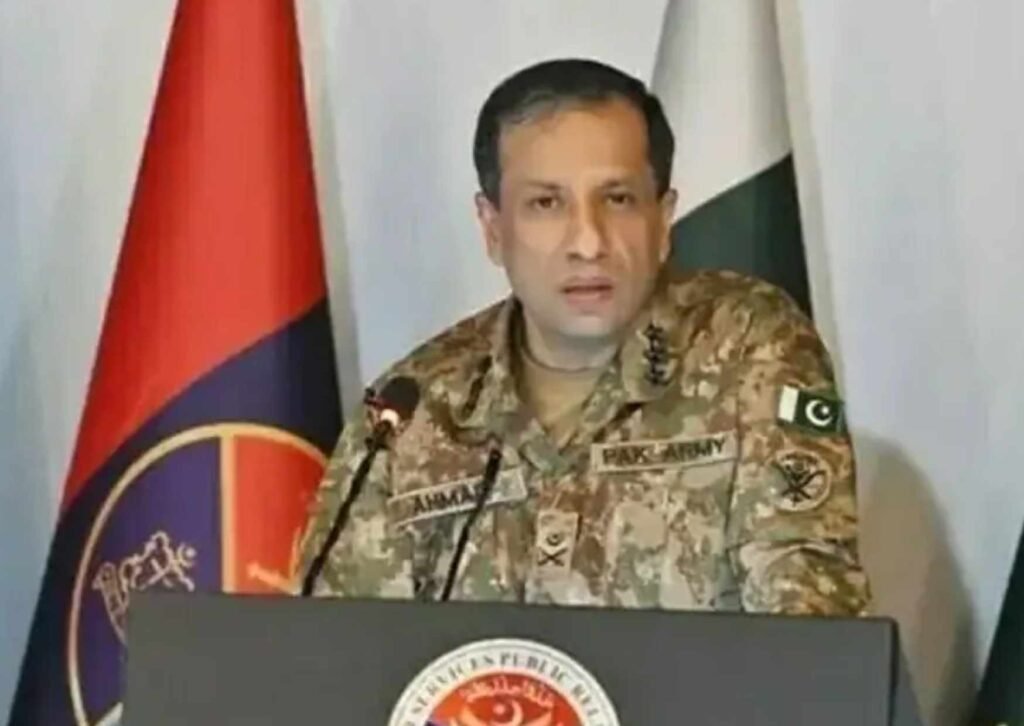
Pakistan’s military media wing has rejected India’s ‘Operation Sindoor’ documentary, describing it as a “Bollywood-style” production that allegedly attempts to portray a military setback as a successful operation.
In a statement issued on Tuesday, the Inter-Services Public Relations (ISPR) accused India of presenting a selective and inaccurate version of last year’s Pakistan-India military confrontation. The statement said the documentary was designed to reshape the narrative surrounding the conflict for a domestic audience.
“More than a year after Marka-i-Haq, India refuses to face the harsh reality,” ISPR said, adding that instead of acknowledging what Pakistan describes as a failed military venture, India had chosen to present events in its preferred version.
The remarks came after Indian content creators produced a highly dramatized documentary featuring senior Indian political and military leadership and focusing on Operation Sindoor, the name New Delhi gave to its strikes on Pakistan on May 7, 2025.
ISPR Questions India’s Account Of Operation Sindoor
ISPR said the documentary used dramatic narration, selectively edited interviews and cinematic reconstructions to present what it described as a distorted account of the military confrontation.
According to the military’s media wing, the production contained “fundamental contradictions” that raised questions about its version of events.
ISPR particularly challenged the documentary’s attempt to connect a speech delivered by Pakistan’s army chief on April 16, 2025, with the Pahalgam attack that occurred six days later.
The Pakistani military said the documentary was attempting to create a conspiracy theory by linking the two events without providing evidence to establish such a connection.
The statement also questioned India’s timeline regarding the alleged perpetrators of the Pahalgam attack.
ISPR said India later claimed that three alleged perpetrators were identified and killed on July 28, 2025, which was 82 days after Operation Sindoor.
The military questioned how Operation Sindoor could be described as punishment for those responsible for the Pahalgam attack if India itself subsequently claimed that the alleged perpetrators were eliminated months later.
Pakistan Challenges ‘100pc Mission Success’ Claim
ISPR also rejected the documentary’s portrayal of Operation Sindoor as a complete military success.
The military said the claim of “100 per cent mission success” did not correspond with what it described as the operational record of the conflict.
According to ISPR, Pakistan’s armed forces successfully resisted Indian military action during what Pakistan calls Marka-i-Haq, claiming that eight Indian military aircraft were shot down.
Pakistan subsequently launched Operation Bunyanum Marsoos, using precision-guided rockets and missiles, Pakistan Air Force precision munitions, long-range loitering munitions and precision artillery.
ISPR said the operation targeted 26 military targets, including facilities that Pakistan claimed were involved in attacks against Pakistani citizens and entities it accused of supporting terrorism against the country.
The Pakistani military presented these events as evidence that the conflict did not result in the unilateral Indian victory portrayed in the documentary.
ISPR Points To Contradictions In Documentary
The military’s statement said the documentary itself contained admissions that were difficult to reconcile with its portrayal of a decisive Indian victory.
ISPR pointed to references in the production to Pakistani missile, drone and air activity, engagements along the Line of Control and the activation of Indian air-defence systems.
According to the statement, these references indicate that the conflict involved sustained military activity and significant responses from Pakistan.
ISPR argued that such acknowledgements contradicted the documentary’s repeated suggestion that Pakistan had been decisively defeated.
The military also challenged the documentary’s account of how the fighting ended.
US Intervention And Ceasefire
According to ISPR, the documentary acknowledged that hostilities ended following communication between the two countries’ directors general of military operations and an agreement to cease military action.
Pakistan’s military said this undermined the portrayal of Operation Sindoor as an exclusively unilateral Indian victory.
ISPR maintained that the cessation of hostilities, which followed US intervention, could not later be presented as evidence of unconditional Indian military success.
The statement also highlighted what it described as contradictions in the documentary’s account of escalation.
According to ISPR, the production simultaneously claimed that India achieved surprise, precision, deep strikes and escalation dominance while also arguing that New Delhi deliberately limited the conflict and gave Pakistan an “exit window”.
The Pakistani military said these competing claims demonstrated that the documentary was designed primarily as a domestic political and military narrative rather than an objective account of events.
ISPR Says Battlefield Record Cannot Be Rewritten
ISPR accused India of attempting to use cinematic reconstruction to reshape the history of the conflict.
“India has not declassified the truth,” the military said, arguing that the documentary had been assembled to present what Pakistan considers a military failure as a successful operation.
The statement said that cinematic presentation could not change the chronology of events, aircraft losses, military casualties or the actual engagements that took place.
ISPR further argued that Pakistan did not need to manufacture a narrative around Marka-i-Haq, saying the operational record, battlefield evidence, diplomatic exchanges and subsequent statements by India provided evidence of what occurred.
The military also reiterated Pakistan’s stated commitment to regional peace and stability.
At the same time, ISPR said the Pakistan armed forces remained prepared to defend the country’s sovereignty, territorial integrity and national interests.
The statement ended with a warning that any future military action against Pakistan would receive a firm response.