
New digitally interactive museum to preserve and celebrate the history and heritage of Sindh and the Pakistan independence movement
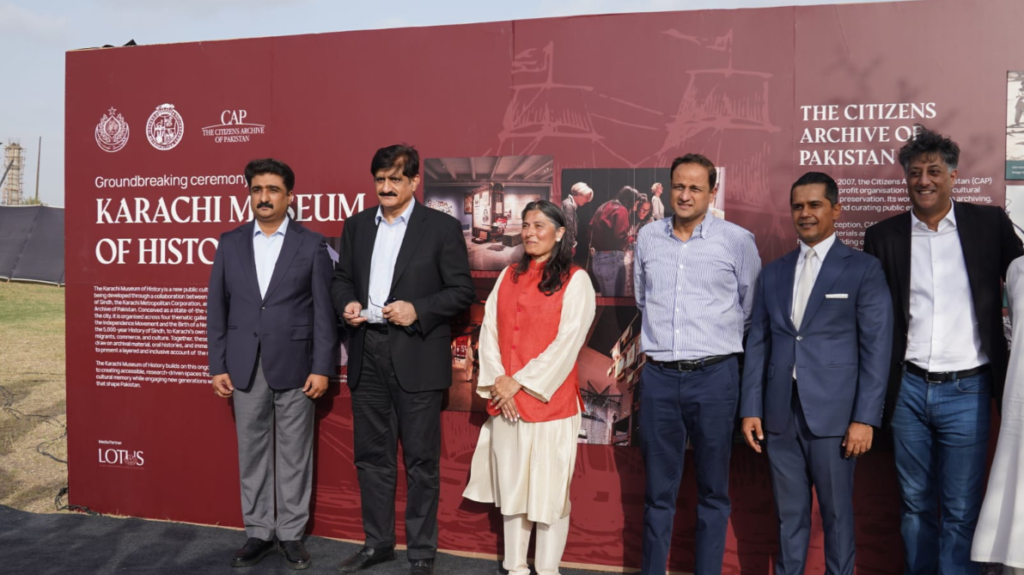
[Karachi, 23rd May 2026] The Government of Sindh’s Culture through its Tourism, Antiquities & Archives Department and the Karachi Metropolitan Corporation (KMC), in collaboration with The Citizens Archive of Pakistan (CAP), marked the groundbreaking of the Karachi Museum of History on May 23, 2026, at Beach view Park, Karachi, formally initiating the development of a major new public cultural institution for the city.
Planned as a landmark cultural and educational space, the Karachi Museum of History will be a digitally interactive museum dedicated to preserving, documenting, and celebrating the history and heritage of Sindh and the Pakistan movement. The initiative builds on CAP’s longstanding commitment to public history and cultural preservation, following the launch of the National History Museum in Lahore in partnership with the Government of Punjab in 2017.
The groundbreaking ceremony was attended by key government officials and civil society members, including the Honourable Chief Minister of Sindh, Syed Murad Ali Shah; Chief Secretary Sindh, Syed Asif Hyder Shah; Honourable Provincial Minister for Culture, Tourism, Antiquities & Archives, Government of Sindh, Syed Zulfiqar Ali Shah; Mayor Karachi, Barrister Murtaza Wahab Siddiqui; representatives of the Karachi Metropolitan Corporation; and members of The Citizens Archive of Pakistan, including Sharmeen Obaid-Chinoy, Patron-in-Chief, CAP, and members from the business community.
The ceremony featured remarks by the Chief Minister of Sindh, the Provincial Minister for Culture, Tourism, Antiquities & Archives, the Mayor of Karachi, and Sharmeen Obaid-Chinoy, followed by a ceremonial groundbreaking and the unveiling of a plaque to mark the formal commencement of the project.
The Karachi Museum of History will build on globally recognized museum practices to create an immersive cultural institution that brings Pakistan’s independence and Sindh’s 5,000-year history to life through storytelling, technology, archival material, and interactive experiences. Conceived as a dynamic civic space, the museum will document Karachi’s layered histories and foreground the voices, memories, and communities that shaped the city.
At a time of rapid urban transformation, the project responds to the need for public institutions in Pakistan that preserve cultural memory while remaining accessible, contemporary, and community-driven. Through innovative exhibition design, oral history, research, and public engagement, the museum aims to become a landmark destination for culture, education, and tourism in Karachi.
Honourable Syed Murad Ali Shah, Chief Minister of Sindh, said, “Karachi is not only a city of commerce and opportunity; it is a living archive of our collective memory, resilience, and cultural diversity. The Karachi Museum of History will preserve that legacy for generations to come.”
Syed Zulfiqar Ali Shah, Honourable Provincial Minister for Culture, Tourism, Antiquities, Archives Department, Government of Sindh, said, “The Karachi Museum of History reflects this department’s commitment to ensuring that Sindh’s extraordinary heritage is preserved, celebrated, and made accessible to all citizens. Through our partnership with the Karachi Metropolitan Corporation and the Citizens Archive of Pakistan, we are creating an institution that will anchor Karachi’s cultural landscape for decades to come”.
“Karachi is one of the great cities of the world – a city built by migration, resilience, and an extraordinary diversity of people and cultures. For too long, it has lacked a civic institution that reflects that richness. The Karachi Museum of History will change that. The Karachi Metropolitan Corporation is proud to play its part in delivering a landmark that belongs to every resident of this city”, added Mayor Murtaza Wahab Siddiqui.
Sharmeen Obaid-Chinoy, Patron-in-Chief, The Citizens Archive of Pakistan, said,“As Pakistan approaches the 80th anniversary of its independence, this partnership with the Government of Sindh and the Karachi Metropolitan Corporation is an opportunity to create a lasting home for the stories that shaped our nation. The museum will honor the people who fought for Pakistan’s independence, celebrate the rich history and culture of Sindh, and reflect the resilience, hope, and extraordinary spirit of Karachi, a city that has carried the dreams of generations from across the country. We hope it becomes a place where people can see themselves, their histories, and their shared future reflected back to them”.
Ahsan Najmi, President, The Citizens Archive of Pakistan, added, “This groundbreaking represents years of work and a shared conviction that Karachi’s communities deserve to see their histories honoured in a permanent, public space. The museum will be research-driven and community-centred, built to display the past and spark dialogue about who we are and where we come from. We could not have reached this milestone without the commitment of the Government of Sindh, its Culture, Tourism, Antiquities, and Archives Department, and the Karachi Metropolitan Corporation. We are eternally grateful for their partnership”.
The ceremony reflects a shared commitment between the Government of Sindh, Karachi Metropolitan Corporation and The Citizens Archive of Pakistan to strengthen heritage and cultural preservation through the development of Karachi Museum of History, as an inclusive, research-driven, and public-centered institution – one that preserves the past while engaging new generations in meaningful dialogue about Pakistan’s cultural identity.
For more information, visit: https://www.instagram.com/citizensarchive/
About The Citizens Archive of Pakistan:
The Citizens Archive of Pakistan (CAP) is a not-for-profit organisation founded in 2007, dedicated to cultural and historical preservation. CAP’s Board of Directors includes: Sharmeen Obaid-Chinoy, Ahsan Najmi, Jahanzeb Awan, Ziad Bashir, Sara Taher Khan, Salim Karim, Rishm Najm, Reema Gani, Jalal Salahuddin, Sabeen Jatoi and Sumaira Khan.