
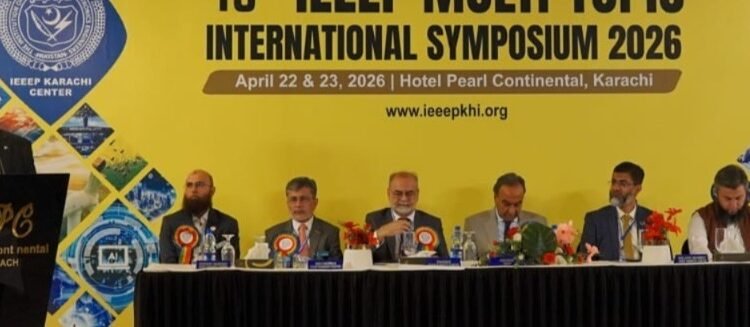
In a forceful and uncompromising call for reform, the Institution of Electrical & Electronics Engineers Pakistan (IEEEP) has demanded that Pakistan immediately align its governance of technical sectors with international standards by appointing highly qualified engineers and domain specialists—rather than generalist civil servants—to lead its ministries, regulators, and public sector agencies.
The demand came during the inaugural session of the 40th Multi-topic International Symposium-2026, where IEEEP leadership warned that decades of mismanagement in critical sectors—particularly energy—stem from a chronic absence of technically competent leadership at the helm.
Addressing a distinguished gathering of engineers, academics, and industry experts, IEEEP President Tahir Basharat Cheema asserted that the time had come to redefine governance boundaries. “Civil servants should be confined to administrative roles such as district management,” he declared. “Technical ministries and specialised agencies must be led by professionals with deep domain expertise. The current model is neither sustainable nor effective.”
Cheema sharply criticised the prevailing structure of regulatory bodies such as National Electric Power Regulatory Authority and Oil and Gas Regulatory Authority, noting that these highly specialised institutions are not being run by professionals with relevant technical expertise. “It is deeply concerning that not a single seasoned power sector practitioner is currently steering the affairs of NEPRA,” he said.
Highlighting the consequences of this systemic oversight, Cheema pointed out that Pakistan’s energy infrastructure remains technologically stagnant.
“Distribution transformers in use today are based on designs dating back to 1908, while much of our grid infrastructure traces its roots to the 1960s. This stagnation is a direct result of the absence of qualified professionals in decision-making roles,” he warned.
He further criticised the performance of key institutions such as the Private Power and Infrastructure Board, stating that its flagship output—independent power producers (IPPs)—has failed to satisfy stakeholders across the board. Similarly, once-prestigious organisations like the Pakistan Council of Scientific and Industrial Research are now grappling with severe financial constraints, rendering them unable to sustain even basic operations, let alone drive innovation. Cheema underscored that the principle of appointing specialists to technical roles was established over a century ago by European administrations, yet Pakistan continues to deviate from this globally accepted norm.
In his opening address, IEEEP Karachi Centre Chairman Navid Akram Ansari called for urgent policy interventions to revitalise Pakistan’s engineering and manufacturing sectors. He urged the government to mandate public sector organisations to prioritise procurement of “Made in Pakistan” products, thereby strengthening domestic industry and encouraging investment in quality enhancement. Ansari also called for the abolition of duties and taxes on imported raw materials used by engineering industries to boost competitiveness in international markets. He stressed the need for establishing a nationwide network of internationally accredited testing laboratories to elevate production standards.
He highlighted the critical role of institutions such as the Engineering Development Board, Pakistan Engineering Council, and the Higher Education Commission in transforming engineering education and industrial output. “IEEEP stands ready to support the government in strengthening academia-industry linkages, enhancing engineering curricula, and promoting research and development,” he added.
Delivering the keynote address, Professor of Practice Tahir Mahmood Chaudhry—CEO of a leading engineering consultancy—called on the Higher Education Commission to equip university vice-chancellors with essential administrative and financial management training. He revealed a startling statistic that only 12.4 per cent of Pakistan’s more than 250 universities have formal placement bureaus to assist graduates in securing employment.
“Placement bureaus are vital for bridging the gap between academia and industry,” he said, warning that their absence is exacerbating graduate unemployment and weakening industrial growth.
Earlier, in his welcome remarks, IEEEP Karachi Centre Honorary Secretary Engineer Imran Zafar announced that over 14 research papers would be presented during the symposium, covering key advancements in electrical and electronics engineering, particularly in the power sector. A dedicated session will also focus on reforming higher education in engineering disciplines, with actionable recommendations expected.
He noted that senior officials from the Higher Education Commission and the Engineering Development Board were unable to attend the symposium due to movement restrictions in Islamabad amid heightened security arrangements.
The symposium has brought into sharp focus a critical national question: can Pakistan afford to let its most technical sectors remain under non-specialist leadership in an increasingly complex and competitive global landscape? The IEEEP’s answer is unequivocal—reform is not just necessary, it is urgent.