
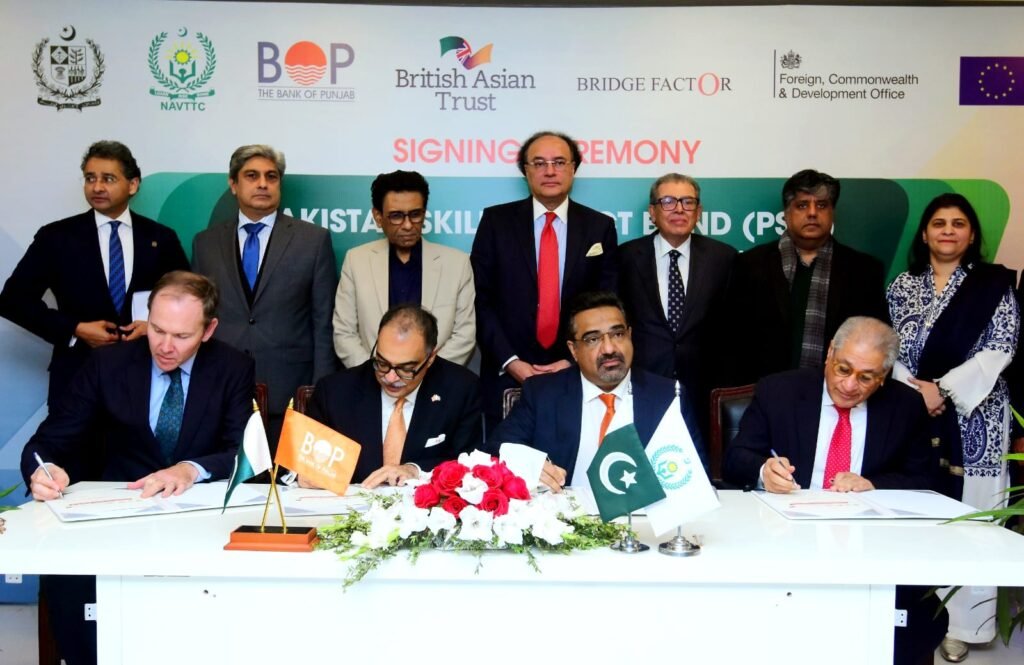
Pakistan Skills Impact Bond has emerged as a landmark initiative in the country’s public finance and human capital development landscape, introducing Pakistan’s first privately funded, outcome-linked skills financing model backed by a Rs1 billion federal guarantee.
The innovative structure signals a decisive shift away from traditional input-based public spending toward a results-driven approach that ties government repayments directly to verified employment outcomes.
Pakistan Skills Impact Bond: A Results-Driven Financing Model
The Pakistan Skills Impact Bond (PSIB) is structured as a three-year instrument, with an initial pilot tranche of Rs1 billion guaranteed by the Ministry of Finance. Unlike conventional training programmes that release funds based on enrolment numbers or infrastructure costs, this model places financial risk on private investors who provide upfront capital.
Public repayments are triggered only when predefined outcomes such as certification completion, job placement, and a minimum six-month employment retention are independently verified.
In practical terms, this means that funds flow not at the start of training but after results are achieved, aligning incentives across government, investors, training providers, and employers.
How the Pakistan Skills Impact Bond Works
Instead of relying on a traditional table, the structure can be explained through three interconnected components.
First, private investors supply upfront capital to finance large-scale technical and vocational training.
Second, training providers, supervised by the National Vocational and Technical Training Commission (NAVTTC), deliver skills aligned with market demand.
Third, government-backed repayments are released only after employment outcomes are verified by independent assessors.
This outcome-based cycle shifts fiscal risk away from the public sector while improving accountability and efficiency in skills development spending.
Reducing Sovereign Risk in Future Tranches
Stakeholders involved in the Pakistan Skills Impact Bond have indicated that future tranches are expected to gradually reduce reliance on sovereign guarantees. Over time, partial repayment mechanisms linked to a nominal share of trainee salaries may be introduced, creating a market-linked and financially sustainable model.
This evolution is aimed at attracting institutional investors and capital market participation, reducing long-term exposure on the government’s balance sheet.
Anchored in Pakistan’s Social Impact Financing Framework
The PSIB is embedded within Pakistan’s newly developed Social Impact Financing Framework, which identifies education and human capital development as the country’s top national priority. Other focus areas under the framework include gender equality, health and well-being, population stabilisation, climate resilience, and poverty reduction.
The framework itself was developed through a multi-stakeholder consultative process involving policymakers, financial institutions, development partners, technology providers, and international organisations.
Institutional Partners Behind the Pakistan Skills Impact Bond
The bond is being implemented through NAVTTC, which is responsible for programme oversight, training standards, and outcome verification.
The Bank of Punjab is participating as a key financial partner, while the British Asian Trust serves as programme manager. The initiative is further supported by the UK’s Foreign, Commonwealth & Development Office (FCDO).
At the launch ceremony, investor and issuer agreements were formally signed, cementing the operational and governance framework of the bond.
Focus on Women, Digital Skills, and Global Employment
At least 40 percent of trainees under the Pakistan Skills Impact Bond will be women, addressing gender gaps in workforce participation and income generation. Training programmes will focus on technical, high-value digital, and freelance-oriented skills, aligned with both domestic industry demand and overseas employment markets.
This demand-driven approach reflects Pakistan’s growing participation in the global freelance economy and international labour mobility.
Policy Perspective: Catalytic, Not Permanent
Finance Minister Senator Muhammad Aurangzeb described the government’s Rs1 billion guarantee as catalytic rather than permanent, aimed at building investor confidence and demonstrating the viability of outcome-based social financing.
The long-term vision, he noted, is to transition toward a fully market-driven model that operates without sovereign guarantees while maintaining strong employment outcomes.
Why the Pakistan Skills Impact Bond Matters
The Pakistan Skills Impact Bond represents the country’s first application of a social impact bond structure in the skills and employment sector. It arrives at a time when policymakers are seeking greater fiscal efficiency, improved training effectiveness, and stronger links between skills development and labour market outcomes.
By aligning public spending with measurable results and leveraging private capital, the PSIB positions skills training as a strategic investment in human capital, rather than a standalone social intervention.