
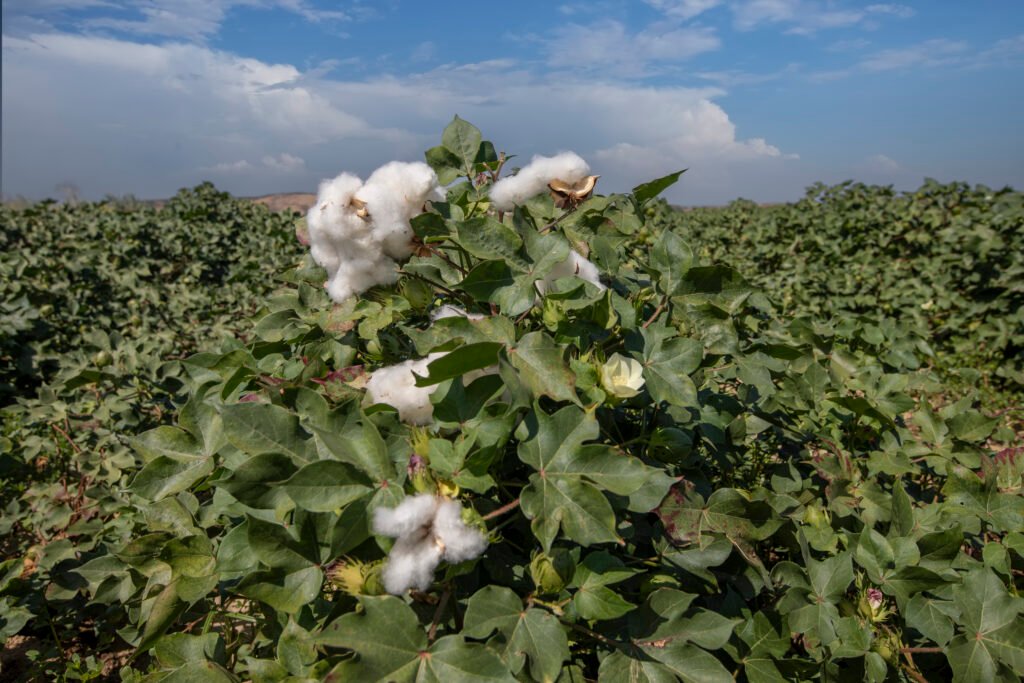
Pakistan Cotton Market Report for December 22, 2025, presents a comprehensive snapshot of global cotton price movements, domestic crop progress, and trade dynamics. The data reflects continued pressure on international cotton markets, while Pakistan’s local cotton sector shows stable arrivals but remains below historical production benchmarks.
Pakistan Cotton Market Report: Global Cotton Price Trends
According to the Pakistan Cotton Market Report, global cotton prices remain under pressure compared to last year. The Cotlook A Index stood at 73.30 cents per pound, down from 76.70 cents per pound on the same date last year, reflecting a decline of over 6 cents per pound .
In the New York Cotton Market (Contract No. 2), March 2026 futures closed at 63.75 cents per pound, while May 2026 contracts settled at 64.84 cents per pound, both significantly lower than last year’s levels. Brazilian cotton prices also weakened to 62.60 cents per pound, highlighting global oversupply and subdued demand conditions .
China, however, remained an outlier, with the China Cotton Index recorded at 97.54 cents per pound, supported by state policy interventions and controlled domestic supply.
Domestic Cotton Prices in Pakistan
The Pakistan Cotton Market Report shows that local lint prices remained relatively stable. The Karachi Cotton Association (Ex-gin price) was recorded at approximately Rs 15,500 per maund, translating to 67.23 cents per pound, lower than last year’s level of 75.55 cents per pound .
Seed cotton prices across Punjab, Sindh, and Balochistan ranged between Rs 5,960 and Rs 7,492 per 40 kg, reflecting regional variations driven by quality, moisture content, and transportation costs.
Pakistan Cotton Market Report: Crop Targets and Sowing Progress
For the 2025-26 cotton season, Pakistan has set a total sowing target of 2.26 million hectares, with Punjab accounting for the largest share at 1.4 million hectares. As of the latest reporting period, approximately 2.00 million hectares or 89% of the target has been sown nationwide .
Punjab and Sindh have achieved around 90% and 89% of their respective targets, while Balochistan lags slightly at 76%. Khyber Pakhtunkhwa continues to contribute a negligible share to cotton cultivation.
Comparison with 2024-25 Cotton Production
The Pakistan Cotton Market Report highlights that during the 2024-25 season, total cotton production reached 7.08 million bales, achieving only 65% of the national production target. Punjab recorded the sharpest shortfall, producing 3.84 million bales against a target of 6.5 million bales, while Sindh performed relatively better at 72% of its target .
These figures underscore structural challenges such as climate variability, pest pressure, and declining farmer incentives.
Seed Cotton Arrivals and Market Activity
As of 15 December 2025, total seed cotton arrivals stood at 5.30 million bales, marginally lower than 5.37 million bales recorded during the same period last year. Textile mills remained the dominant buyers, accounting for over 4.49 million bales, while exporter participation remained limited .
Unsold stocks were recorded at approximately 536,863 bales, suggesting balanced supply-demand conditions in the domestic market.
Pakistan Cotton Trade: Export and Import Trends
The Pakistan Cotton Market Report shows negligible raw cotton exports during July–November 2025, while imports declined by over 24% in quantity and 30% in value compared to last year. However, full-year data for 2024-25 reveals a sharp rise in cotton imports, increasing by more than 230% in volume, highlighting Pakistan’s continued reliance on imported cotton to meet textile sector demand .
The Pakistan Cotton Market Report for December 2025 reflects a sector navigating global price weakness, moderate domestic sowing progress, and structural production gaps. While seed cotton arrivals remain steady, declining global prices and rising import dependence continue to pose challenges for farmers and policymakers alike.
As the 2025-26 season unfolds, market participants will closely monitor weather conditions, government support measures, and international demand trends to assess the outlook for Pakistan’s cotton economy.