
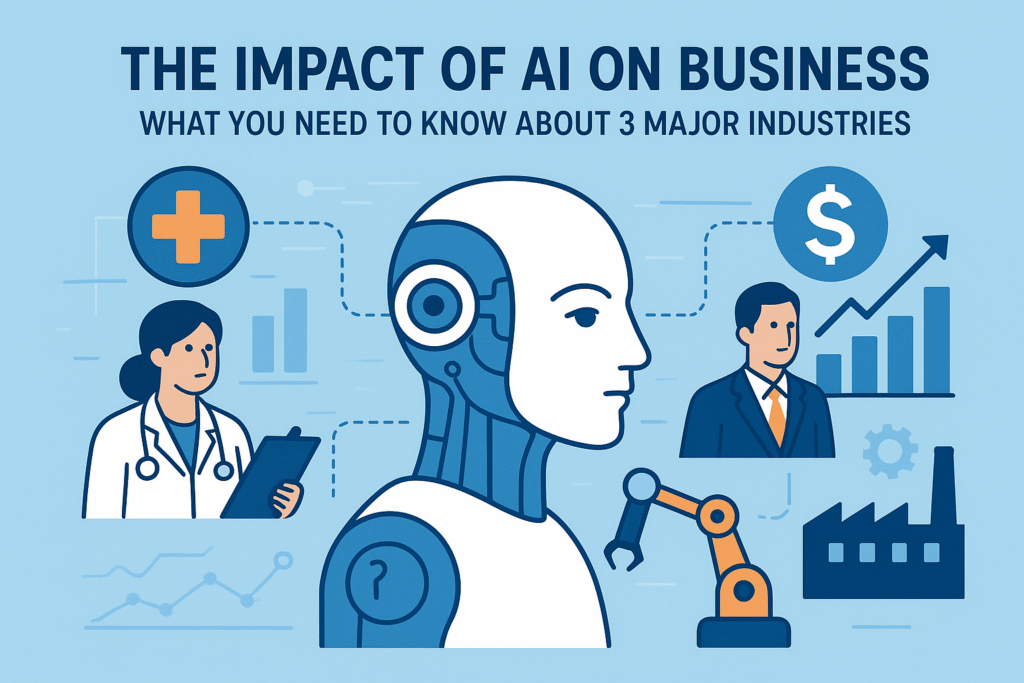
The next few years may redefine what work looks like across several major industries and according to a leading OpenAI executive, the transformation has already begun.
On a recent episode of the Unsupervised Learning podcast, Olivier Godement, Head of Product for Business at OpenAI, shared why he believes life sciences, customer service, and software engineering are entering an era of accelerated automation. His insights offer a candid look into how fast AI technologies are evolving and how businesses should prepare.
1. Life Sciences & Pharma: AI Is Becoming the New Research Partner:
Godement’s first prediction is bold but grounded in real-world progress:
the life sciences and pharmaceutical industries are on the brink of a major AI-driven shift.
Working closely with companies like Amgen, Godement sees firsthand how drug discovery and development processes can be streamlined.
“Once you lock the recipe of a drug, getting it to market takes months, sometimes years,” he explained. “Models are now very good at consolidating huge datasets and tracking document changes. A lot of this admin work can be automated.”
In an industry where delays cost billions and impact human lives, AI automation could radically shorten development timelines, reduce operational overhead, and accelerate medical innovation.
2. Software Engineering: The Most Heated Debate in Tech:
Few topics have sparked more controversy in 2024 and 2025 than the future of software engineering.
According to Godement, while AI isn’t replacing engineers outright “yet” the trajectory is clear.
“We’re not at the point of fully automating a software engineer’s job. But we now have a line of sight to get there.”
AI-powered coding tools have already become standard across tech companies. Large models can generate boilerplate code, debug issues, review pull requests and even propose architectural solutions.
A recent Indeed report reinforces the shift: software engineers, QA engineers, product managers and project managers are the four roles most frequently cut during tech layoffs, largely due to automation and restructuring.
The message is unmistakable:
coding is becoming more automated, and the nature of engineering roles is evolving fast.
3. Customer Service & Sales: Automation Is Closer Than We Think:
Customer-facing roles may feel safe for now, but Godement believes the next two years will bring surprising changes.
Working with companies like T-Mobile, OpenAI is already seeing customer support tasks automated at scale with high accuracy.
“We’re achieving strong results at meaningful scale. My sense is we’ll be surprised in the next year or two at how many tasks can be reliably automated.”
From chat support to sales assistance and ticket resolution, AI systems are becoming more conversational, reliable and available 24/7 making them valuable assets for large enterprises.
Are White-Collar Jobs at Risk? Industry Leaders Say Yes:
Across Silicon Valley, warnings are growing louder.
AI pioneer Geoffrey Hinton, known as the “Godfather of AI,” recently said that while physical jobs like plumbing remain safe for now, intellectual and clerical roles face the greatest risk.
“For mundane intellectual labor, AI is going to replace everybody,” Hinton said.
He even admitted he’d be terrified to work in a call center today.
Paralegals, administrative staff, analysts and customer support agents: these are roles where AI is already outperforming humans in speed, accuracy and cost.
The Bottom Line: AI Isn’t Coming, It’s Already Here:
Olivier Godement’s insights reflect a bigger trend:
The AI revolution is touching every corner of the business world.
Industries at the forefront:
• Life Sciences → Faster drug discovery, automated documentation
• Software Engineering → AI-assistance becoming the norm
• Customer Service & Sales → Massive automation potential at enterprise scale
As AI systems improve, the businesses that adapt early will lead and those that don’t may struggle to survive.