
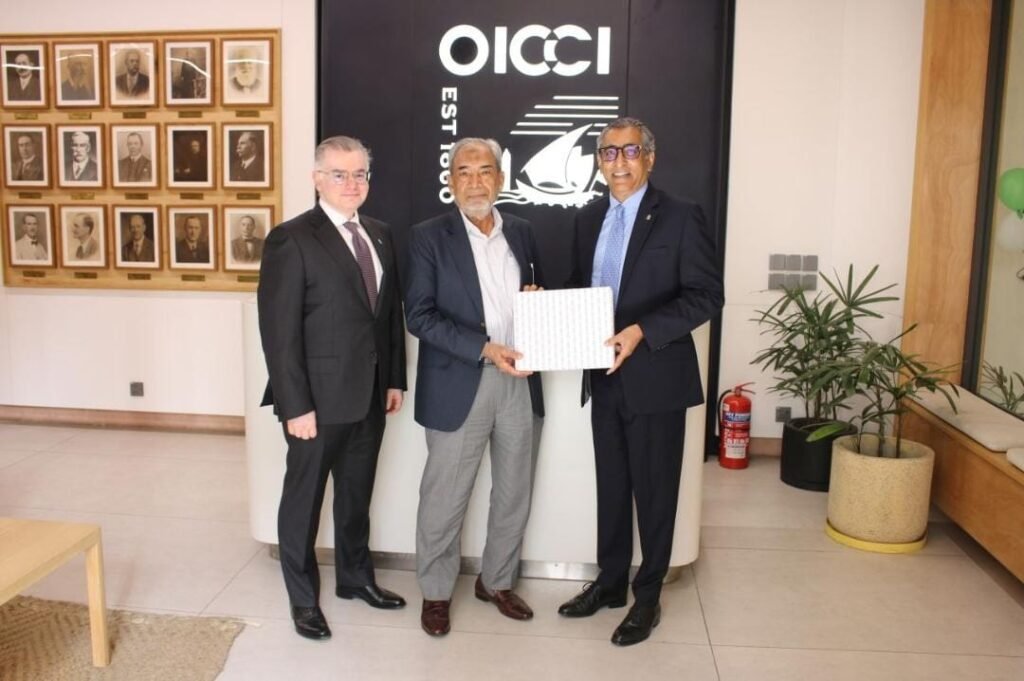
Standard Chartered Pakistan is entering a new leadership phase as Adil Salahuddin takes over as Chief Executive Officer, succeeding Rehan Shaikh, who has also completed his tenure as a prominent figure associated with the Overseas Investors Chamber of Commerce and Industry.
The leadership transition was highlighted during a recent visit to OICCI, where outgoing CEO Rehan Shaikh and incoming CEO Adil Salahuddin met OICCI Secretary General M. Abdul Aleem. The meeting signals that the relationship between Standard Chartered Pakistan and the country’s leading foreign-investor business platform is expected to continue despite the change at the bank’s top management level.
For a financial institution with a long-standing presence in Pakistan, the transition carries significance beyond a routine corporate leadership change. Standard Chartered Pakistan operates in a market where foreign investment, banking sector confidence, regulatory stability and access to international financial networks remain critical issues for businesses.
Rehan Shaikh Leaves Behind a Strong OICCI Association
OICCI used the occasion to recognize Rehan Shaikh for his leadership and longstanding association with the Chamber. His previous role as OICCI President placed him at the intersection of Pakistan’s corporate sector and international investors.
His departure therefore represents more than a change at Standard Chartered Pakistan. It also marks the end of an influential chapter in the bank’s engagement with the broader business community.
OICCI appreciated Shaikh’s contributions during his tenure and acknowledged the value of his participation in the Chamber’s activities. Such leadership roles can be particularly important in Pakistan, where foreign investors frequently seek stronger engagement with policymakers, regulators and business organizations.
However, appreciation alone should not obscure the larger challenge. Pakistan’s business community needs sustained institutional engagement rather than relationships built around individual corporate leaders. The real test for the new leadership will be whether Standard Chartered Pakistan can maintain and expand this engagement under Adil Salahuddin.
Adil Salahuddin Faces a Bigger Business Challenge
OICCI has welcomed Adil Salahuddin into his new role and expressed confidence in continued collaboration with Standard Chartered Pakistan.
For the incoming CEO, maintaining that relationship will be important, but the expectations from a major international bank operating in Pakistan are considerably broader.
The banking sector faces pressure from economic uncertainty, changing interest-rate conditions, foreign exchange challenges and the evolving needs of businesses seeking international financing. Multinational companies also require predictable regulations and reliable financial infrastructure to expand their operations.
Standard Chartered Pakistan has an opportunity to strengthen its position by supporting trade finance, corporate banking, investment flows and cross-border transactions. Its international network can potentially provide an important bridge between Pakistani businesses and global markets.
OICCI Relationship Will Remain a Key Test
The continued partnership between OICCI and Standard Chartered Pakistan could become increasingly important as Pakistan seeks to attract and retain foreign investment.
Yet the business community should judge this relationship by measurable outcomes rather than ceremonial meetings and leadership statements. Greater investment, improved access to financing and stronger support for international businesses would provide more meaningful evidence of progress.
The leadership change at Standard Chartered Pakistan therefore presents both continuity and a fresh opportunity. Rehan Shaikh leaves with OICCI’s recognition, while Adil Salahuddin begins his tenure with the responsibility of translating institutional relationships into stronger business outcomes.
For Pakistan’s corporate sector, the real question is not simply who leads Standard Chartered Pakistan next. It is whether the bank can use its global reach and local presence to help unlock greater investment, trade and financial opportunities for the country.