
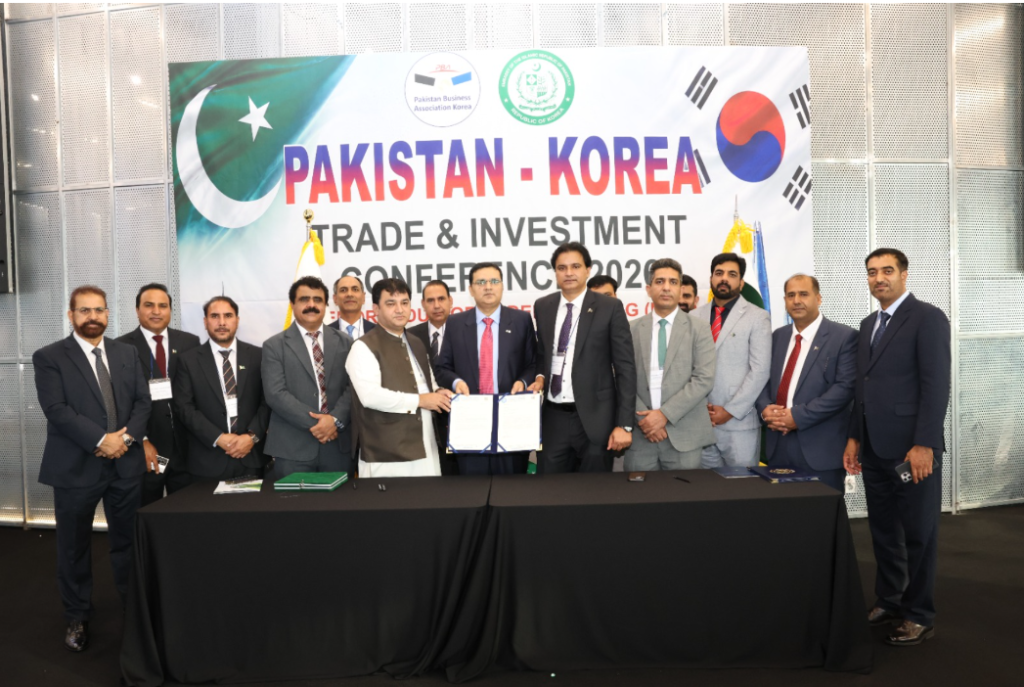
Pakistan Korea CEPA negotiations have gained fresh commercial momentum after a major trade and investment conference in Seoul brought together more than 170 Pakistani and Korean businessmen and produced six Memoranda of Understanding between companies from both countries.
The development is significant because the conference took place as Pakistan and the Republic of Korea prepare for the next phase of negotiations on a Comprehensive Economic Partnership Agreement. Pakistan Commerce Minister Jam Kamal Khan said the first round of negotiations had been successfully completed, with the second round expected soon.
The proposed Pakistan Korea CEPA could eventually create wider market access for Pakistani exporters. However, the real test will not be the signing ceremony. It will be whether Pakistani companies can actually increase exports, secure long term Korean buyers and compete effectively in one of Asia’s most demanding markets.
Six MOUs Put Pakistan Korea CEPA Under Commercial Pressure
The Seoul conference resulted in six MOUs covering business areas including salt, cosmetics, oil and sesame seed trade. Pakistani companies from Sialkot, Gujranwala and other business chambers participated in the B2B sessions with Korean companies.
These agreements are expected to provide a foundation for future commercial contracts. Yet an MOU should not be confused with confirmed investment or guaranteed export revenue.
This is where Pakistan Korea CEPA faces an important credibility test. Pakistan has signed or announced numerous business agreements in the past, but many have struggled to translate into large scale commercial activity. The government and business organizations therefore need to publish follow up data showing how many of these six MOUs become actual purchase orders, investments or export contracts.
Without such tracking, MOUs can easily become headline generating events rather than measurable economic outcomes.
Pakistan Targets Textiles Leather IT and Agro Food Exports
The conference highlighted Pakistan’s export potential in textiles and apparel, leather products, surgical and sports goods, agro food products, minerals and IT services.
These sectors offer substantial opportunities in Korea, but opportunity alone will not guarantee market penetration. Pakistani exporters face intense competition from established Asian suppliers that already benefit from efficient logistics, consistent quality standards, advanced production systems and strong buyer relationships.
The Pakistan Korea CEPA could help address some of these barriers by improving market access and creating clearer trade rules. Pakistani exporters, however, will still need to meet Korean standards, strengthen product branding and ensure reliable delivery.
For Pakistan, this means CEPA negotiations should not focus only on tariff reductions. The agreement should also address non tariff barriers, certification requirements, customs procedures and practical access for smaller exporters.
Korean Investors Need More Than Export Promises
Officials from the Special Investment Facilitation Council and the Trade Development Authority of Pakistan briefed Korean participants about investment and export opportunities.
The message is attractive, but Korean investors are likely to examine Pakistan’s business environment beyond promotional presentations. Regulatory predictability, energy costs, taxation, dispute resolution, infrastructure and foreign exchange conditions will remain critical factors in investment decisions.
Pakistan therefore needs to convert trade conferences into a structured investor facilitation mechanism rather than treating them as isolated promotional events.
The Pakistan Business Association of Korea and the Embassy of Pakistan in Seoul are expected to continue facilitating commercial engagement. A second conference is also planned for March 2027.
Pakistan Korea CEPA Needs Results Not Just Announcements
The Seoul conference is a positive signal for Pakistan Korea CEPA, but six MOUs should be viewed as an opening rather than a breakthrough.
The real economic impact will depend on whether these agreements produce actual trade and investment. Pakistan also needs to identify high value Korean markets, prepare exporters for technical requirements and aggressively pursue sectors where Pakistani products can compete on quality and price.
If the government can connect CEPA negotiations with measurable export targets and sustained private sector engagement, the agreement could become an important tool for expanding Pakistan’s presence in the Korean market.
If not, the latest conference risks becoming another example of Pakistan generating impressive trade headlines without achieving equally impressive commercial results.