
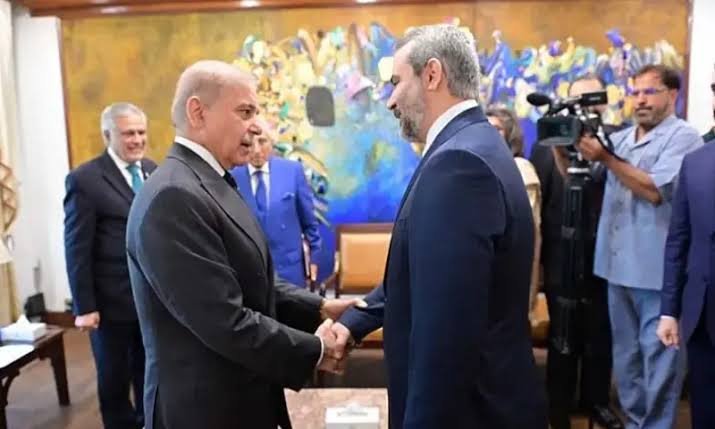
Pakistan and Syria have reaffirmed their commitment to strengthening bilateral trade, investment and broader economic cooperation during a high-level meeting in Islamabad.
Syrian Foreign Minister Asaad Hassan al-Shaibani, accompanied by a senior delegation, met Federal Minister for Commerce Jam Kamal Khan at the Ministry of Commerce. The two sides discussed ways to translate their longstanding political and cultural ties into stronger commercial relations.
Jam Kamal Khan welcomed the Syrian delegation and highlighted Pakistan’s solidarity with the Syrian people, while expressing hopes for Syria’s peace, stability, reconstruction and long-term prosperity.
Pakistan Highlights Export And Investment Potential
The Commerce Minister briefed the Syrian delegation on Pakistan’s diverse economic and export capabilities.
He identified several sectors with potential for greater cooperation, including:
- Textiles and apparel
- Pharmaceuticals
- Leather
- Sports goods
- Food processing
- Rice and agricultural products
- Light engineering
- Information technology
- Cosmetics
- Value-added products
Jam Kamal Khan said the complementary strengths of the two economies could create opportunities for increased trade, investment and joint ventures.
He also stressed the importance of stronger interaction between the private sectors of Pakistan and Syria to identify commercially viable opportunities.
Syria Seeks Cooperation In Reconstruction
The Syrian Foreign Minister outlined his country’s reconstruction and development priorities, highlighting the resilience of the Syrian people and ongoing efforts to restore essential infrastructure and public services.
He identified several areas where Pakistani businesses could potentially contribute, including housing, real estate, energy, transportation, seaports, agriculture, industry and human-resource development.
Al-Shaibani also noted that the current level of bilateral trade does not reflect the economic potential of the two countries.
He called for sustained institutional engagement and stronger business-to-business connections to expand commercial relations.
Pakistan-Syria Joint Business Council Proposed
The Syrian side proposed establishing a Pakistan-Syria Joint Business Council to facilitate direct interaction between business communities.
The council could provide a platform for companies from both countries to identify investment opportunities, explore partnerships and address practical obstacles to trade.
Al-Shaibani also proposed holding a joint investment forum in Damascus, bringing together representatives from Pakistan and Syria’s public and private sectors.
Such a forum could provide businesses with an opportunity to assess investment prospects arising from Syria’s reconstruction and development needs.
Syrian Economic Delegation To Visit Pakistan
The Syrian Foreign Minister informed Jam Kamal Khan that a delegation from Syria’s Ministry of Economy, which also oversees trade and industry, would visit Pakistan to examine opportunities for bilateral cooperation.
The proposed visit could help move discussions from broad areas of interest toward specific commercial projects and trade opportunities.
Pakistan also expressed its willingness to coordinate with Syrian authorities to identify priority sectors and develop a practical roadmap for economic cooperation.
Virtual Business Meetings Proposed
Jam Kamal Khan suggested arranging virtual meetings between Pakistani and Syrian businesses before physical engagements.
The proposal is aimed at making future business delegations more focused and productive by allowing companies to identify potential partners and areas of mutual interest in advance.
Business matchmaking could be particularly useful in sectors such as pharmaceuticals, food processing, construction, engineering and agricultural products.
Revival Of Joint Ministerial Commission
Pakistan also proposed reviving the Pakistan-Syria Joint Ministerial Commission and its relevant Joint Working Groups.
The commission could provide a structured institutional mechanism for following up on agreements and coordinating cooperation across multiple sectors.
Jam Kamal Khan also emphasised the need to activate the existing framework between the chambers of commerce of the two countries through regular exchanges, business delegations and business-to-business meetings.
A stronger institutional framework could help ensure that bilateral economic discussions continue beyond individual high-level meetings.
Pakistan Considers Trade Delegation To Syria
Pakistan expressed its willingness to explore sending a trade and business delegation to Syria.
Jam Kamal Khan also conveyed Pakistan’s interest in strengthening its trade representation and institutional presence in Syria in the future.
For Pakistani companies, increased engagement with Syria could potentially open opportunities linked to reconstruction, infrastructure development, agriculture, manufacturing and consumer markets.
However, translating these opportunities into actual trade and investment will require businesses to assess market conditions, financing, logistics, regulatory requirements and commercial risks carefully.
Historical And Cultural Links Highlighted
During the meeting, Jam Kamal Khan also referred to the historical and cultural connections between Pakistan and Syria.
He particularly highlighted traditions and historical accounts pointing to ancestral links between the Baloch people and Syria, saying these connections further strengthen the longstanding ties between the peoples of the two countries.
The reference underscored the broader historical relationship that provides a foundation for expanding modern economic and commercial cooperation.
Pakistan And Syria Look Toward Stronger Economic Ties
The meeting reflects a growing effort by Pakistan and Syria to strengthen economic relations alongside their longstanding political and cultural ties.
Both sides identified significant potential for increased trade and investment, particularly as Syria focuses on reconstruction and Pakistan seeks new markets for its exports and opportunities for its businesses.
The proposed Joint Business Council, investment forum, ministerial commission and business matchmaking initiatives could provide practical mechanisms for moving bilateral cooperation forward.
The real test, however, will be implementation.
If both countries can establish regular institutional engagement, improve business connectivity and identify commercially viable projects, the latest discussions could provide a foundation for stronger Pakistan-Syria trade and investment relations in the years ahead.