
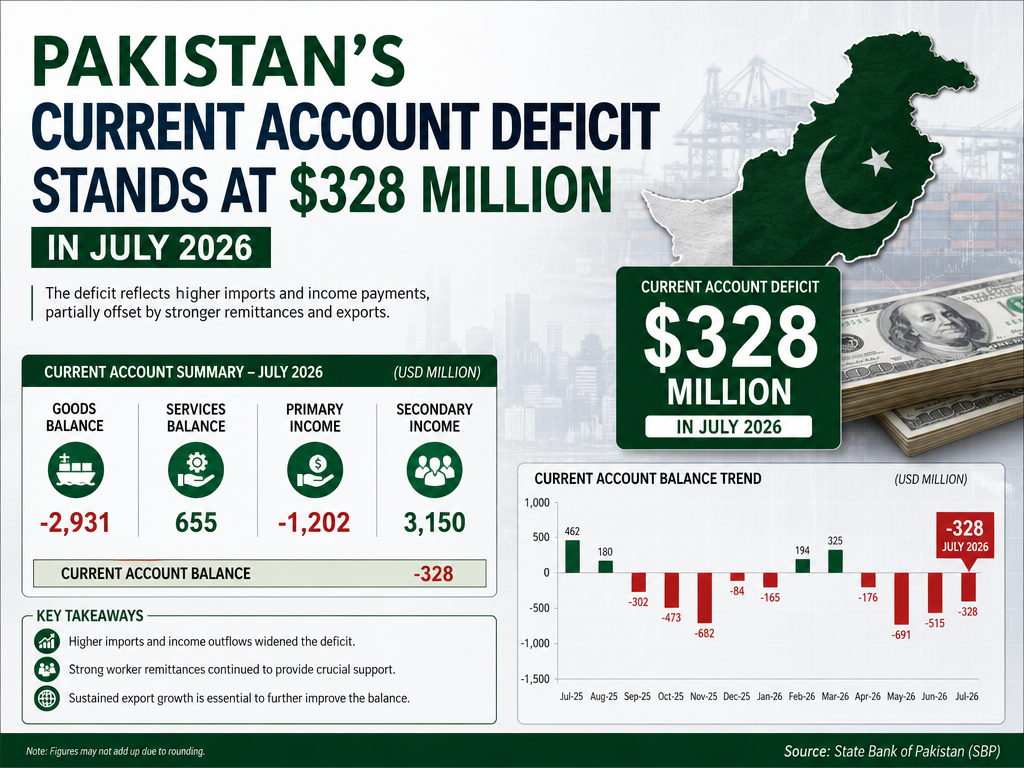
Pakistan’s current account deficit stood at $328 million in July 2026, improving from the $529 million deficit recorded in July 2025, according to the latest Balance of Payments data released by the State Bank of Pakistan.
The improvement was supported by strong workers’ remittances, which reached $3.631 billion during the month. However, the country’s trade imbalance remained a major pressure point, with the goods and services trade deficit widening to $3.374 billion.
Current Account and Income Flows
Secondary income remained the key stabilising factor, recording $3.939 billion in credit, largely driven by workers’ remittances.
At the same time, primary income posted an $848 million outflow, while the combined balance of goods, services and primary income showed a deficit of $4.222 billion.
Trade Deficit Remains a Challenge
Pakistan’s goods exports stood at $3.008 billion in July, while imports reached $6.154 billion.
Services exports amounted to $927 million, compared with services imports of $1.155 billion.
The figures highlight that despite stronger remittance inflows, Pakistan continues to face pressure from its external trade imbalance.
Balance of Payments Shows Overall Surplus
The financial account provided significant support, recording a net inflow of $1.139 billion.
As a result, the overall Balance of Payments position recorded a $1.389 billion surplus, with reserve assets increasing by the same amount.
SBP gross foreign exchange reserves, including cash foreign currency holdings and excluding unsettled claims on the Reserve Bank of India, reached $18.339 billion at the end of July.
Reserves excluding CRR/SCRR stood at $17.149 billion.
FY26 Current Account Moves Into Deficit
For the full fiscal year 2026, Pakistan recorded a $304 million current account deficit, compared with a $1.838 billion surplus in FY25.
Workers’ remittances, however, remained a major source of external support. Total remittances for FY26 reached $41.585 billion, up from $38.3 billion a year earlier.
The latest data provides some breathing space for Pakistan’s external account, but maintaining stability will depend on stronger exports, disciplined import management and continued growth in remittances.
The figures are provisional and may be revised as more complete information becomes available.