
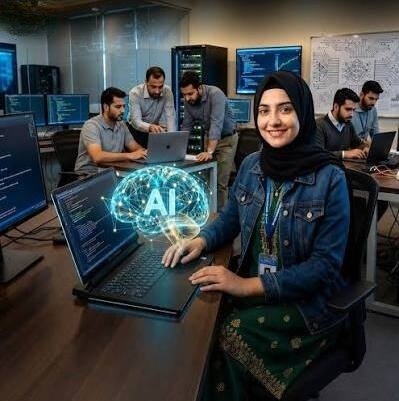
MoITT, UN Women and KOICA Partner to Promote Inclusive AI Development
Pakistan has launched South Asia’s first national Gender-Responsive AI School, marking a significant milestone in the country’s digital transformation agenda. The initiative, introduced by the Ministry of Information Technology and Telecommunication (MoITT) in partnership with UN Women Pakistan and supported by the Korea International Cooperation Agency (KOICA), aims to strengthen national capacity for developing ethical, inclusive and gender-responsive artificial intelligence.
The programme is designed to equip policymakers, government institutions, parliamentarians, United Nations personnel, academia, civil society, private sector representatives and community leaders with the knowledge and practical skills needed to ensure women and girls participate equally in Pakistan’s rapidly evolving digital economy.
Pakistan Sets a Regional Benchmark for AI Education
Speaking at the launch ceremony, UN Women Pakistan Country Representative Jamshed M. Kazi described the initiative as a landmark achievement for the Asia-Pacific region.
He said Pakistan had become the first country in South Asia to introduce a national Training of Trainers (ToT) programme under the UN Women AI School, with customised learning pathways for the executive, legislative and judicial branches, as well as civil society and the private sector.
According to Kazi, the programme establishes a new regional benchmark by moving beyond existing models and creating a comprehensive national framework for gender-responsive AI education.
Curriculum Covers AI Governance, Ethics and Practical Skills
The Gender-Responsive AI School combines theoretical learning with hands-on training to help participants understand both the opportunities and challenges presented by artificial intelligence.
The curriculum includes modules on:
- AI foundations
- Gender-responsive and ethical AI
- AI governance
- Prompt engineering
- AI agents
- AI applications for public administration and inclusive development
Before the official launch, specialised training sessions had already been conducted for parliamentarians, government officials, UN personnel, academic institutions and civil society organisations, creating an initial network of AI champions across the country.
KOICA Backs Inclusive Digital Innovation
KOICA Pakistan Deputy Country Director Sodam Baek said the initiative represents an investment in Pakistan’s inclusive digital future.
She noted that strengthening digital skills while promoting responsible AI would help build an innovation ecosystem where women and girls can participate equally and contribute to sustainable economic development.
Addressing the Global Gender Gap in AI Policy
The initiative also responds to a significant gap in global AI governance.
According to UN Women, only a small number of nearly 140 national AI policies worldwide explicitly address gender considerations. The new AI School aims to help Pakistan develop policies and institutions that integrate gender equality into future AI development.
The programme aligns with several international commitments, including the Global Digital Compact, the CSW67 Agreed Conclusions and the Beijing+30 agenda, translating global policy objectives into practical national action.
MoITT and UN Women Sign Long-Term Partnership
During the ceremony, MoITT and UN Women Pakistan signed a Memorandum of Understanding (MoU) to institutionalise the Gender-Responsive AI School.
The platform was formally handed over to the ministry, reinforcing Pakistan’s ownership of the initiative and supporting its long-term sustainability.
Federal Minister for Information Technology and Telecommunication Shaza Fatima Khawaja said artificial intelligence is transforming every sector of society and emphasised the government’s commitment to ensuring that transformation remains inclusive.
She said the partnership with UN Women and KOICA would strengthen institutional capacity, promote ethical AI governance and create greater opportunities for women and girls to lead in Pakistan’s digital economy.
Supporting Pakistan’s Digital Transformation Agenda
Pakistan has become the first country in South Asia to host the complete national Training of Trainers programme under the UN Women AI School initiative.
Since its regional launch in 2024, the broader programme has trained more than 5,000 policymakers, UN officials, civil society leaders and young innovators across Asia and the Pacific.
The launch supports Pakistan’s wider digital transformation strategy while contributing to the United Nations Sustainable Development Goals, particularly SDG 5 (Gender Equality) and SDG 9 (Industry, Innovation and Infrastructure).
MoITT, UN Women and KOICA said they will continue working with development partners, universities, civil society organisations and the private sector to ensure artificial intelligence becomes a driver of innovation, equality and sustainable development across Pakistan.