
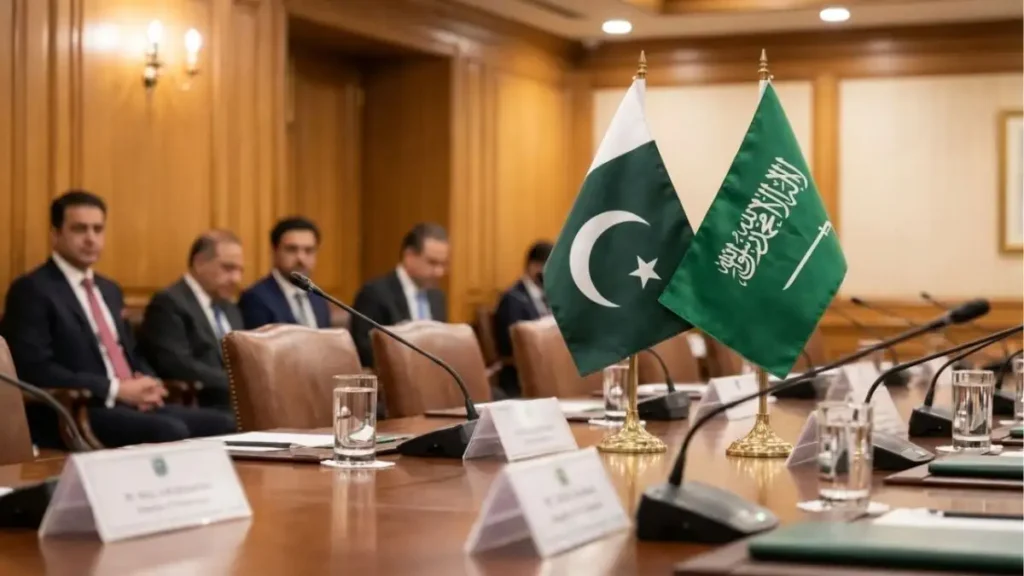
Saudi Arabia rolls over $3bn loan to Pakistan, providing a major boost to the country’s external financing position and ensuring that foreign exchange reserves remain stable as Islamabad continues to navigate economic challenges under the International Monetary Fund (IMF) programme.
Finance Minister Muhammad Aurangzeb confirmed the development while speaking to reporters after a meeting of the Senate Standing Committee on Finance on Thursday. Responding to a question about the status of the Saudi deposit, the minister said, “Everything is fine,” confirming that the financial arrangement had been successfully renewed.
The confirmation ends days of speculation after the $3 billion Saudi deposit matured earlier this week without any official announcement from the Ministry of Finance regarding its extension.
Saudi Arabia Rolls Over $3bn Loan to Pakistan, Strengthening External Financing
The Saudi Arabia Rolls Over $3bn Loan to Pakistan development is considered significant because the deposit is one of the key pillars supporting Pakistan’s foreign exchange reserves and overall macroeconomic stability. Maintaining adequate reserves is crucial for meeting external debt obligations, stabilizing the rupee, and strengthening investor confidence.
Saudi Arabia had originally provided the $3 billion deposit in April this year for a period of three months. The financing enabled Pakistan to repay a maturing loan owed to the United Arab Emirates (UAE), helping the country avoid additional pressure on its foreign exchange reserves.
Although the deposit matured at the beginning of this week, the government had remained silent regarding its renewal. Aurangzeb’s statement is the first official confirmation that Saudi Arabia has agreed to extend the facility.
Pakistan and Saudi Arabia Deepen Economic Cooperation
The finance minister made the announcement shortly after returning from Saudi Arabia, where he travelled alongside Federal Minister for Energy Sardar Awais Leghari. During the visit, Pakistani and Saudi officials discussed a range of issues, including financial cooperation, energy collaboration, investment opportunities, and broader economic relations between the two countries.
The successful rollover reflects the longstanding strategic and economic partnership between Islamabad and Riyadh. Saudi Arabia has repeatedly provided financial assistance to Pakistan during periods of economic stress, including deposits at the State Bank of Pakistan (SBP), oil financing facilities, and investment commitments.
IMF Commitments and External Financing Strategy
The Saudi Arabia Rolls Over $3bn Loan to Pakistan arrangement also aligns with Pakistan’s commitments under the $7 billion IMF Extended Fund Facility (EFF). Under the IMF programme, Pakistan secured assurances from Saudi Arabia, China, and the UAE that they would maintain a combined $12.5 billion in deposits with the SBP until September next year to support the country’s balance of payments.
However, the financial support framework has evolved over recent months. The UAE reduced part of its exposure, prompting Saudi Arabia to increase its financial commitment. According to government officials, Saudi Arabia’s total exposure to Pakistan has now increased to approximately $8 billion, underscoring Riyadh’s continued support for Pakistan’s economic stabilization efforts.
Government sources also revealed that Islamabad is working on additional measures to ease pressure on its external financing requirements. Officials are exploring options to extend the maturity of other external loans while negotiating with Chinese authorities over payments owed to Chinese power producers operating under the China-Pakistan Economic Corridor (CPEC).
The government is examining ways to restructure outstanding energy sector liabilities by spreading repayments over a longer period. Officials believe such arrangements would improve liquidity and reduce short-term financing pressures.
Pakistan Seeks Long-Term Deferred Oil Facility
At the same time, Pakistan has approached Saudi Arabia with another major request. According to sources, Islamabad has sought a $6.7 billion deferred oil payment facility for a period of 15 years.
The proposed oil financing arrangement is aimed at strengthening Pakistan’s energy security as geopolitical tensions in the Middle East continue to create uncertainty in global energy markets. A long-term deferred payment facility would allow Pakistan to import crude oil and petroleum products without placing immediate pressure on its foreign exchange reserves.
Energy experts believe such an arrangement could significantly improve Pakistan’s external account while providing greater certainty over future energy supplies.
Senate Committee Debates BISP Vacancies
Besides discussing Pakistan’s external financing situation, the Senate Standing Committee on Finance also reviewed staffing challenges at the Benazir Income Support Programme (BISP).
Committee members examined the issue of more than 1,300 vacant positions, representing nearly 38% of BISP’s approved workforce.
The discussion exposed differing views between Finance Minister Muhammad Aurangzeb and BISP Chairperson Senator Rubina Khalid regarding whether fresh recruitment is necessary.
Aurangzeb argued that the matter should instead be considered by the Senate Standing Committee on Poverty Alleviation, while Rubina Khalid maintained that the Finance Committee was the appropriate forum because the Ministry of Finance had opposed recruitment requests.
Rubina Khalid informed lawmakers that BISP has not conducted any new hiring since 2014, resulting in a substantial shortage of staff that has affected the programme’s operational efficiency and service delivery.
The finance minister, however, argued that digital transformation would reduce the need for expanding the workforce.
He announced that the entire Rs838 billion allocated for BISP during the current fiscal year would be distributed through digital payment systems, making operations more efficient while reducing administrative costs.
Aurangzeb suggested that instead of filling vacant positions, the government should adopt an attrition policy, allowing workforce numbers to decline naturally over time as employees retire or leave the organization.
Committee Refers Recruitment Issue for Further Review
Following deliberations, the Senate Standing Committee decided to refer the matter to the government’s committee on expenditure rationalization for a detailed review before making any decision on future recruitment.
Officials informed lawmakers that BISP currently has an approved workforce of approximately 3,486 employees, of which nearly 1,300 positions remain vacant.