
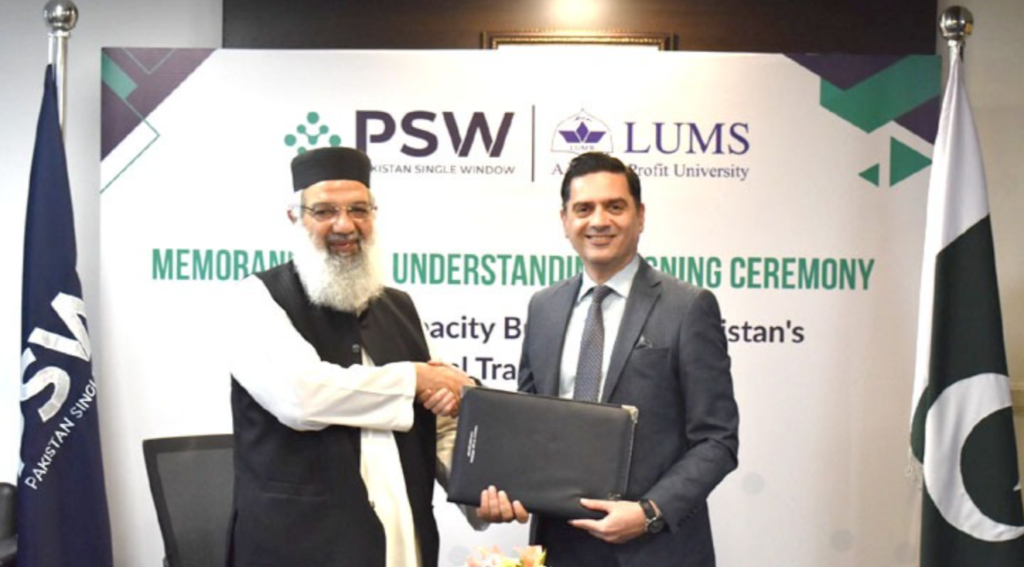
LAHORE: The Lahore University of Management Sciences (LUMS) and Pakistan Single Window (PSW) have signed a Memorandum of Understanding (MoU) to collaborate on capacity building, executive education, and research initiatives aimed at strengthening Pakistan’s trade facilitation ecosystem.
The agreement was signed at the Pakistan Single Window headquarters in Islamabad by Aftab Haider, Chief Executive Officer of Pakistan Single Window, and Dr. Tariq Jadoon, Provost of LUMS, in the presence of senior representatives from both institutions.
The collaboration is designed to combine academic expertise with practical industry knowledge to enhance professional competencies, promote evidence-based policymaking, and support the modernization of Pakistan’s cross-border trade environment.
Partnership to Support FBR Customs Training
Under the MoU, LUMS and PSW will jointly support capacity-building initiatives under the Federal Board of Revenue’s (FBR) Postgraduate Diploma (PGD) Program for Probationary Assistant Collectors of Customs.
The collaboration will focus on strengthening knowledge and professional skills in areas including digital trade, trade facilitation, logistics, cross-border trade systems, data governance, and other subjects aligned with PSW’s mandate.
The initiative aims to equip customs officials with the expertise required to navigate Pakistan’s evolving trade landscape and improve the efficiency of border management.
Executive Education and Professional Development
As part of the partnership, both institutions will jointly design and deliver executive education programmes, technical trainings, seminars, workshops, and other professional development initiatives.
The agreement also provides opportunities for LUMS and PSW to participate in each other’s conferences, policy dialogues, exhibitions, and knowledge-sharing events, fostering greater collaboration between academia and the public sector.
These initiatives are expected to strengthen institutional capacity while promoting best practices in customs administration and international trade.
Joint Research to Support Policy Development
The MoU also establishes a framework for collaborative research focusing on digital trade, logistics, trade facilitation, cross-border trade systems, and data governance.
Both institutions will work together to develop policy papers, analytical studies, and other knowledge products aimed at supporting evidence-based policymaking and generating practical insights for stakeholders across Pakistan’s trade ecosystem.
The research initiatives will also contribute to the FBR’s Customs training programme by integrating academic research with practical policy applications.
Officials Highlight Importance of Collaboration
Commenting on the partnership, Dr. Tariq Jadoon, Provost of LUMS, said the collaboration reflects the university’s commitment to advancing executive education and applied research that addresses national priorities.
He noted that combining academic excellence with practical expertise would create meaningful learning opportunities while contributing to the strengthening of Pakistan’s trade and customs landscape.
Pakistan Single Window CEO Aftab Haider said developing a modern and efficient trade ecosystem requires continuous investment in human capital and knowledge.
He added that the partnership demonstrates PSW’s commitment to fostering innovation, building institutional capacity, and supporting the development of future leaders in customs and trade facilitation.
Supporting Pakistan’s Trade Modernization
The partnership reflects the shared commitment of LUMS and Pakistan Single Window to promoting professional excellence, research-driven policymaking, and institutional collaboration.
By focusing on executive education, technical training, and applied research, the initiative is expected to contribute to the modernization of Pakistan’s cross-border trade systems while strengthening the country’s broader trade facilitation framework.
The collaboration also supports ongoing efforts to improve customs efficiency, enhance digital trade capabilities, and develop a more competitive and transparent trade environment for Pakistan.