
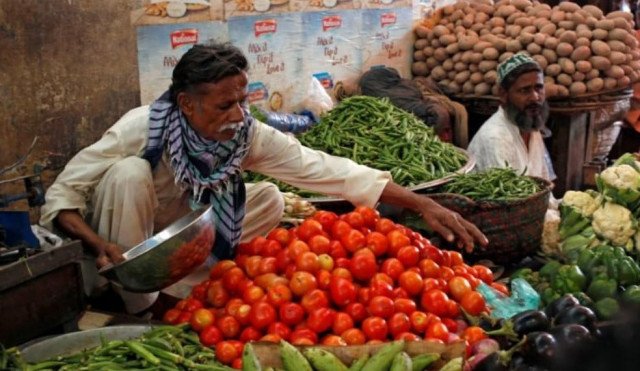
Pakistan SPI inflation edged up 0.46% for the week ended June 18, 2026, driven primarily by sharp increases in perishable food items, according to data released by the Pakistan Bureau of Statistics (PBS).
The Sensitive Price Index tracks weekly price movements of 51 essential commodities across 50 markets in 17 cities, serving as a near real-time barometer of short-term inflation trends.
Tomatoes and Potatoes Lead Weekly Price Surge
Perishable vegetables topped the list of weekly price movers. Tomatoes recorded the sharpest increase at 16.65%, followed by potatoes at 6.82%.
Chicken prices rose 5.60%, adding pressure on household food budgets. Other items that recorded increases included washing soap (1.16%), gur (0.65%), mutton and LPG (0.51% each), shirting (0.48%), long cloth (0.43%), eggs (0.35%), fresh milk (0.29%), and curd (0.26%).
Onions, Garlic, and Fuel Offer Some Relief
Not all prices moved upward. Onions fell 2.98% on a weekly basis, while garlic dropped 2.51%. Bananas declined 1.28%.
On the energy side, petrol prices fell 1.06% and diesel dropped 0.51%, offering modest relief to consumers and transporters alike.
Other weekly decreases were recorded in pulse mash (1.04%), salt powder (0.95%), pulse moong (0.61%), wheat flour (0.53%), and pulse gram (0.04%).
Breakdown of Price Movements
Out of 51 tracked items, prices of 25 items (49.02%) increased during the week, while 11 items (21.57%) declined and 15 items (29.41%) remained stable.
The data showed that price pressures remained broadly concentrated in the food segment, particularly in vegetables and proteins.
Annual SPI Jumps 15.28%
On a year-on-year basis, Pakistan SPI inflation stood at 15.28%, reflecting sustained upward pressure on essential commodity prices over the past 12 months.
The annual breakdown painted a sharper picture of structural price stress. Onion prices surged 79.76% compared to the same period last year, while tomatoes jumped 68.59%. Electricity charges for Q1 rose 59.40%, wheat flour climbed 58.72%, and LPG increased 52.66%.
Petrol and diesel posted annual increases of 44.73% and 44.39% respectively. Mutton rose 16.30%, chilli powder 15.20%, beef 12.86%, garlic 10.74%, and bread 8.67%.
Some Annual Declines Provide Cushion
A handful of commodities recorded significant year-on-year price declines, offering some relief to consumers.
Potato prices fell 41.09% on an annual basis, eggs dropped 26.98%, pulse gram declined 22.32%, and sugar fell 17.51%. Salt powder was down 14.09%, pulse masoor dropped 12.25%, pulse moong fell 5.48%, and chicken declined 4.24%.
Urea and Cement Prices Show Mixed Trends
Beyond food and energy, the PBS data also tracked input costs in agriculture and construction.
The average price of Sona Urea stood at Rs4,662 per 50-kg bag — up 0.25% from the previous week and 4.75% higher than a year ago, adding to the cost burden on farmers ahead of the upcoming crop cycle.
Cement averaged Rs1,503 per 50-kg bag, down 0.50% from the prior week but still 6.19% above last year’s level, reflecting lingering cost pressures in the construction sector.
What the Data Signals
The weekly SPI reading confirms that food price volatility — particularly in vegetables and proteins — remains the primary driver of Pakistan SPI inflation in the near term.
While fuel price declines and lower pulse prices provide partial offsets, the double-digit year-on-year increase of 15.28% underscores the scale of the inflation challenge facing Pakistani households. Policymakers will be watching whether perishable-led weekly spikes translate into sustained price trends in the weeks ahead.