
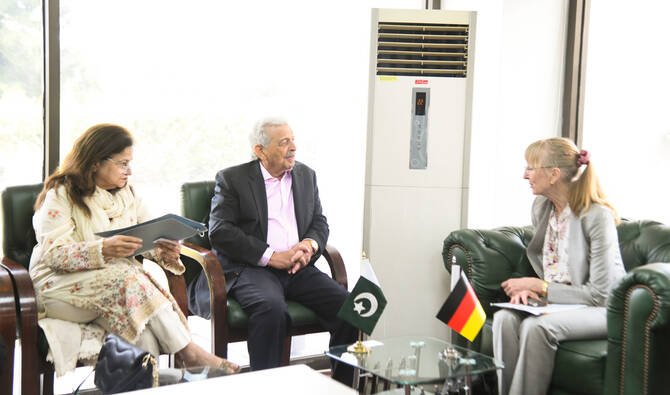
Pakistan and Germany moved to strengthen Pakistan Germany agriculture cooperation on Thursday, as Federal Minister for National Food Security and Research Rana Tanveer Hussain met German Ambassador to Pakistan Ina Lepel in a high-level bilateral meeting.
The two sides agreed to explore deeper collaboration in agriculture, livestock development, food security, research, and technology transfer.
Low Yields, High Stakes
Minister Hussain highlighted the central role of agriculture in Pakistan’s economy, noting that the sector contributes nearly 25% to the country’s GDP.
Despite its scale, low crop yields remain a persistent challenge. The minister said the government has focused on agricultural research, certified seeds, mechanisation, and climate-resilient crop varieties to lift productivity.
He stressed that Pakistan needed to modernise farming practices to remain competitive and to safeguard long-term food security.
Livestock Sector Takes Centre Stage
A significant portion of the discussion was devoted to Pakistan’s livestock sector, which accounts for around 60% of total agricultural output.
Hussain proposed bilateral cooperation in livestock genetics, breed improvement, advanced reproductive technologies, animal feed development, and Foot and Mouth Disease vaccine production.
He also invited German companies and institutions to collaborate in dairy modernisation, agricultural mechanisation, food processing, and the establishment of modern slaughterhouses.
Biotechnology Policy Opens New Doors
The minister informed the German delegation that Pakistan is introducing its first-ever Biotechnology Policy, designed to open new avenues for research, innovation, and foreign investment.
He also raised the need for collaboration on traceability systems, food safety standards, and Sanitary and Phytosanitary (SPS) compliance — steps that would help Pakistan broaden its international market access.
Germany Signals Commitment and Investment Interest
Ambassador Lepel welcomed Pakistan’s efforts to modernise its agriculture sector and reaffirmed Germany’s commitment to expanding Pakistan Germany agriculture cooperation in the areas of climate resilience, livestock development, and research.
She acknowledged Pakistan’s Biotechnology Policy initiative and noted that several German firms are already exploring active investment opportunities in the country.
PARC Stresses Research and Capacity Building
Chairman of the Pakistan Agricultural Research Council (PARC) and Animal Husbandry Commissioner Dr Syed Murtaza Hassan Andrabi underlined the value of joint research and capacity building.
He said Pakistan stood to gain from German expertise, particularly through the import of high-quality embryos and semen for breed improvement — a step that could deliver significant livestock productivity gains over time.
A Shared Commitment to Sustainable Growth
Both sides concluded the meeting with a shared commitment to strengthen bilateral ties aimed at sustainable agricultural growth and enhanced food security.
The meeting marked a concrete step toward formalising cooperation between the two countries on one of Pakistan’s most critical economic sectors. With German investment interest growing and Pakistan rolling out new policy frameworks, the groundwork for a deeper partnership appears firmly in place.