
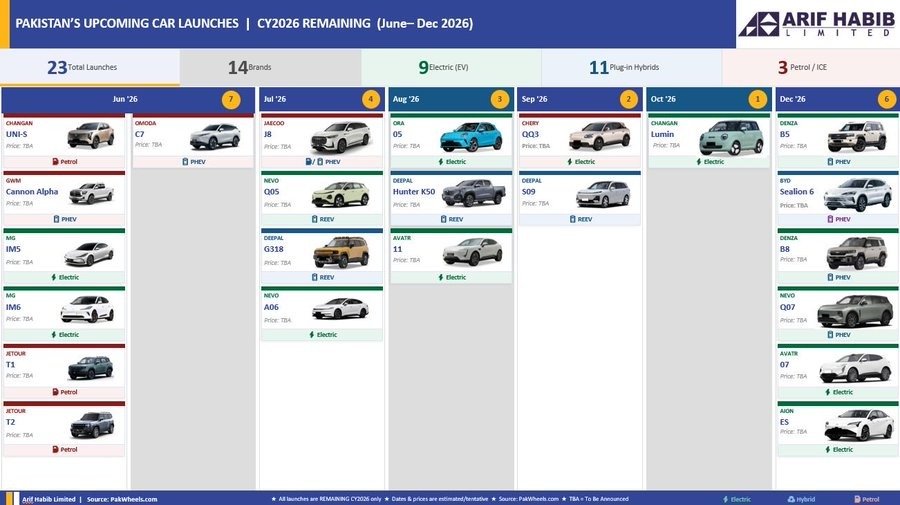
Arif Habib Limited (AHL) has released its latest ‘Upcoming Automobile Launch Tracker’, projecting approximately 23 new vehicle introductions in Pakistan between June and December 2026. These launches span 14 brands and include a strong mix of 9 electric vehicles (EVs), 11 plug-in hybrids (PHEVs), and 3 internal combustion engine (ICE) models.
This wave of new models signals continued momentum in Pakistan’s automotive industry, driven by growing consumer demand for modern, efficient, and electrified vehicles.Electrification Gains MomentumThe tracker highlights a clear shift toward greener powertrains. With 20 out of 23 upcoming vehicles featuring electric or plug-in hybrid technology, OEMs are aggressively expanding their electrified portfolios. Recent market entries like GAC Aion V and Aion UT have already generated interest, setting the stage for more launches.
Upcoming highlights include BYD’s Sealion 6 PHEV, Denza B5, and Denza B8 models. These additions are expected to strengthen BYD’s presence as the company ramps up local assembly plans. Chinese brands continue to lead the charge, bringing competitive pricing and advanced features suited to Pakistani roads and consumer preferences.Industry observers note that policy support, improving charging infrastructure in major cities, and rising fuel costs are encouraging buyers to consider EVs and hybrids.
The focus remains on SUVs and crossovers, which dominate the new launch list, but the portfolio is broadening.Diversification Across SegmentsWhile SUVs remain the star segment, manufacturers are introducing variety. The tracker points to premium sedans, electric hatchbacks, and lifestyle pickup trucks entering the market. Notable mentions include Chery’s Omoda C7, NextGen’s Jaecoo J8, and SAZEW’s Cannon Alpha pickup.
These launches cater to different price points and use cases — from urban commuters seeking efficient hatchbacks to families wanting spacious SUVs and adventure enthusiasts eyeing rugged pickups. The inclusion of premium offerings also indicates growing interest in luxury and feature-rich vehicles among upper-middle-class buyers.AHL’s analysis suggests this product diversification reflects evolving consumer preferences.
Buyers are no longer satisfied with basic mobility; they seek technology, safety features, connectivity, and better efficiency. Local assemblers and importers are responding by bringing global models adapted for Pakistan.
The sustained launch pipeline is expected to inject competition, potentially leading to better pricing, improved after-sales service, and faster technology transfer. Recent sales data has shown double-digit growth in several months, with EVs posting particularly strong gains in some periods.
Analysts believe these new models could help Pakistan’s auto industry move closer to long-term goals of reducing oil imports and lowering emissions. However, challenges remain, including the need for wider charging networks, consistent policy frameworks, and development of local component manufacturing.
Overall, the second half of 2026 looks promising for auto enthusiasts and the broader economy. With nearly two dozen new vehicles on the horizon, Pakistan’s roads are poised to see greater variety, advanced technology, and a faster transition toward sustainable mobility.