
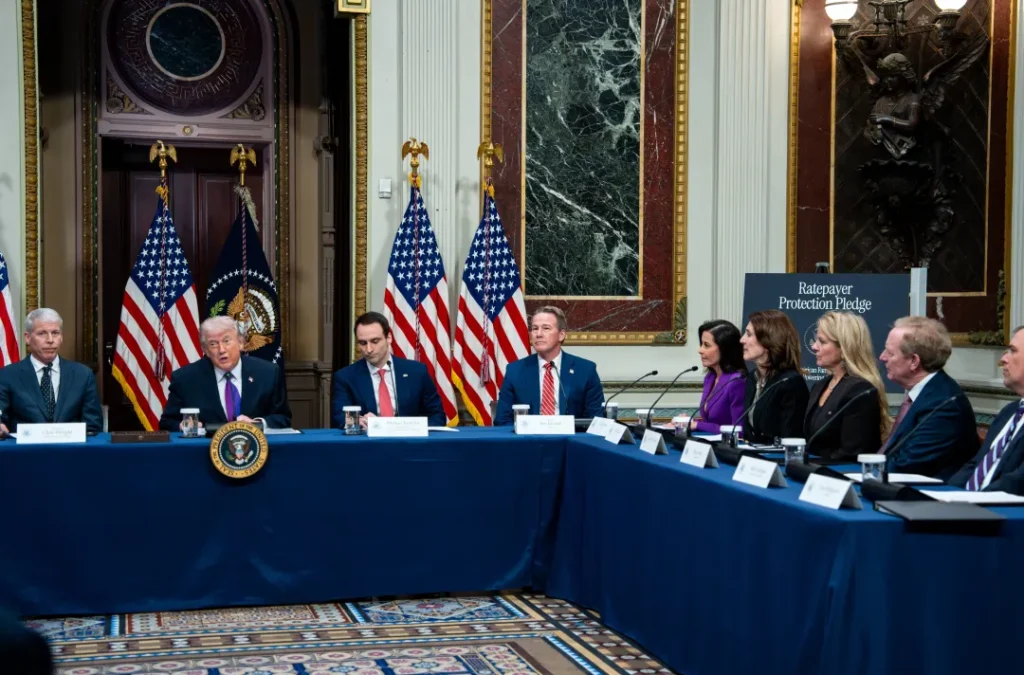
President Donald Trump hosted a high-profile White House event on March 4, 2026, where major technology companies signed the “Ratepayer Protection Pledge.” The voluntary agreement commits tech giants to cover the costs of new electricity generation and infrastructure needed for their power-hungry AI data centers, aiming to shield American households and small businesses from rising utility bills.
Key Signatories and Participants The pledge was signed by Google, Microsoft, Meta, Amazon, Oracle, xAI, and OpenAI. Executives from these firms attended the roundtable, joining Trump to formalize the commitment. The initiative, first announced in Trump’s recent State of the Union address, reflects growing concerns over the massive energy demands of AI infrastructure straining regional power grids.
Details of the Pledge Under the agreement, companies promise to build, bring, or buy dedicated power sources—such as new plants or expanded capacity—to meet data center needs. They will also fund upgrades to power delivery systems and enter special rate arrangements with utilities.
Trump emphasized that these steps would ensure data centers receive required electricity “without driving up electricity costs for consumers,” while making the grid “stronger and more resilient.” He described it as a “historic win for countless American families,” noting that local opposition to data center projects could reverse now that costs won’t burden ratepayers.
Political Timing and Voter Concerns The signing occurred ahead of the November 2026 midterm elections, as energy affordability emerges as a key voter issue. Communities and state lawmakers have increasingly scrutinized data center expansions due to potential bill hikes and grid pressure from AI-driven demand.
Trump highlighted that some previously rejected or delayed projects might now advance with clearer cost protections in place. A White House official stressed that no new data center developments would proceed without communities understanding the pledge.
Broader Implications and Criticisms Trump portrayed the deal as tech firms funding a “colossal expansion of U.S. energy,” supporting AI leadership while curbing inflation. However, critics question its effectiveness. Jon Gordon of Advanced Energy United pointed out challenges in rapidly building new generation, even if funded by hyperscalers, and expressed concern over a potential emphasis on natural gas or fossil fuels rather than quicker renewables like solar and wind.
Environmental groups have raised alarms about health risks from additional fossil fuel plants. The pledge remains voluntary and lacks federal enforcement, prompting some to view it as symbolic amid calls for stronger consumer safeguards.
Outlook The agreement signals collaboration between the administration and Big Tech to balance AI growth with energy affordability. As data center proliferation continues, its real-world impact will depend on implementation and whether it meaningfully prevents cost pass-throughs to everyday Americans.