
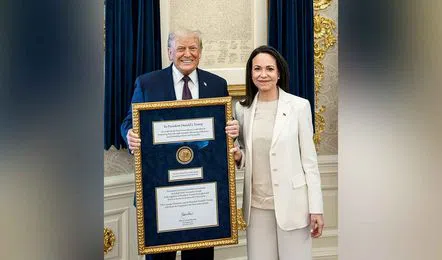
U.S. President Donald Trump met Venezuelan opposition leader María Corina Machado at the White House on January 15, 2026, in a private lunch that lasted over an hour. Machado, the 2025 Nobel Peace Prize winner, presented Trump with her Nobel medal as a gesture recognizing his “commitment to the freedom of the Venezuelan people.”
Trump accepted the medal, posting on social media that it was a “wonderful gesture of mutual respect” for his work. The encounter marked their first in-person meeting and came amid competing influences on U.S. policy toward Venezuela following the U.S. capture of former President Nicolás Maduro and the interim leadership of Delcy Rodríguez, Maduro’s former vice president.
Read More: https://theboardroompk.com/musks-starlink-faces-major-security-test-amid-irans-deadly-crackdown/
Symbolism of the Nobel Gesture Amid Policy Tensions Machado described the meeting as “excellent” and framed the medal presentation as appreciation for Trump’s role in toppling Maduro through a U.S. military operation earlier in January.
The Nobel medal was inscribed with a message thanking Trump for “Extraordinary Leadership in Promoting Peace through Strength.” Trump has long coveted the Nobel Peace Prize, having campaigned for it openly. However, the Norwegian Nobel Committee clarified that the prize itself cannot be transferred or shared.
The gesture highlighted Machado’s efforts to build rapport with Trump, who has questioned her short-term leadership viability despite her opposition credentials.
Trump’s Focus on Oil and Interim Government Ties The meeting underscored Trump’s pragmatic approach to Venezuela, prioritizing access to its vast oil reserves and economic rebuilding over immediate democratic transitions.
Trump has praised interim leader Delcy Rodríguez as a “terrific person” with whom the U.S. is “getting along very well,” following a recent phone call. White House officials emphasized Trump’s “realistic assessment” that Machado lacks sufficient support to lead soon.
Meanwhile, Machado later met bipartisan U.S. senators on Capitol Hill, where she received more enthusiastic backing and raised concerns about ongoing repression under Rodríguez. The dynamics reflect broader U.S. policy debates on stabilizing Venezuela through engagement with its current leadership while sidelining opposition calls for swift elections.