
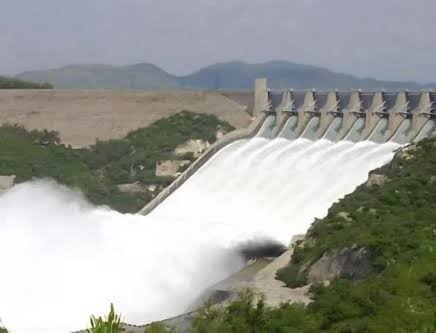
A government-appointed inquiry committee has held all three principal stakeholders—the Water and Power Development Authority (Wapda), the contractor, and the project consultant—responsible for the Tarbela-5 cofferdam collapse, concluding that unauthorized post-contract design changes and multiple contractual violations led to the failure.
The inquiry found that the collapse of the cofferdam at the 1,530-megawatt Tarbela-5 Extension Hydropower Project in August 2025 has delayed the project by at least two years and caused its estimated cost to surge by more than 285%.
Originally approved at Rs82.36 billion in 2017, the project’s revised cost has now climbed to Rs317 billion, with further increases still possible.
Inquiry Blames Contractor, Consultant and Wapda
According to the findings of the three-member independent inquiry committee, responsibility for the incident rests with all parties involved in the project.
The report stated that the contractor proposed changes to the original cofferdam design despite contractual provisions prohibiting such modifications.
The consultant accepted the revised design without ensuring that it fully complied with technical and contractual requirements, while Wapda approved the changes shortly before construction was completed without questioning either their contractual validity or engineering implications.
The committee concluded that these combined failures resulted in the construction of a vulnerable cofferdam that ultimately collapsed.
Unauthorized Design Changes Identified
The inquiry revealed that the original cofferdam design was altered following a proposal by the contractor, Power Construction Corporation of China Ltd (PCCCL).
Instead of the originally approved design, the cofferdam was converted into a rock-filled structure across the entire project area, including the diversion channel.
According to the committee, this alternative design provided weaker structural protection and significantly increased the risk of failure.
The report noted that Wapda approved the revised design without conducting adequate scrutiny or questioning whether such changes were permissible under the contract.
Flooding Not the Main Cause
Following the collapse, Wapda attributed the incident to unusually high flood flows.
However, the inquiry rejected that explanation.
The committee found that water flows during the incident remained within Tarbela Dam’s historical annual range and were considerably lower than the cofferdam’s original design capacity.
Instead, investigators concluded that inadequate protection layers and insufficient filter arrangements contributed to the structural failure.
The report stated that the collapse could have been avoided had the original engineering specifications been maintained.
Consultant Failed to Conduct Independent Review
The inquiry also criticized the performance of the project’s consultant.
According to the report, Wapda requested a performance review of the cofferdam in July 2023.
Rather than carrying out an independent technical assessment, the consultant forwarded Wapda’s request to the contractor.
The contractor submitted its monitoring report more than a year later, in October 2024.
The inquiry concluded that the consultant failed to exercise proper engineering oversight throughout the project.
The consultant for the project was a joint venture comprising MM Pakistan and BIDR China, while MML-UK was later removed from the project.
Massive Financial Impact
The inquiry highlighted the severe financial consequences of the Tarbela-5 cofferdam collapse.
The project, financed partly through approximately $700 million in loans from the World Bank and the Asian Infrastructure Investment Bank (AIIB), has experienced significant cost overruns and schedule delays.
Initially targeted for completion in 2026, the hydropower project is now expected to be completed by June 2028.
According to the Planning Commission, the delays and rising costs could increase the project’s levelised electricity generation cost over a 30-year period to around Rs27–28 per unit.
If realised, this would make Tarbela-5 the most expensive renewable energy project in Pakistan in terms of generation cost, raising concerns about its long-term economic viability.
Irregular Payments Also Identified
The inquiry committee further reported irregularities in project payments.
According to the findings, payments intended for permanent construction works were instead made for temporary structures.
The report warned that these financial decisions could weaken the government’s legal position when seeking compensation from the contractor for losses resulting from the cofferdam collapse.
Investigators concluded that the collapse not only halted construction but also created cascading contractual, financial, and operational liabilities that continue to affect the project.
Consultancy Contract Terminated
Separately, Wapda terminated the consultancy agreement with MML-UK, citing persistent staffing deficiencies.
According to the report, the consultancy firm failed to provide an appropriately qualified project manager throughout its engagement.
The inquiry also noted that MML issued a termination notice in May 2025 and withdrew its personnel from the project site without observing the contractually required 30-day notice period.
Lessons for Future Infrastructure Projects
The inquiry described the incident as an example of serious weaknesses in the planning, execution, monitoring, and governance of major infrastructure projects financed through foreign loans.
The committee stressed that contractual obligations, engineering standards, and independent technical oversight must be strictly enforced to avoid similar failures in future public-sector projects.
With construction now expected to continue until mid-2028 and project costs continuing to rise, the Tarbela-5 cofferdam collapse has become one of Pakistan’s most expensive infrastructure setbacks, raising fresh questions about project management, accountability, and the protection of public funds.