University Road Karachi

Murad Ali Shah Reviews University Road Work as Karachi BRT Red Line Faces Delay Concerns
Pakistan

Murad Ali Shah Reviews University Road Work as Karachi BRT Red Line Faces Delay Concerns

Sindh Chief Minister Murad Ali Shah conducted an early morning visit to University Road in Karachi on Thursday to inspect ongoing development work, including progress on the much-delayed Karachi Bus Rapid Transit (BRT) project. The visit, which also included the Mayor of Karachi, aimed to assess construction quality and ensure timely completion of key infrastructure schemes across the city. Inspection of Development Work on University Road During the visit, officials from the Frontier Works Organisation (FWO) briefed the chief minister on the pace of construction and current progress. Murad Ali Shah expressed satisfaction with the overall development but stressed the importance of maintaining high-quality standards. He reiterated that improving Karachi’s major road networks remains a top priority for the provincial government. According to him, ongoing efforts are focused on upgrading the city’s infrastructure to meet modern urban requirements. Timely Completion and Quality Assurance The chief minister directed relevant departments to accelerate work on all ongoing development projects and avoid unnecessary delays. He emphasized that public convenience must remain central to all infrastructure planning and execution. Senior officials, including Karachi Commissioner Syed Hassan Naqvi and the Managing Director of the Water Board, also accompanied him during the inspection. BRT Red Line Project Under Scrutiny The Karachi BRT Red Line project, a major public transport initiative, continues to face delays and operational challenges. Earlier, Provincial Minister Sharjeel Memon acknowledged that the project could take a year or more to complete. He noted that while efforts are underway to clear and restore sections of University Road, several technical and logistical issues have slowed progress. Authorities have been directed to complete side roads before Eid to ease traffic pressure in the area. Government Commits to Completing Project Despite Delays Despite setbacks, Sindh government officials have reaffirmed their commitment to completing the Karachi BRT Red Line project. Sharjeel Memon stated that although discussions had previously considered halting the project, the government decided to move forward due to its long-term importance for Karachi’s public transport system. He added that large-scale development work is currently underway across the city, with a focus on addressing long-standing infrastructure challenges. Karachi’s Infrastructure Karachi continues to face significant urban infrastructure issues, including traffic congestion, road damage, and delays in public transport projects. The Karachi BRT Red Line project is seen as a key solution aimed at improving mobility for millions of daily commuters. However, repeated delays have raised public concern about execution timelines and project management efficiency. Push for Urban Improvement Continues The latest inspection reflects ongoing efforts by the provincial government to accelerate development and improve urban infrastructure. Officials say the focus remains on completing critical projects that can ease transportation challenges and support Karachi’s growing population.
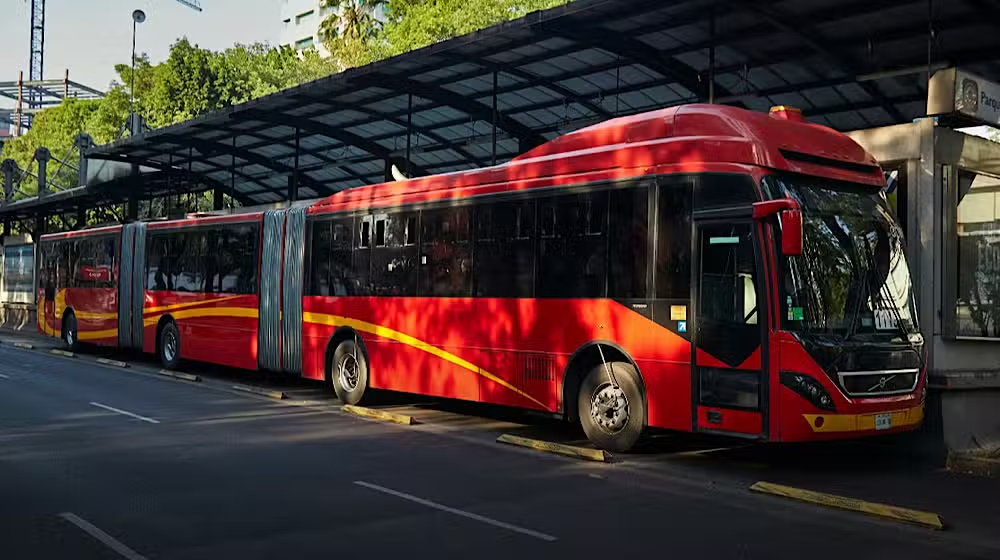
BRT Red Line Faces Fresh Delay in Karachi as Work Slows Again
Pakistan

BRT Red Line Faces Fresh Delay in Karachi as Work Slows Again

The BRT Red Line project in Karachi has once again slowed sharply as construction activity drops across multiple key stretches. Large sections of the route now show little to no visible progress, raising renewed concerns over delays and project coordination. Field observations indicate that machinery remains idle in several areas. Labour presence has also reduced significantly compared to earlier phases of construction. Authorities had previously assured steady progress after resolving financial issues. However, the situation on the ground now reflects another setback for one of Karachi’s most important transport projects. Project Divided Into Two Major Sections The BRT Red Line is divided into two main segments for execution. Lot 1 runs from Airport Signal to Mosamiyat. Lot 2 extends from Mosamiyat to Numaish. Lot 2 continues to face the most serious challenges. This section is longer and involves more complex urban construction work along heavily populated corridors. Officials had earlier prioritized resolving delays in this segment. Despite that, progress remains inconsistent and slow. Past Financial Disputes Still Affect Progress Construction on Lot 2 had already faced a major suspension last year. The halt came after financial disagreements between contractors and project authorities. The dispute escalated to legal proceedings before payments were eventually cleared. Work resumed after intervention, but the recovery has not been stable. Although officials later claimed that the matter had been resolved, current conditions suggest lingering effects on project execution and contractor performance. Visible Work Slowdown Across Key Routes A field review of the project corridor shows a clear slowdown in activity. At People’s Chowrangi, no machinery is currently active, and construction appears suspended. Further along toward Hassan Square, only a small number of workers are visible. A few machines are present, but no active construction is taking place. On the Hassan Square to Nipa stretch, work has been halted due to the ongoing installation of the K-IV water pipeline. This infrastructure project has directly interfered with the BRT construction timeline. Even where machinery is stationed, most equipment remains idle. No consistent operational activity is visible across major sections of the route. Pipeline Work Adds New Layer of Delay The K-IV water supply project has become a major factor affecting the BRT Red Line progress. Construction teams have been forced to pause work in multiple areas where pipeline installation is underway. This overlap between infrastructure projects has created logistical challenges. Road space is limited, and coordination between agencies remains weak. Officials have not provided a clear revised schedule for resolving these conflicts. As a result, uncertainty continues to grow over project completion timelines. Lot 2 Remains the Most Troubled Section The Mosamiyat to Numaish segment continues to face repeated interruptions. This part of the route passes through some of Karachi’s busiest urban zones. Construction delays here have a wider impact on traffic flow and daily commuting. Residents in surrounding areas report prolonged road blockages and diversions. Despite being the largest and most critical segment, Lot 2 has not shown consistent progress in recent months. Commuters Face Ongoing Disruption The slowdown in BRT Red Line construction has continued to affect daily commuters across Karachi. University Road and adjoining corridors remain heavily congested. Travel times have increased due to lane closures and construction barriers. Alternative routes are also under pressure due to diverted traffic. Residents say they continue to face uncertainty over when normal road conditions will return. Many had expected faster completion timelines based on earlier official statements. Repeated Delays Raise Governance Questions The repeated slowdown has raised concerns about project management and coordination. Observers point to a lack of synchronization between infrastructure agencies working in the same corridor. Financial disputes, utility relocation, and construction planning issues have all contributed to delays. Despite earlier claims of resolution, progress remains uneven. The situation has also triggered questions about long term planning for urban transport development in Karachi. Importance of the BRT Red Line Project The BRT Red Line is one of Karachi’s key mass transit initiatives. The project is designed to improve public transport, reduce congestion, and provide a reliable travel option for millions of residents. Once completed, it is expected to connect major residential and commercial zones through a dedicated bus corridor. However, repeated delays have slowed down the delivery of these benefits, leaving commuters dependent on existing overcrowded transport systems.

Scroll to Top