Federal Board of Revenue Pakistan

FBR Tax Shortfall Widens to Rs684 Billion Amid Economic Pressures
Breaking News, Pakistan

FBR Tax Shortfall Widens to Rs684 Billion Amid Economic Pressures

The Federal Board of Revenue (FBR) tax shortfall has widened significantly, reaching Rs684 billion during the first 10 months of the current fiscal year, raising concerns over Pakistan’s revenue performance. According to reported data, Federal Board of Revenue collected Rs10,261 billion from July to April against a target of Rs10,945 billion, highlighting a substantial gap in tax collection. Revenue Targets Missed as Collection Slows The latest figures reveal that the FBR tax shortfall continues to grow as collection efforts fall behind expectations. In April 2026 alone, the FBR collected Rs956 billion against a target of Rs1,029 billion, resulting in a monthly shortfall of Rs73 billion. Officials acknowledged that the tax authority now faces mounting pressure to meet its revised annual target. To achieve the full-year goal of Rs13,979 billion, the FBR must collect an additional Rs3,718 billion in May and June—an ambitious target given the current pace of revenue generation. External Factors Deepen Fiscal Challenges Economic disruptions linked to the Gulf War have further aggravated the FBR tax shortfall. Officials noted that declining imports have led to a sharp drop in sales tax collection at the import stage, traditionally a major revenue source. At the same time, slowed economic activity has reduced overall taxable transactions, limiting income and sales tax inflows. An FBR official stated that both import contraction and reduced market activity have significantly constrained revenue growth in recent months. IMF Refuses to Revise Annual Target In light of the widening FBR tax shortfall, authorities approached the International Monetary Fund seeking a downward revision of the annual tax target. The FBR proposed reducing the target from Rs13,979 billion to around Rs13,400–13,500 billion. However, the IMF declined the request, maintaining strict fiscal targets as part of broader economic conditions tied to Pakistan’s financial programme. This decision has added further pressure on tax authorities to improve collection performance within a limited timeframe. Breakdown of Tax Collection Provisional data shows that the FBR tax shortfall persists despite contributions from multiple revenue streams. During the first 10 months: Income tax collection stood at Rs5,142 billionSales tax generated Rs3,825.5 billionFederal excise duty contributed Rs672.9 billionCustoms duty added Rs1,119.5 billion The total gross collection reached Rs10,760.6 billion. However, after issuing refunds amounting to Rs498.9 billion, the net collection remained Rs10,261.7 billion. Uncertainty Over Final Revenue Outcome Despite the widening FBR tax shortfall, officials indicated that achieving a collection between Rs13,000 billion and Rs13,200 billion by June could still be viewed as a reasonable outcome under current circumstances. However, meeting the original or even revised targets remains a major challenge. With only two months remaining in the fiscal year, the performance of key sectors, import trends, and enforcement measures will play a decisive role in determining the final revenue figures. The growing FBR tax shortfall underscores broader economic pressures facing Pakistan, as authorities struggle to balance fiscal discipline with slowing economic activity.
FBR Corruption Case Highlights Government’s Zero-Tolerance Policy
Pakistan

FBR Corruption Case Highlights Government’s Zero-Tolerance Policy

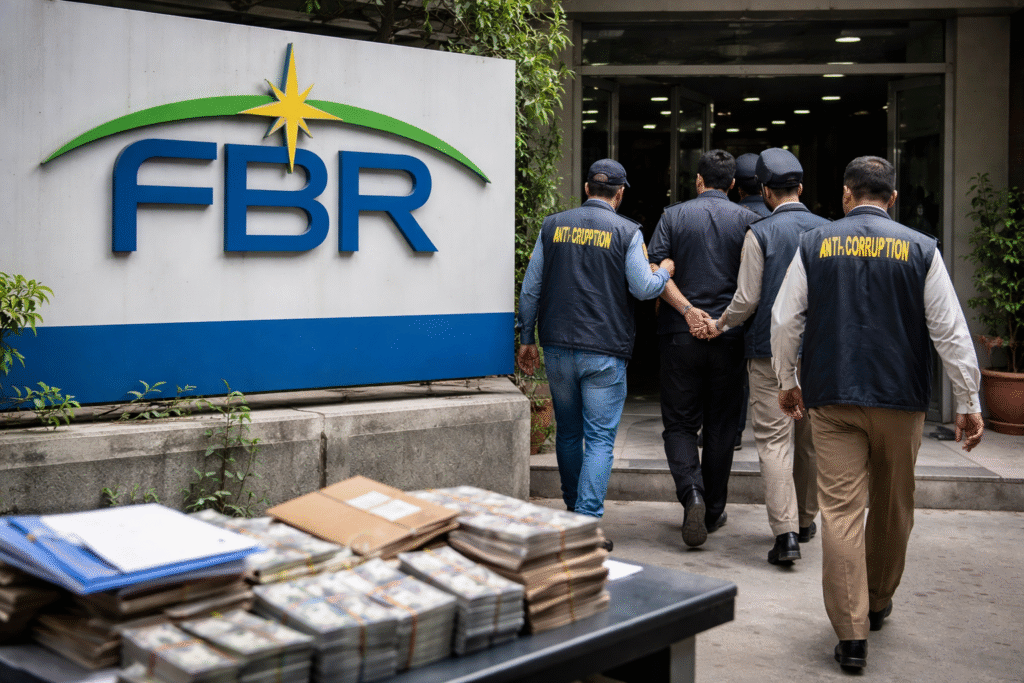
FBR corruption case developments have once again brought accountability in Pakistan’s civil service into sharp focus, as Prime Minister Shehbaz Sharif has approved the dismissal of a senior Inland Revenue Service (IRS) officer on proven corruption charges. The decision reinforces the government’s stated commitment to transparency, discipline, and institutional reform within key revenue-generating departments. The dismissed officer, Riaz Ali Shah (BS-20), was serving as Chief (Accounting) in the Organizational Audit Wing of the Federal Board of Revenue (FBR). Although posted in Karachi, he was formally attached to the FBR headquarters in Islamabad at the time disciplinary action was finalized. FBR Corruption Case: Background of Disciplinary Proceedings The FBR corruption case against Riaz Ali Shah was initiated under the Civil Servants (Efficiency & Discipline) Rules, 2020, following serious allegations of inefficiency, misconduct, and corruption. The formal process began on August 18, 2025, when an Order of Inquiry, Charge Sheet, and Statement of Allegations were issued. These documents outlined multiple violations related to misuse of authority, procedural irregularities, and conduct unbecoming of a senior public servant entrusted with financial oversight responsibilities. Inquiry Findings in the FBR Corruption Case To ensure procedural transparency, Zubair Bilal (IRS/BS-21) was appointed as the Inquiry Officer. After conducting a detailed examination of evidence, records, and official conduct, the inquiry report was submitted on November 12, 2025. The findings were significant. Out of twelve charges, eleven were conclusively proven, demonstrating a sustained pattern of misconduct rather than isolated administrative lapses. Based on these findings, the inquiry officer formally recommended removal from service, categorizing the violations as serious enough to warrant the maximum disciplinary penalty. Show Cause Notice and Opportunity of Hearing As required under law, the accused officer was given an opportunity to defend himself. A Show Cause Notice was issued on November 19, 2025, granting ten days to submit a written response. Riaz Ali Shah submitted his reply on December 5, 2025. To further uphold principles of natural justice, Syed Hamid Ali (PCS/BS-21) was appointed as the Hearing Officer. A personal hearing was scheduled for December 24, 2025, providing the officer a final chance to present his case in person. However, he failed to appear, weakening his defense at a critical stage of the proceedings. Prime Minister’s Decision in the FBR Corruption Case After reviewing the complete disciplinary record—including the charge sheet, inquiry report, show cause reply, and hearing notes—Prime Minister Shehbaz Sharif, exercising his authority under the Civil Servants (Efficiency & Discipline) Rules, 2020, approved the major penalty of dismissal from service. The dismissal effectively ends the officer’s government career and serves as a precedent-setting action within the Federal Board of Revenue, one of Pakistan’s most strategically important institutions. Why This FBR Corruption Case Matters This FBR corruption case carries broader implications beyond the removal of a single officer. It sends a strong message across the civil service that rank and seniority will not shield individuals from accountability. The case also reflects growing political will to clean up governance structures, particularly in revenue and audit functions that directly impact Pakistan’s fiscal stability. For businesses, investors, and taxpayers, such actions help restore confidence in state institutions by signaling that financial oversight bodies are being held to higher ethical standards. Accountability at the Core of Governance Reform The dismissal of a BS-20 IRS officer in this FBR corruption case underscores the government’s zero-tolerance stance on corruption and misconduct. As Pakistan continues to face economic and fiscal challenges, enforcing accountability within revenue authorities remains critical to strengthening governance, improving tax compliance, and rebuilding public trust. This case stands as a clear reminder that corruption will not be tolerated at any level of public service a message with lasting implications for Pakistan’s administrative and economic future.

Scroll to Top