
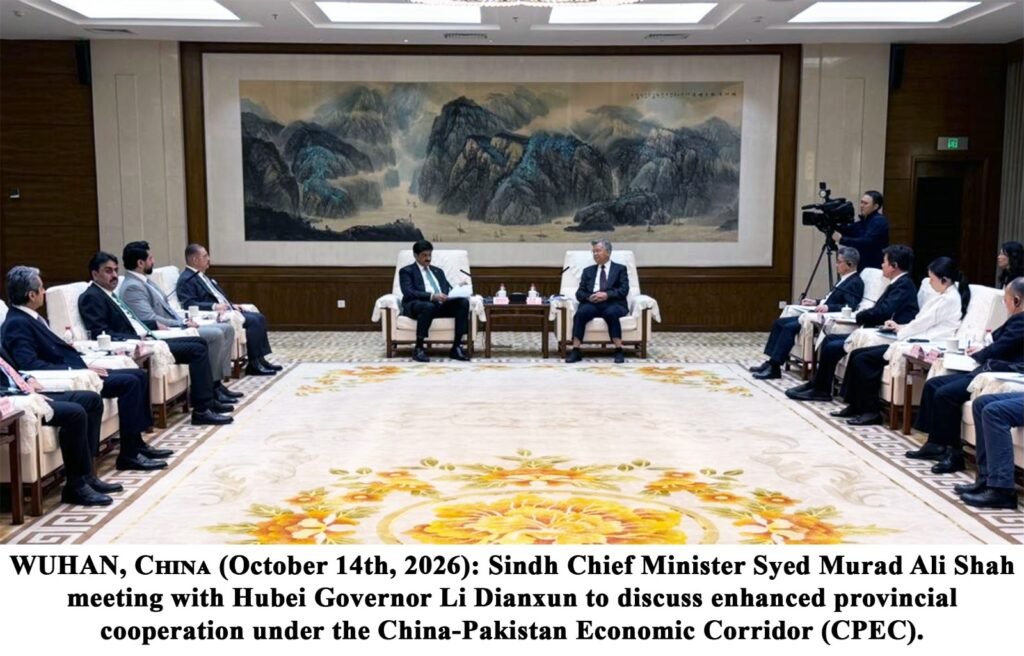
Sindh Chief Minister Syed Murad Ali Shah met senior leadership of China’s Hubei province in Wuhan on October 14 to explore expanded cooperation in agriculture, information technology, education, vocational training and trade. The meeting aimed to strengthen provincial-level partnerships and translate Pakistan-China diplomatic ties into practical economic and development opportunities.
Leading a high-level delegation during his official visit to China, Shah held talks with Hubei Governor Li Dianxun and provincial Communist Party Secretary Guan Xiaotao. Discussions also covered business-to-business partnerships, joint investment opportunities and people-to-people exchanges.
Hubei Signals Interest in Stronger Ties With Sindh
Governor Li Dianxun welcomed the Sindh delegation and reaffirmed Hubei’s commitment to strengthening cooperation with the province. He highlighted Hubei’s industrial base, advanced manufacturing capabilities and research institutions as potential foundations for joint ventures.
The governor expressed interest in expanding collaboration in modern agriculture, digital industries, vocational training and business partnerships. These areas could provide opportunities for both sides to pursue mutually beneficial projects under the next phase of the China-Pakistan Economic Corridor (CPEC).
Sindh Seeks Greater Role for Hubei Businesses in CPEC
Shah described the Pakistan-China relationship as a cornerstone of Pakistan’s foreign policy, emphasizing its resilience amid regional and global challenges.
He also highlighted the significance of the 75th anniversary of diplomatic relations between Pakistan and China, formally established on May 21, 1951. Pakistan was among the first countries to recognize the People’s Republic of China.
The chief minister invited Hubei-based enterprises to participate actively in the next phase of CPEC, particularly in projects focused on green growth, agricultural modernization and skills development.
Agricultural Cooperation Focuses on Research and Modernization
Agriculture featured prominently in the discussions, with Shah acknowledging China’s support in training 1,000 Pakistani agricultural graduates, many of whom studied at Huazhong Agricultural University.
He also welcomed ongoing cooperation in horticultural crop research and the establishment of a joint laboratory for smart and digital agriculture.
Highlighting Sindh’s agricultural potential, Shah sought Hubei’s expertise in hybrid rice, high-yield seed development and farm mechanization. He also emphasized the need for advanced cold-chain logistics to reduce post-harvest losses across fruits, vegetables, meat, dairy and fisheries.
Improved storage and transportation infrastructure could help preserve product quality and strengthen market access for Sindh’s agricultural and food producers.
Technology Partnerships and Investment Opportunities
To promote innovation, Shah proposed connecting technology incubators and investors in Wuhan with startups in Sindh through joint incubation programmes.
He also invited Chinese companies to explore pilot projects in Karachi involving port logistics, industrial automation and urban traffic management.
Such cooperation would create opportunities to exchange technical expertise and explore technology-based solutions for industrial and urban development.
Education and Vocational Training on the Agenda
The discussions also covered stronger university-to-university links, particularly in engineering and digital technologies.
Shah called for joint technical and vocational education and training (TVET) initiatives to equip Sindh’s young people with skills relevant to modern manufacturing and evolving industry requirements.
The proposed collaboration aims to strengthen skills development while building closer links between educational institutions and industry.
Sindh-Hubei Engagement Aims to Deepen Pakistan-China Partnership
Both sides expressed confidence that closer engagement between Sindh and Hubei would strengthen the broader Pakistan-China All-Weather Strategic Cooperative Partnership.
The discussions identified potential areas for cooperation spanning agriculture, technology, trade, education and industrial development. The next step will be translating these areas of interest into practical partnerships and investment projects.