SBP Regulatory Sandbox has reached a major milestone as the State Bank of Pakistan (SBP) officially announced the shortlisted applicants for the first cohort of its flagship innovation initiative. Launched under SBP Vision 2028, the Regulatory Sandbox aims to accelerate innovation, enhance competition, and enable secure adoption of digital financial services across Pakistan.
Introduced through official guidelines issued in May 2025, the SBP Regulatory Sandbox provides a controlled live testing environment where banks and fintech firms can pilot innovative solutions without immediately being subject to full regulatory requirements. The first cohort was announced in August 2025, attracting strong interest from both regulated financial institutions and local and international fintech companies.
SBP Regulatory Sandbox Themes Focused on Future-Ready Finance
Under the SBP Regulatory Sandbox, applications were invited across three strategic themes designed to address structural gaps and emerging opportunities within Pakistan’s financial ecosystem.
The first theme, open banking, focuses on secure data sharing and API-driven financial services to improve customer experience and competition. The second theme targets technology-enabled inward remittances, a critical area for Pakistan’s foreign exchange inflows. The third theme addresses remote onboarding of merchants, aimed at expanding digital payments acceptance, especially among SMEs and underserved segments.
These focus areas align with SBP’s broader objective of building an inclusive, digitally enabled, and resilient financial system.
Shortlisted Companies Under the SBP Regulatory Sandbox First Cohort
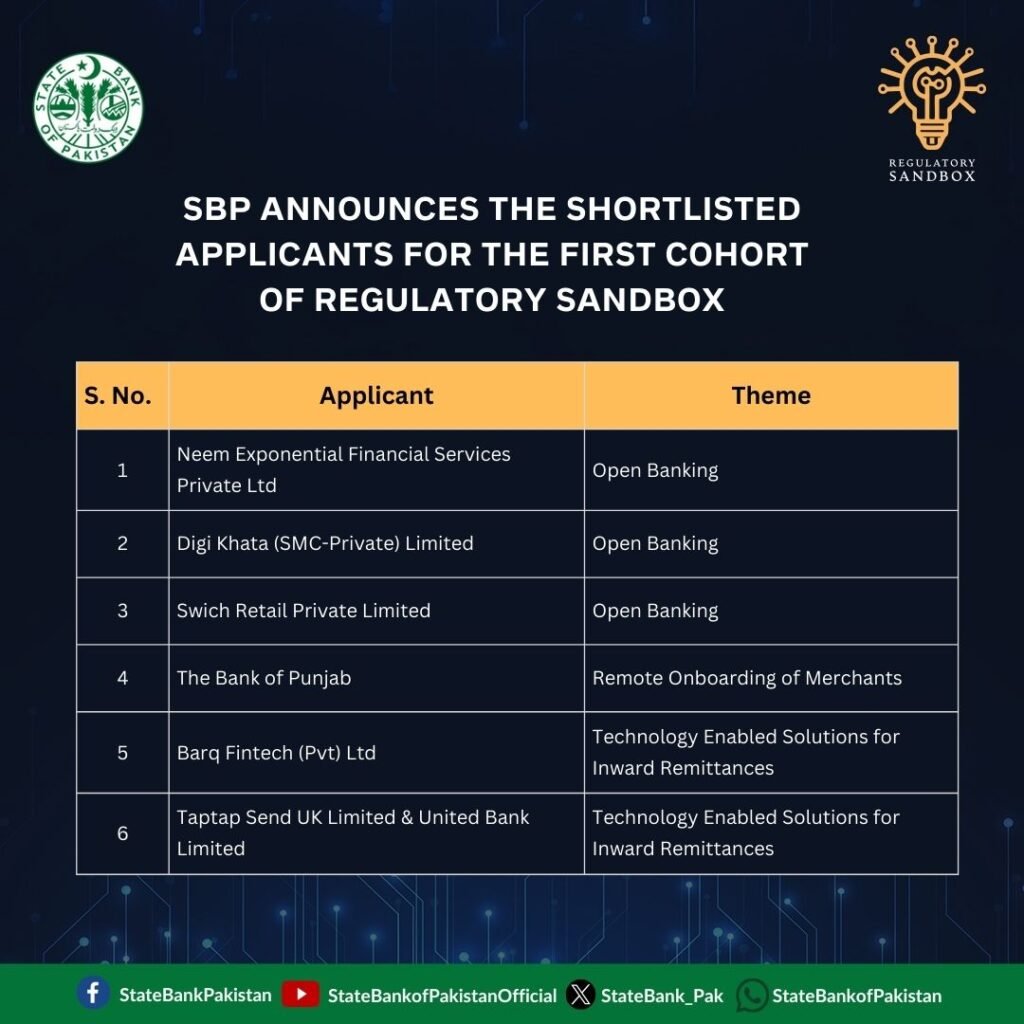
After a rigorous evaluation process, SBP has shortlisted six applicants to test their solutions under the SBP Regulatory Sandbox. To ensure transparency and effective governance, a high-level Steering Committee has been established to oversee the entire process.
Under the open banking theme, three fintech companies were shortlisted: Neem Exponential Financial Services Private Limited, Digi Khata (SMC-Private) Limited, and Swich Retail Private Limited. These firms are expected to develop API-driven platforms that enhance interoperability, financial data access, and customer-centric banking services.
In the remote onboarding of merchants category, The Bank of Punjab was selected, highlighting the growing role of traditional banks in digital transformation and merchant digitization.
For technology-enabled inward remittances, Barq Fintech (Private) Limited and a joint initiative between Taptap Send UK Limited and United Bank Limited were shortlisted. These solutions aim to improve speed, transparency, and cost efficiency in cross-border remittance flows.
Testing Phase Under the SBP Regulatory Sandbox
The shortlisted participants will be allowed to test their proposed solutions in a controlled live environment for up to six months, subject to specific regulatory and operational conditions defined by SBP at the time of approval. This testing phase enables real-world validation while ensuring consumer protection, data security, and systemic stability.
The SBP Regulatory Sandbox framework allows regulators to observe emerging risks early, while innovators receive structured regulatory guidance before scaling their products commercially.
Why the SBP Regulatory Sandbox Matters for Pakistan’s Economy
The SBP Regulatory Sandbox is expected to play a pivotal role in fostering fintech innovation, strengthening digital payments infrastructure, and improving financial inclusion. By enabling collaboration between banks and fintech firms, SBP is laying the groundwork for practical, scalable, and user-centric financial solutions.
As Pakistan continues its transition toward a digital economy, initiatives like the SBP Regulatory Sandbox support innovation without compromising financial stability an approach increasingly adopted by leading central banks globally.
Looking Ahead
SBP anticipates that insights gained from the first cohort will help refine regulatory frameworks, accelerate innovation cycles, and encourage further investment in Pakistan’s fintech ecosystem. The success of the SBP Regulatory Sandbox could pave the way for additional cohorts and broader adoption of next-generation financial technologies.