
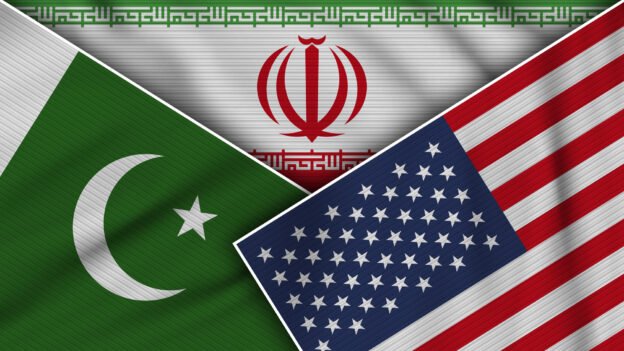
The Pakistan Institute of Development Economics hosted a seminar titled “Economics of War & Interdependencies: Iran, Pakistan, & The Middle East” at its Islamabad campus, bringing together experts to discuss shifting geopolitical dynamics, Pakistan’s peacemaker role, and the link between security, economics, and diplomacy. The session featured Syed Hassan Akbar and Sarah Zaman, and was moderated by Fasi Zaka, focusing on Pakistan’s evolving role in global affairs.
Syed Hassan Akbar highlighted how the traditional divide between security and economic policy has blurred, with geoeconomics now central to global strategy. He pointed to examples like US-China competition and tech disputes to illustrate this shift, noting its reflection in Pakistan’s 2022 National Security Policy. He also discussed the global transition from a unipolar to a multipolar world, warning of prolonged instability but emphasizing opportunities for Pakistan to maintain strategic balance through “no camp politics,” preserving ties with both China and the United States.
In the second half, Sarah Zaman explored the growing influence of media and technology in shaping narratives during conflicts such as Iran and Gaza. She emphasized how social media has transformed information flows, enabling real-time tracking of military developments while also complicating verification and credibility. The ongoing internet restrictions in Iran were cited as an example of how seriously governments now treat digital information spaces.
A key theme of the seminar was Pakistan’s diplomatic repositioning—from a country affected by prolonged conflict to an emerging mediator in the US-Iran dynamic. However, both speakers stressed that diplomacy alone is insufficient without structural economic reform. Zaman noted that Pakistan’s reliance on transit-route diplomacy must evolve into productive economic capacity through investment in industry, workforce development, and population management, cautioning that goodwill alone cannot sustain long-term gains.
The discussion concluded with insights into potential economic benefits of Pakistan’s mediation role, including diversified energy imports, increased interest in critical minerals, support from global financial institutions, and expanded regional connectivity. Opportunities such as transit revenues, energy corridors, and projects like CPEC were highlighted, alongside challenges posed by regional instability and sanctions.
On regional security, both speakers acknowledged that normalization with India remains unlikely in the near term, with immediate focus on conflict prevention. Domestic challenges—including terrorism, regional instability, and political divisions—were also discussed as key policy priorities. The seminar reaffirmed PIDE’s commitment to fostering informed dialogue on Pakistan’s economic and geopolitical trajectory.