
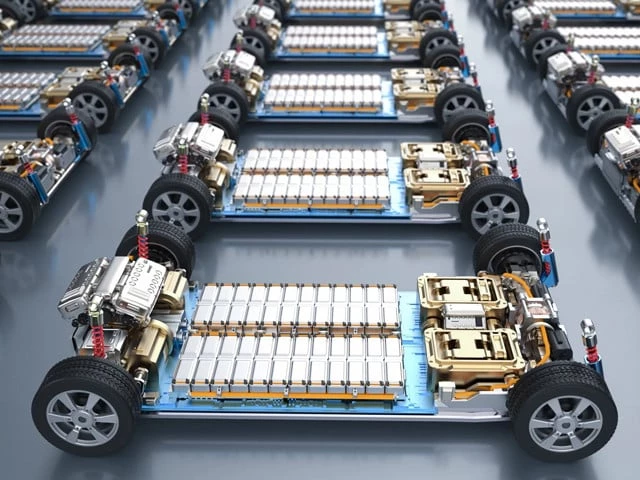
The Ministry of Industries has directed the Pakistan Standards and Quality Control Authority (PSQCA) to develop standards for lithium-ion batteries used in electric vehicles (EVs), as Pakistan moves to strengthen safety and quality requirements for its emerging electric mobility and energy storage industries.
The move comes as the government works with industry stakeholders to finalise the Next Generation Energy Storage Policy 2026-2033. Engineering Development Board (EDB) Chief Executive Hammad Mansoor is expected to present an updated version of the policy at an upcoming stakeholders’ meeting.
A senior official of the Ministry of Industries said PSQCA had been asked to develop the necessary standards while the broader energy storage policy was being prepared.
The initiative aims to establish a regulatory framework for EV-grade batteries, including requirements covering safety, durability, thermal management, battery management systems and performance under Pakistan’s road and weather conditions.
Pakistan Needs EV-Grade Battery Standards
Pakistan currently has no dedicated standards for advanced lithium-ion battery packs designed for four-wheeled electric vehicles.
The official explained that the country mainly has access to basic consumer-grade lithium batteries used in products such as mobile phones and laptops. However, EV battery systems operate at much higher voltages and capacities and require more advanced industrial safety and performance standards.
Electric vehicle battery packs must be capable of handling significant electrical loads while maintaining safety during charging, driving, accidents, extreme temperatures and other demanding conditions.
The government therefore wants PSQCA to establish standards that can be incorporated into the proposed Next Generation Energy Storage Policy.
The standards could also provide clearer requirements for manufacturers, assemblers and importers entering Pakistan’s growing EV market.
EV Industry Seeks Local Battery Manufacturing
Several EV assemblers operating in Pakistan have expressed willingness to work with the Engineering Development Board on establishing facilities for lithium-ion battery assembly or cell manufacturing.
The development of local battery production could support the government’s broader efforts to increase domestic manufacturing and reduce dependence on imported components.
However, officials believe safety standards must be established before the industry expands significantly.
The standards would also apply to imported batteries to ensure that products entering Pakistan meet minimum requirements for safety, durability and performance.
The ministry official said standards were necessary to ensure that imported lithium-ion batteries are safe and durable under local operating conditions.
Battery Safety And Abuse Testing
One of the major components of the proposed framework is Cell Safety and Abuse Testing.
The standards are expected to include extreme stress validation to determine how battery cells behave under potentially dangerous conditions.
The proposed testing framework could require cells to undergo computerised and physical destruction tests, including mechanical crushing, overcharging and thermal abuse.
The objective would be to ensure that batteries do not catch fire or become dangerously unstable when subjected to severe stress.
Such testing is particularly important for EV batteries because damage to individual cells can potentially trigger thermal events that spread across an entire battery pack.
The proposed standards would therefore establish minimum safety requirements before batteries can be used in electric vehicles.
Battery Management Systems Need Regulation
Another key area identified by the ministry is the Battery Management System (BMS).
BMS technology monitors and manages battery cells during charging and operation. It can track parameters such as voltage, temperature and battery condition and intervene when operating conditions become unsafe.
According to the ministry official, Pakistan currently has no dedicated regulations covering BMS technology for EV batteries.
The proposed standards would require smart BMS systems capable of responding rapidly to abnormal voltage conditions.
Microsecond-level cutoffs could be required to protect battery cells from overvoltage and undervoltage conditions. Such problems can contribute to cell swelling and other battery failures.
Establishing BMS requirements would therefore become an important part of the country’s EV battery safety framework.
Thermal Safety And Fire Containment
Pakistan’s climate also creates specific challenges for lithium-ion battery operation.
The proposed standards include requirements for Thermal Defect Logging to ensure batteries remain functional and safe under local temperatures and environmental conditions.
Another important requirement would be a Fire Containment mechanism.
Under the proposed framework, finished battery packs could be required to incorporate materials such as aerogel or fire-retardant epoxy sheets. These materials can help limit heat transfer between battery modules if a single cell experiences a failure.
Containing heat within a damaged section could reduce the risk of thermal propagation and help prevent a single-cell failure from developing into a larger battery fire.
Batteries To Face Pakistan-Specific Durability Tests
The proposed framework would also introduce a Pakistani Road Durability requirement.
Under this standard, battery packs would have to withstand a one-metre drop onto bare concrete without developing structural cracks, leaks or internal damage.
The requirement is intended to ensure that battery packs can withstand the physical stresses associated with Pakistan’s road conditions and vehicle operating environments.
The standards would also address environmental protection.
Battery packs would need suitable dust shields and weatherproofing, including protection against water exposure. This is particularly important in Pakistan because heavy rainfall, flooding and monsoon conditions can expose vehicles and their electrical systems to significant amounts of water.
Water-submersion resistance would therefore be an important consideration for EV battery design.
Policy Could Support Pakistan’s EV Industry
The development of lithium-ion battery standards could provide greater certainty to EV manufacturers, assemblers, importers and potential battery producers.
A clearly defined regulatory framework could help manufacturers understand the technical requirements for selling or producing EV batteries in Pakistan while giving consumers greater confidence in battery safety and reliability.
The initiative also fits into the government’s broader efforts to promote electric mobility and develop domestic energy storage capabilities.
With the Next Generation Energy Storage Policy 2026-2033 under development, battery standards could become a key component of Pakistan’s transition toward electric transportation and cleaner energy technologies.
The final standards will determine how EV-grade batteries are tested, certified and regulated in Pakistan. Their implementation could also influence future investment in local battery assembly and manufacturing.