
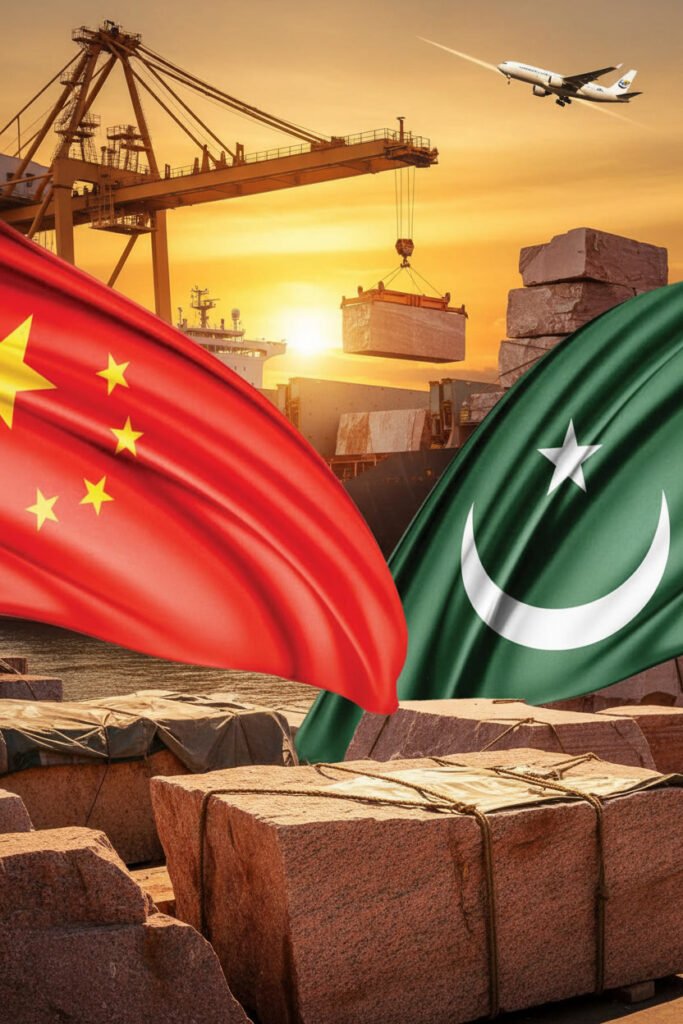
Pakistan is preparing to formally ask China for unilateral tariff concessions on nearly 700 product lines under the proposed third phase of the China Pakistan Free Trade Agreement, as Islamabad pushes for trade parity with ASEAN and African countries already benefiting from preferential Chinese policies.
According to sources cited by Business Recorder, Commerce Minister Jam Kamal and Commerce Secretary Jawad Paul have arrived in Beijing to hold consultations with Chinese officials ahead of Prime Minister Shehbaz Sharif’s expected engagements in China.
Pakistan Pushes for Equal Market Access
Officials say Pakistan wants China to extend the same tariff advantages already granted to ASEAN members and 53 African countries. China introduced unilateral zero tariff access for African states from May 1, 2026, while ASEAN countries continue to receive preferential treatment under various trade arrangements.
Pakistani authorities argue that concessions secured during earlier phases of the CPFTA have gradually lost their effectiveness because of China’s later agreements with competing economies. Islamabad believes Pakistani exporters now face higher tariffs than rivals from Southeast Asia and Africa in several sectors.
Sources said Pakistan has completed a detailed review of Chinese import trends to identify sectors where Pakistani products can compete if tariff barriers are reduced. The proposed list includes around 700 tariff lines covering multiple export categories.
Pakistan China Trade Imbalance Remains a Major Concern
Pakistan’s trade imbalance with China remains one of the country’s biggest economic challenges. During fiscal year 2024–25, Pakistan exported goods worth around USD2.375 billion to China, while imports from China remained close to USD20 billion annually.
Over the past five years, Chinese exports to Pakistan reportedly crossed USD100 billion, whereas Pakistani exports to China stayed near USD10 billion.
Officials say Pakistan’s export basket relies heavily on raw materials such as cotton and copper, which limits export earnings because these products are later re imported into Pakistan as higher value finished goods.
The government now wants to shift toward value added exports in sectors including textiles, minerals, engineering goods, and meat products. Officials estimate that Pakistan’s meat export potential alone could reach USD5 billion if market access improves.
Focus on SPS Protocols and Green Channel Facility
Negotiations under CPFTA Phase III are also focusing on removing non tariff barriers. More than a dozen Sanitary and Phytosanitary protocols and Technical Barriers to Trade agreements have reportedly been signed during the talks.
Pakistan is also seeking additional trade facilitation measures, including the establishment of a “Green Channel” at the Khunjerab Pass border crossing. Officials believe faster customs clearance could help exporters reduce delays and improve supply chain efficiency.
Rice Exports and Long Term Procurement Deals
Pakistan is expected to request special relief for rice exports to China. Officials are likely to seek a waiver of the existing 1 percent import duty on Pakistani rice and request a special quota arrangement similar to the one previously offered by China during 2019 and 2020.
Islamabad will also encourage Chinese state owned enterprises, especially COFCO, to enter long term procurement agreements with Pakistani rice exporters. Authorities believe stable procurement contracts could strengthen export growth and provide certainty to local suppliers.
Visa Facilitation and Investment Demands
Pakistani officials are also expected to request easier visa processing for exporters and businessmen traveling to China. Business groups have repeatedly argued that visa delays restrict market access and weaken trade engagement opportunities.
At the same time, Islamabad wants China to increase investment and joint ventures in export oriented industries located in Pakistan. Officials say sustainable trade balance improvements will only be possible if Chinese companies help build local manufacturing and processing capacity.
CPFTA Phase II Failed to Deliver Expected Results
Pakistan and China have been operating under Phase II of the CPFTA since January 2020. However, officials believe the agreement has not produced the expected export growth for Pakistan.
Bilateral trade reached nearly USD19.4 billion during 2024–25, but Pakistan’s exports remained mostly stagnant at around USD2.37 billion. The trade deficit with China now accounts for almost 59 percent of Pakistan’s total trade gap.
Officials warn that without fresh tariff concessions and equal treatment in the Chinese market, Pakistan may continue struggling to fully benefit from the free trade agreement while China expands economic ties with other regions.