
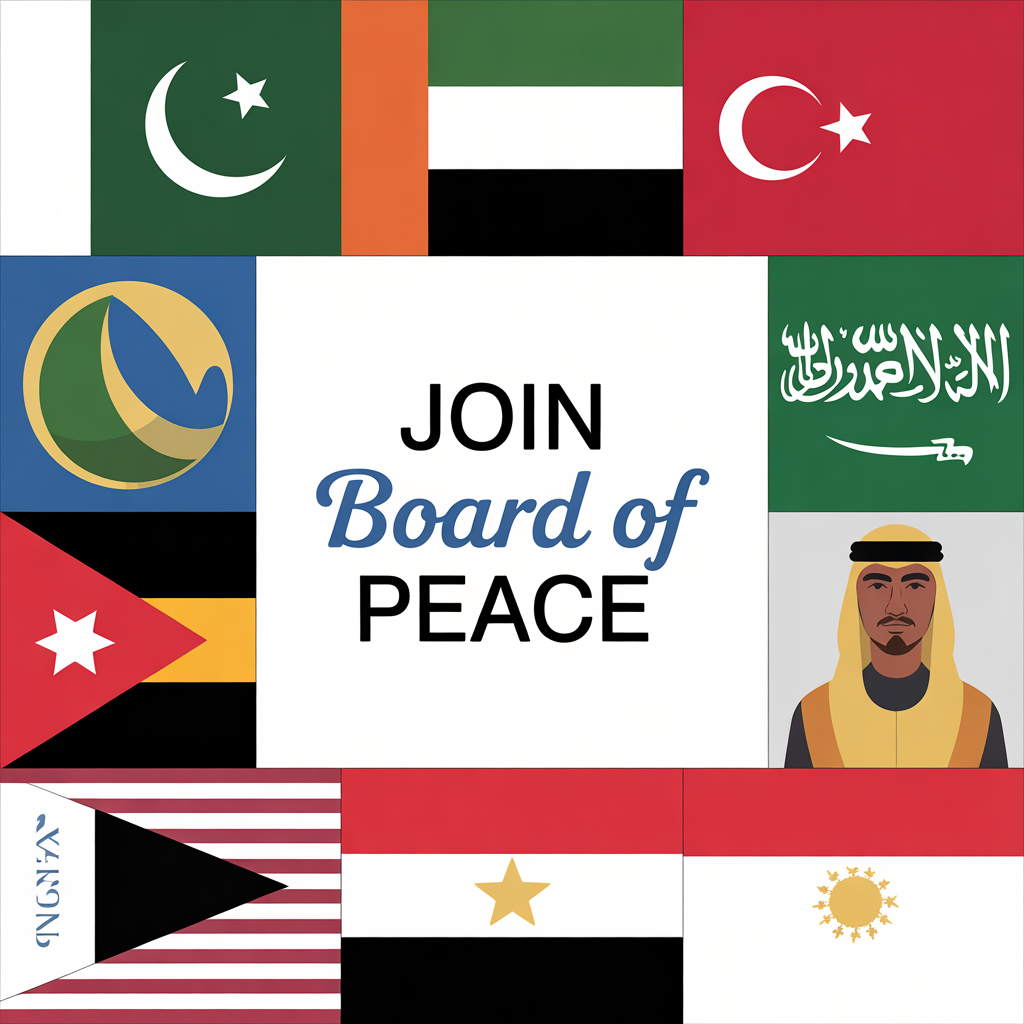
WASHINGTON/DOHA: In a significant diplomatic outreach, President Donald Trump secured commitments from Saudi Arabia, Turkey, Egypt, Jordan, Indonesia, Pakistan, Qatar, and the United Arab Emirates to participate in his newly established “Board of Peace.”
Read More: https://theboardroompk.com/jpmorgan-allen-co-to-earn-180-million-no-matter-who-buys-warner-bros/
Announced January 21, 2026, the advisory group aims to provide counsel on ending regional conflicts and promoting long-term stability across the Middle East and beyond.
Non-Binding Forum with High-Level Representation
Each participating nation will appoint senior diplomats or former leaders to the board. Meetings will focus on Gaza ceasefire sustainability, Lebanon reconstruction, Yemen de-escalation, and measures to contain Iran’s regional activities.
Trump stressed the board would operate independently of the United Nations or existing frameworks, offering “fresh ideas from respected voices.”
Differing National Motivations
Gulf states—Saudi Arabia, UAE, and Qatar—view participation as aligning with their economic diversification and security goals. Egypt and Jordan see it as reinforcing their roles in Palestinian-Israeli mediation.
Türkiye joins despite past friction with Trump, signalling willingness to engage on Syria and broader Muslim-world issues. Indonesia and Pakistan emphasize humanitarian and multilateral dimensions, with Pakistan highlighting nuclear risk reduction in South Asia.
Strategic Context
The initiative follows Trump’s return to office and his stated desire to resolve lingering Middle East conflicts quickly. It builds on the Abraham Accords legacy while attempting to include previously skeptical actors.
Critics note the absence of Iran, Syria, and direct Palestinian Authority representation, raising questions about inclusivity. Supporters argue the board’s non-binding nature allows frank discussion without immediate political costs.
Outlook
The first session is set for mid-February 2026.
Success will depend on follow-through and whether recommendations translate into tangible policy shifts.