
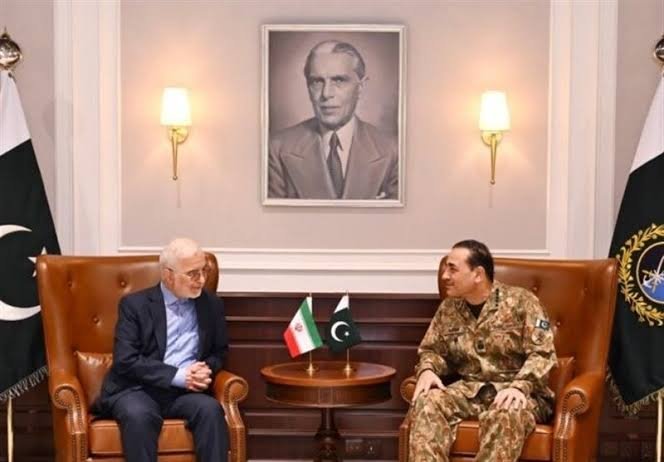
Pakistan and Iran reaffirmed their commitment to strengthening bilateral security cooperation, enhancing border management and promoting regional peace as Iranian Interior Minister Eskandar Momeni held separate meetings with Chief of Defence Forces and Chief of the Army Staff Field Marshal Syed Asim Munir and Prime Minister Shehbaz Sharif during his official visit to Islamabad.
According to the Inter-Services Public Relations (ISPR), Momeni met Field Marshal Asim Munir at the General Headquarters (GHQ) in Rawalpindi, where both sides discussed matters of mutual interest, regional and bilateral security, effective border management and continued cooperation between the two neighbouring countries.
Pakistan And Iran Discuss Border Security And Regional Stability
The military’s media wing said the discussions focused on maintaining peace along the shared border and strengthening coordination to address common security challenges. Both sides also reviewed mechanisms for enhancing cooperation aimed at promoting long-term regional stability.
During the meeting, the visiting Iranian minister appreciated Pakistan’s consistent diplomatic efforts to ease tensions in the region. He acknowledged Islamabad’s role in encouraging dialogue, promoting de-escalation and supporting peaceful solutions to regional disputes.
The ISPR said the meeting concluded with a reaffirmation of both countries’ commitment to maintaining close coordination and strengthening cooperative mechanisms to safeguard regional security while promoting mutual prosperity.
Prime Minister Shehbaz Sharif Reiterates Support For Diplomacy
Earlier in the day, Momeni also called on Prime Minister Shehbaz Sharif at the Prime Minister’s House, where discussions focused on the evolving security situation in the Middle East and expanding Pakistan-Iran relations.
The prime minister expressed deep concern over the latest escalation in the Gulf and reiterated Pakistan’s readiness to play a constructive diplomatic role in reducing tensions between the United States and Iran.
According to an official statement issued by the Prime Minister’s Office, Shehbaz Sharif urged all parties to exercise maximum restraint and avoid actions that could further destabilise the region.
The premier reiterated Pakistan’s commitment to serving as an honest mediator and facilitator, stressing that Islamabad would continue supporting peaceful dialogue and diplomatic engagement to promote regional peace and stability.
Senior members of the federal cabinet attended the meeting, including Deputy Prime Minister Mohammad Ishaq Dar, Interior Minister Syed Mohsin Raza Naqvi, Information Minister Attaullah Tarar, Minister of State for Interior Talal Chaudhry, Adviser to the Prime Minister Dr Syed Tauqir Shah, and other senior government officials.
Iranian Minister Appreciates Pakistan’s Diplomatic Efforts
Prime Minister Shehbaz welcomed the Iranian delegation and recalled his recent visit to Tehran to attend the funeral ceremony of the late Supreme Leader Ayatollah Sayyid Ali Khamenei. He conveyed his best wishes to Iran’s leadership, including President Dr Masoud Pezeshkian and the country’s Supreme Leader.
Momeni thanked the prime minister for the warm reception extended to his delegation and conveyed greetings from the Iranian leadership. He said his visit aimed to strengthen bilateral cooperation and follow up on agreements reached during recent high-level engagements between the two countries.
The Iranian minister also appreciated the diplomatic efforts of Prime Minister Shehbaz Sharif, Deputy Prime Minister Ishaq Dar and Field Marshal Asim Munir in facilitating dialogue that resulted in the Islamabad Memorandum of Understanding (MoU) between the United States and Iran earlier this year. He also thanked the prime minister for travelling to Tehran to attend the funeral of Iran’s late Supreme Leader.
Momeni arrived in Islamabad on Monday night on an official visit and was received by Interior Minister Mohsin Naqvi. He is leading a high-level delegation comprising senior Iranian government officials.
Before meeting the prime minister, the visiting minister was presented with a ceremonial police parade in Islamabad. He also visited the Pakistan Monument, where a Federal Constabulary contingent presented a guard of honour in his honour.
Regional Developments Remain In Focus
His visit comes at a time when Pakistan continues diplomatic efforts to preserve the Islamabad Memorandum of Understanding, which was signed last month in an attempt to end hostilities between the United States and Iran.
However, the security situation has deteriorated again following renewed military exchanges. According to reports, the United States continued strikes inside Iran, while Tehran responded by targeting American radar and air defence installations in the Gulf. Iranian officials have accused Washington of violating the ceasefire agreement, while diplomatic contacts through international mediators reportedly remain ongoing.
The regional conflict has also expanded, with Iran reimposing restrictions in the Strait of Hormuz, prompting countermeasures by the United States. Yemen’s Houthi movement has also announced a maritime embargo targeting Saudi Arabia, adding another dimension to the regional crisis.
Pakistan And Iran Aim To Expand Bilateral Trade
Beyond security and diplomacy, Pakistan and Iran are seeking to significantly expand economic cooperation.
Speaking to Iranian media after arriving in Islamabad, Momeni said both countries are working toward increasing annual bilateral trade from approximately $3 billion to $10 billion. He stressed that achieving this target would require substantial improvements in cross-border transport infrastructure and logistics.
According to remarks carried by Iran’s Mehr News Agency, Momeni said nearly 2,000 trucks or containers would need to cross the Pakistan-Iran border each day to support the proposed trade volume. At present, only about 20 percent of that transport capacity is being utilised.
He said improving border infrastructure, facilitating trade, expanding transport connectivity and implementing agreements reached during President Masoud Pezeshkian’s recent visit would remain key priorities during discussions with Pakistani officials.
Pakistan and Iran also continue discussions on enhancing connectivity between ports, strengthening border trade and reviving the long-delayed Iran-Pakistan gas pipeline, which both sides see as an important project for boosting regional energy cooperation.
Longstanding Bilateral Relations Continue To Grow
Sharing a 900-kilometre border, Pakistan and Iran maintain longstanding historical, cultural and economic ties. While their relationship has occasionally faced challenges due to cross-border militant activity and regional security concerns, both countries continue to emphasise dialogue, cooperation and stronger economic integration as the foundation for long-term regional stability.