
Pakistan is once again facing the economic consequences of rising global energy prices as tensions around the Strait of Hormuz increase concerns about inflation and energy security.
The latest increase in petroleum prices has added pressure on households and businesses. According to the Pakistan Bureau of Statistics (PBS), headline inflation reached 11.7% year-on-year in May 2026, marking the highest level since June 2024.
For millions of Pakistanis, expensive fuel means higher costs for almost everything.
“When petrol becomes expensive, everything becomes expensive,” said Jabbar Khan, a father of nine.
He recalled that a decade ago, his family could buy monthly groceries for Rs12,000 to Rs15,000. Today, even spending up to Rs20,000 only fills a single shopping bag.
Rising Fuel Costs Affect Daily Life
The impact of higher fuel prices has spread beyond transportation.
Research by the Pakistan Institute of Development Economics (PIDE) shows that expensive fuel raises transportation and distribution costs. As a result, businesses increase prices, pushing up the cost of food, consumer goods and essential services.
Many families are struggling to cope.
Saleem Abdullah said earning enough money for basic meals has become increasingly difficult. Transportation expenses now consume a larger share of his daily income.
Similarly, Islamabad-based painter Musa Khan, who earns around Rs25,000 a month, said he faces difficult choices every month.
“I don’t know whether to pay the electricity bill, the gas bill, or manage household expenses,” he said.
Heavy Dependence on Imported Energy Creates Risks
Analysts believe Pakistan’s dependence on imported fuel remains one of its biggest economic vulnerabilities.
Muhammad Faran Khan, Associate Director at KTrade Securities, said around 80% to 85% of Pakistan’s energy imports come from Gulf countries and pass through the Strait of Hormuz.
He noted that higher oil prices have increased the country’s import bill and put additional pressure on foreign exchange reserves.
At the same time, rising transportation, food and housing costs have reduced the purchasing power of ordinary citizens.
Pakistan’s domestic oil and gas production has declined over the years. The country also faces challenges such as circular debt, inadequate fuel reserves and inefficiencies in the energy sector.
Experts say these structural weaknesses continue to expose Pakistan to external shocks.
Solar Power Emerges as a Popular Alternative
As fuel and electricity costs rise, more consumers are turning to renewable energy.
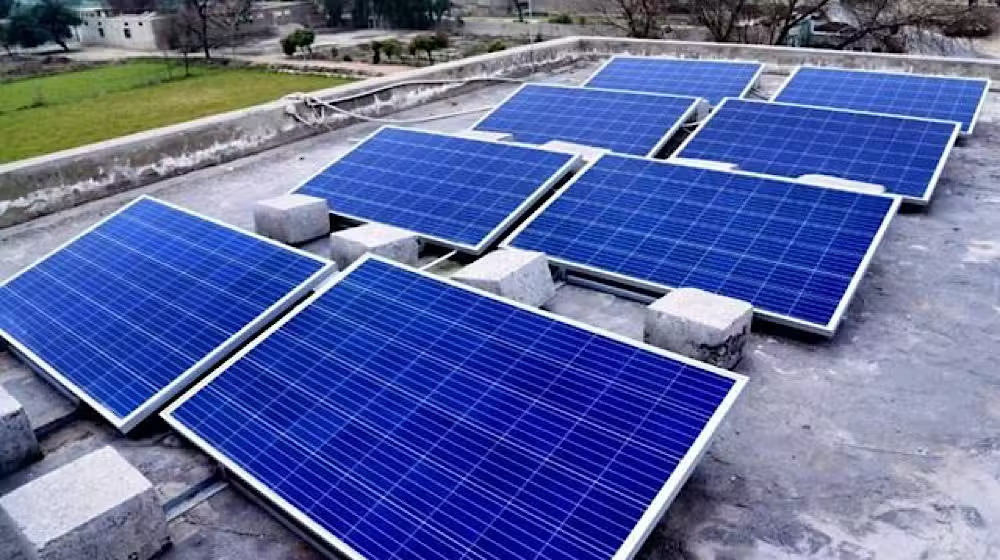
Pakistan has become one of the fastest-growing solar markets in the world. Falling prices of solar equipment, particularly Chinese-made photovoltaic panels, have encouraged households and businesses to install rooftop systems.
According to the Institute for Energy Economics and Financial Analysis (IEEFA), rooftop solar now contributes nearly one-quarter of Pakistan’s electricity supply.
Experts believe expanding solar, wind and hydropower generation can reduce the country’s dependence on imported fuels.
Aslam Shah, who spends a large part of his income on transport and utility bills, sees solar energy as a practical solution.
“Solar feels like a better solution because it becomes your own source of power,” he said.
Business owners are also embracing renewable energy.
Faizan Obaid, an event planner in Islamabad, said transportation and electricity have become major operating costs.
“Solar clearly looks like a much more reasonable option,” he said.
Electric Vehicles Gain Popularity
The search for alternatives is also transforming Pakistan’s automobile sector.
Muhammad Aurangzeb, an Islamabad-based auto electrician, recently converted a Suzuki Mehran into a fully electric vehicle capable of travelling more than 220 kilometres on a single charge.
“With petrol becoming so expensive, EVs are now the only practical alternative for many people,” he said.
Mechanic Shakeel Ahmad, who has more than 20 years of experience, said customer preferences have changed significantly.
“People are now moving away from large-engine vehicles and searching for EVs and hybrid cars,” he said.
China Cooperation Could Accelerate Transition
Analysts believe growing cooperation with China could help Pakistan speed up its transition towards electric mobility.
Chinese automakers and battery manufacturers are increasing their presence in Pakistan through assembly projects and technology partnerships.
Experts say local manufacturing could lower prices, create jobs and strengthen the country’s automotive industry.
Muhammad Faran Khan said even limited transfer of Chinese manufacturing capacity could provide major economic benefits.
Energy Security Becomes a Household Priority
The latest fuel-price surge highlights how global events continue to affect Pakistan’s economy and daily life.
As inflation rises and imported energy becomes more expensive, many Pakistanis are taking energy security into their own hands.
From rooftop solar systems to electric vehicles, ordinary citizens are increasingly looking for ways to reduce dependence on costly imported fuels and protect themselves from future energy shocks.