
The overseas Pakistanis economy is no longer just a support system it is fast emerging as the central pillar of Pakistan’s financial stability, global credibility, and future growth. From record-breaking remittances to rising global demand for Pakistani talent, the economic footprint of overseas Pakistanis is reshaping national priorities.
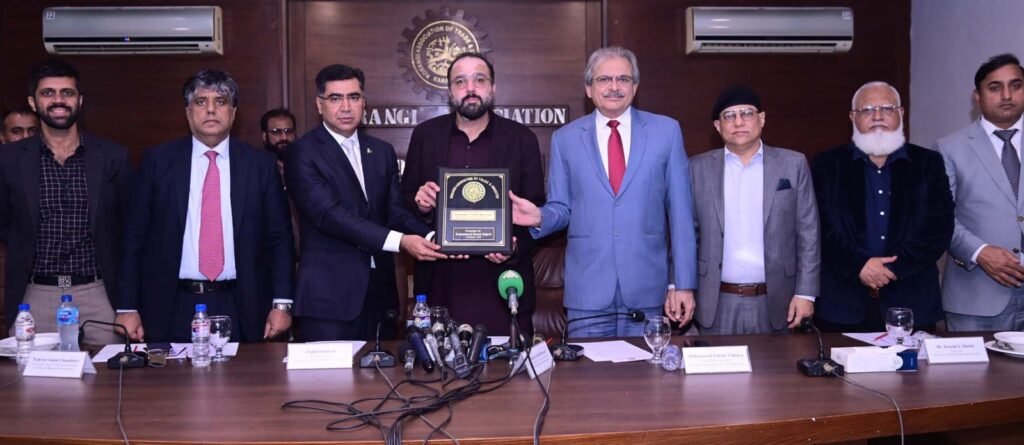
This powerful message was reinforced during a high-level engagement between the Federal Minister for Overseas Pakistanis and Human Resource Development, Chaudhry Salik Hussain, and Pakistan’s industrial leadership at the Korangi Association of Trade and Industry (KATI) in Karachi.
Overseas Pakistanis Economy and Government Reforms
Speaking to industrialists, Chaudhry Salik Hussain described overseas Pakistanis as the backbone of the national economy, stressing that the government is actively rolling out reforms to protect both overseas workers and local industry.
One of the most significant developments is the complete digitalisation of institutions such as EOBI, aimed at ending physical notices, surprise inspections, and unnecessary harassment of businesses. According to the minister, industrialists will now experience facilitation instead of fear, a shift designed to rebuild trust and improve compliance.
He further emphasized that the Federal Board of Revenue (FBR) must evolve from a rigid revenue collector into a business-friendly, facilitative institution that encourages voluntary participation and expands the tax base organically.
How Overseas Pakistanis Economy Stabilises Pakistan
Acting President KATI Zahid Hameed highlighted the sheer scale of overseas Pakistanis’ contribution. More than nine million Pakistanis living abroad send approximately $38 billion annually, providing crucial support to:
• Foreign exchange reserves
• Current account stability
• National currency strength
• Economic resilience during global shocks
He called overseas Pakistanis the true ambassadors of Pakistan, noting that improved certification and skill development could unlock billions of dollars in additional remittances by moving workers into higher-paying roles.
Skills, Jobs, and the Future of Overseas Pakistanis Economy
A key pillar of strengthening the overseas Pakistanis economy lies in skills transformation. The government plans to send 800,000 Pakistanis abroad for employment this year, driven by rising demand in GCC countries, Korea, and Japan.
Pakistan is launching soft-skills and technical training programmes in collaboration with international partners. A landmark reform announced during the event was the reduction in minimum age for women seeking overseas employment from 35 to 25 years, enabling longer careers, higher earnings, and increased remittance flows.
To illustrate the earning potential, the minister revealed that Pakistani workers in Korea remit an average of $1,800 per month, underscoring the value of targeted skill development.
Overseas Pakistanis Economy and Industrial Confidence
Acting Patron-in-Chief KATI Zubair Chhaya drew attention to challenges undermining industrial confidence. Repeated audit notices, rigid tax enforcement, and high energy costs have discouraged investment and expansion.
He pointed out that Korangi industrial area alone generates $3 billion in exports, proving that Pakistan’s industrial engine is capable of driving growth if properly supported. He urged policymakers to facilitate industrial contributors rather than penalize them, especially when competing economies offer lower costs and smoother regulatory environments.
Public-Private Partnerships: A Growth Multiplier
Former KATI President Masood Naqi reinforced the need for structured collaboration between government and industry. He noted that Korangi unmatched in revenue generation and employment, and already provides internationally competitive workforce training.
He called for reforms within EOBI, resolution of pending court cases through consultation, and a modern governance structure to restore confidence. According to Naqi, effective mechanisms and skilled trainers already exist—what’s needed is alignment and trust.
A National Opportunity Waiting to Be Unlocked
Concluding the engagement, Chaudhry Salik Hussain invited industrialists to Islamabad, reaffirming the government’s commitment to dialogue, partnership, and actionable reforms.
The message was clear:
The overseas Pakistanis economy is not just sustaining Pakistan it is positioning the country for a stronger, smarter, and more competitive future.