
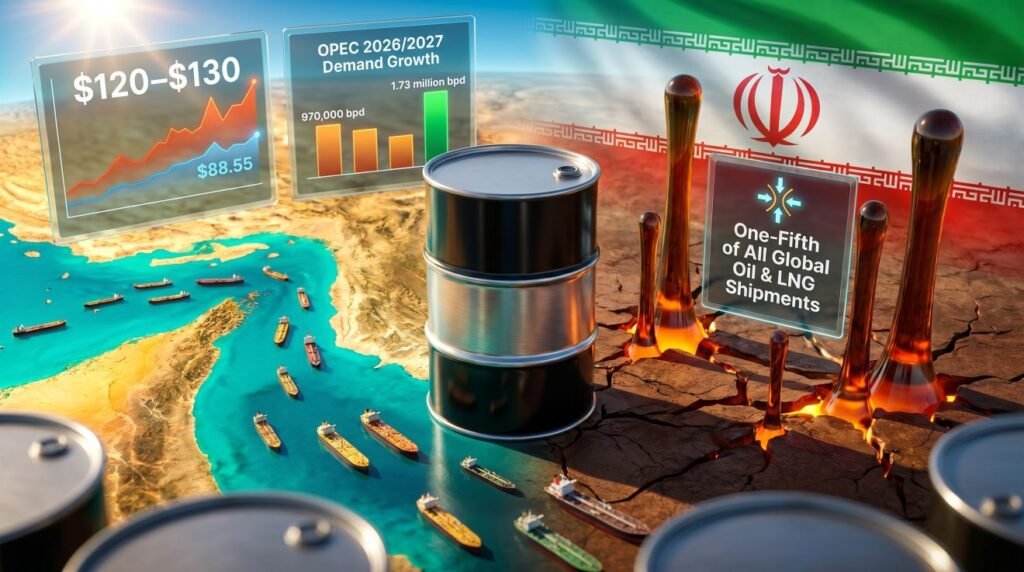
Oil Prices Climb 1% on Tuesday as investors reassessed geopolitical risks in the Middle East following a sharp decline in the previous trading session. Concerns over potential disruptions to global energy supplies and uncertainty surrounding negotiations between the United States and Iran continued to support the market.
Oil Prices Recover After Sharp Decline
Traders remained cautious despite comments from US President Donald Trump, who indicated that Washington was delaying further military action against Iran while diplomatic efforts continued.
Brent crude futures for the front month rose by $1.12, or 1.3%, to $84.89 per barrel by 0355 GMT. The benchmark had fallen about 7% during the previous session, reaching its lowest level in three weeks.
Meanwhile, US West Texas Intermediate (WTI) crude futures climbed by 77 cents, or nearly 1%, to $81.11 per barrel after recording losses of more than 5% a day earlier.
The earlier decline in prices followed remarks by President Trump, who said the United States was temporarily postponing further attacks on Iran while discussions aimed at ending the conflict continued.
However, sentiment shifted once again after Iranian officials denied that any negotiations with Washington were underway.
Iranian Foreign Ministry spokesman Esmail Baghaei dismissed claims that talks were taking place, saying no meetings between the two sides had been scheduled. His remarks reinforced fears that regional tensions could intensify and disrupt global oil supplies.
Strait Of Hormuz Remains A Key Risk
The Strait of Hormuz remains at the centre of the dispute. The strategic waterway is one of the world’s most important energy routes, connecting oil-producing countries in the Gulf region with international markets.
Before the conflict escalated, nearly 20% of the world’s crude oil and liquefied natural gas shipments passed through the narrow passage, highlighting its significance to the global economy.
Analysts at ING said the market reaction may have been excessive, given the continued uncertainty surrounding the conflict.
“The scale of the sell-off seems fairly overdone, given that there’s still considerable uncertainty,” the analysts said in a research note.
They also pointed to Iran’s denial of negotiations and warnings from Washington that additional action could be taken if no agreement is reached.
Another point of contention involves the future status of the Strait of Hormuz. US officials have argued that an agreement reached in June required Iran to ensure unrestricted access to the shipping route, while Tehran insists that the deal preserved its authority over the waterway.
Analysts at Barclays reported that exports of crude oil and refined petroleum products passing through the strait averaged 4.2 million barrels per day during the week ending July 31, compared with 3.2 million barrels per day a week earlier.
Shipping Companies Adapt To Heightened Risks
Shipping companies are also adapting to the heightened risks in the region.
Recent shipping data showed that six Saudi-flagged supertankers altered their routes in the Gulf of Aden and chose longer journeys around southern Africa. At the same time, two tankers carrying Saudi crude oil successfully passed through the Bab el-Mandeb Strait.
Although vessel traffic through the Strait of Hormuz and the Bab el-Mandeb Strait remained relatively stable at the beginning of the week, risks to shipping operations persist.
Security concerns increased after the United Kingdom Maritime Trade Operations agency reported an incident involving a cargo vessel near Oman’s Al Khasab region. According to the report, the vessel informed authorities that it had been struck by an unidentified projectile.
Market Analysts See Continued Volatility
Market analysts believe that geopolitical developments will continue to influence oil prices in the coming weeks.
Tim Waterer, chief market analyst at KCM Trade, said ongoing regional tensions have increased insurance costs, extended shipping times and forced some vessels to adopt alternative routes.
He added that the security risks associated with the Strait of Hormuz and the Bab el-Mandeb Strait continue to support market prices by raising concerns about the stability of future energy supplies.
As uncertainty continues to dominate the market, investors are expected to closely monitor diplomatic developments and shipping activity across some of the world’s most strategically important waterways.