
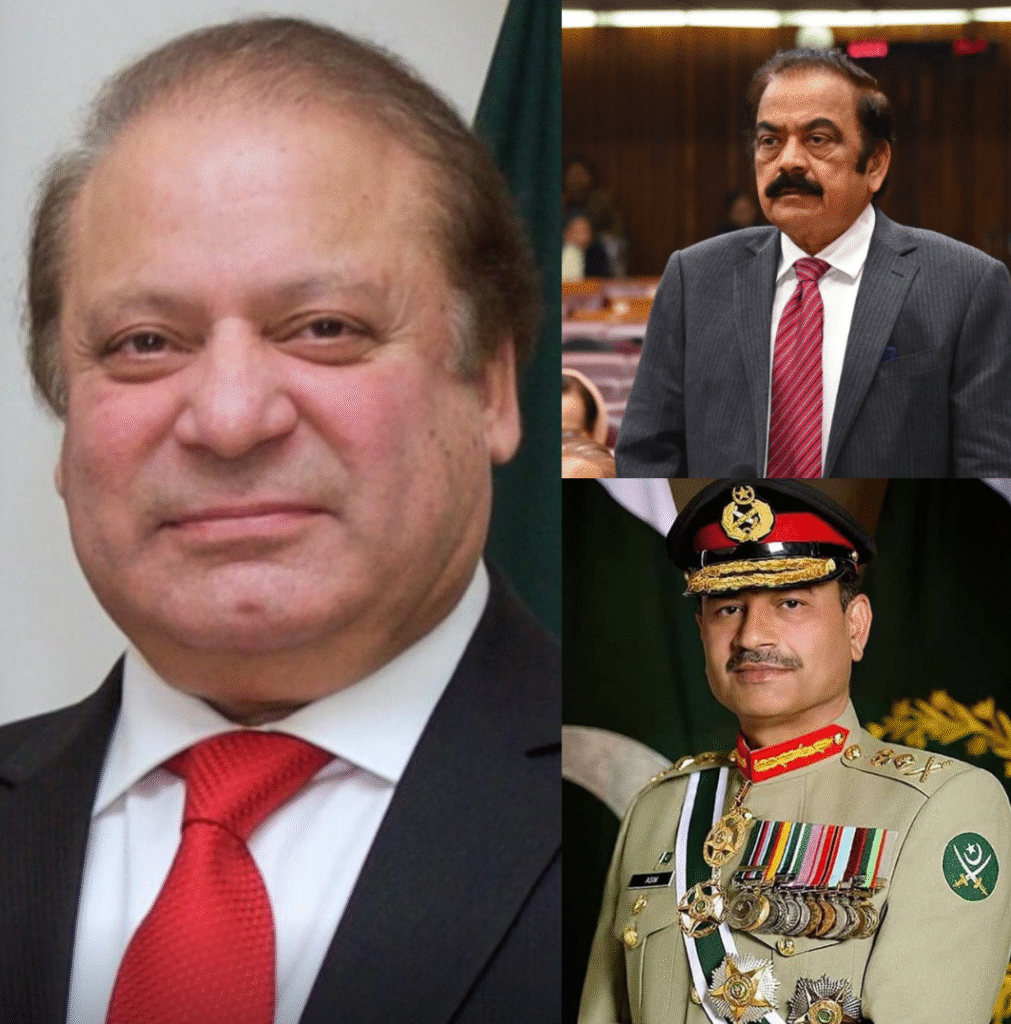
ISLAMABAD: Two days after Chief of Army Staff and Field Martial General Syed Asim Munir completed his three-year tenure on 29 November, the federal government has yet to issue the crucial notification appointing the country’s first Chief of Defence Forces (CDF) – a powerful new position created through the recently passed 27th Constitutional Amendment.
The unusual silence has triggered intense political speculation and a flurry of social-media theories ranging from behind-the-scenes power struggles to alleged London-based vetoes.
Speaking to reporters outside Parliament House on Monday evening, Adviser to the Prime Minister on Political and Public Affairs Rana Sanaullah attempted to douse the fire, insisting that the delay was purely procedural and that the notification would be issued immediately upon Prime Minister Shehbaz Sharif’s return from abroad.
“The Prime Minister is returning in a day or so. The moment he lands, the matter will move forward,” Sanaullah said, refusing to give an exact date for either the PM’s arrival or the notification. By late Monday night, Mr Sharif had still not returned to Pakistan.
He emphasised that the government was following a strict constitutional sequence. “First comes the Constitution, then the law, and then the rules. We are taking every step with complete care and precision. There is no question of bypassing procedure,” he maintained.
Under the 27th Amendment, the CDF will serve as the senior-most uniformed officer above the three service chiefs and will enjoy a fixed five-year term – significantly longer than the three-year tenure of individual service chiefs. The amendment also grants the CDF authority over joint strategic planning and operational command in certain scenarios.
Although no official shortlist has been released, senior government and military sources confirm that the incumbent COAS, Gen Asim Munir, remains the overwhelming favourite to be elevated to the new post. If appointed, his current role would automatically merge into the CDF position, effectively extending his tenure until November 2030.
Sanaullah acknowledged that “multiple options” were under consideration but stressed that “until the final decision is taken, no notification can be issued.” He added that the CDF’s term would officially commence only from the date of the notification – a clause that has added legal complexity to the timing.
The adviser categorically rejected rumours that PML-N supremo Nawaz Sharif, currently in London for medical treatment, had raised objections to Gen Munir’s elevation. “This impression is 100 percent incorrect,” Sanaullah declared. “Mian Nawaz Sharif has never expressed any reservation on the subject of the CDF. Whatever statements are being attributed to him have either been taken out of context or are completely fabricated.”
The controversy has been amplified by the opposition Pakistan Tehreek-e-Insaf (PTI), which has accused the government of deliberately creating constitutional uncertainty to retain undue civilian influence over the military high command.
In a related development, Rana Sanaullah disclosed details of a tense closed-door meeting held earlier in the day with a PTI delegation in the National Assembly Speaker’s chamber. The opposition lawmakers had demanded immediate facilitation for party leaders to meet imprisoned former prime minister Imran Khan in Adiala Jail.
According to Sanaullah, the government side requested the delegation to wait until Prime Minister Shehbaz Sharif’s return so that a “structured and sustainable” arrangement could be finalised. However, within hours of the meeting’s conclusion, Khyber Pakhtunkhwa Chief Minister Sohail Afridi issued what Sanaullah described as an open threat.
“Immediately after they left, a threat was received from the KP chief minister,” Sanaullah claimed. “In such an environment of intimidation and disruptive behaviour, no jail meeting can be permitted.”
PTI spokespersons rejected the accusation, calling it another attempt to deflect attention from the CDF controversy and the government’s alleged unwillingness to allow Imran Khan access to his lawyers and party leadership.
Meanwhile, diplomatic circles in Islamabad are watching the situation with keen interest. Several friendly countries that maintain close defence ties with Pakistan have privately expressed hope for a swift and smooth transition, underscoring Gen Munir’s personal rapport with key international partners, particularly in the Gulf and Washington.
Within military circles, junior and mid-level officers have largely remained silent in public, but off-the-record conversations reveal a strong preference for continuity under Gen Munir rather than the uncertainty of a last-minute outsider appointment, according to media reports.
Legal experts point out that, technically, Gen Munir continues to discharge duties as COAS even after 29 November because no successor has been named and the CDF notification remains pending – a situation made possible by the transitional clauses inserted in the 27th Amendment.
Political analysts believe the government deliberately scheduled the amendment’s final passage and enforcement in such a way that the CDF decision would fall during Prime Minister Shehbaz Sharif’s physical presence in the country, allowing him to personally oversee the sensitive transition rather than handling it remotely.
As Monday drew to a close, the Prime Minister’s Office issued no official itinerary for Mr Sharif’s return, and the Defence Ministry remained silent on the CDF file. With each passing hour, the political temperature continued to rise.
PTI announced countrywide protests for Tuesday, demanding “immediate restoration of constitutional order” and the issuance of the CDF notification without further delay. Concurrently, PML-N loyalists began circulating messages urging patience and trust in the leadership’s judgment.
For now, Pakistan finds itself in an extraordinary interregnum: its most powerful military office is technically vacant, yet fully functional; its most powerful new constitutional post remains unfilled; and the entire nation awaits a single notification that will shape civil-military relations for the next half-decade.
Until Prime Minister Shehbaz Sharif boards his flight home – whenever that may be – the speculation, the protests, and the behind-the-scenes manoeuvring are likely to intensify rather than subside.