
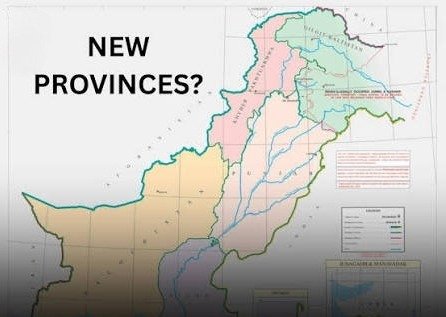
Pakistan’s latest New Provinces Debate has rapidly emerged as one of the country’s most contentious political issues, exposing deep divisions between the federal government, provincial leadership, legal institutions, and opposition parties.
What began as a discussion on improving governance has evolved into a wider constitutional and political controversy, with critics warning that proposals to alter provincial boundaries could undermine federal harmony if pursued without broad consensus.
New Provinces Debate Faces Strong Opposition from Sindh
Sindh Chief Minister Syed Murad Ali Shah has firmly rejected proposals to create new provinces, describing the idea as an old political narrative that has repeatedly failed to gain public support in Sindh.
Speaking to journalists, Murad Ali Shah questioned claims that Pakistan’s existing governance framework had collapsed. He noted that the country continues to function under a democratic system where different political parties govern various provinces while coalition governments operate where necessary.
He argued that if weaknesses exist within the governance system, policymakers should focus on practical constitutional reforms rather than reviving proposals that have historically generated political controversy.
The chief minister also made it clear that Sindh would oppose any attempt to redraw provincial boundaries under the banner of administrative reform.
PPP Says Parliament Must Lead Constitutional Reforms
Senior leaders of the Pakistan Peoples Party (PPP) stressed that any discussion regarding changes to Pakistan’s governance structure must take place through Parliament rather than through public statements or media debates.
Party representatives said constitutional amendments require political consensus and parliamentary approval. They maintained that elected institutions—not individual ministers—should determine whether governance reforms are necessary.
PPP leaders also urged Prime Minister Shehbaz Sharif to consult coalition partners before initiating discussions on matters carrying major constitutional and political implications.
Legal Community Raises Constitutional Concerns
The controversy widened after the Lahore High Court Bar Association criticised suggestions regarding changes to Pakistan’s governance framework.
The association argued that national stability depends on adherence to the Constitution, judicial independence, and the rule of law rather than experiments with alternative governance models.
Legal experts also questioned the timing of the debate, arguing that Pakistan is already facing political uncertainty, institutional challenges, and governance issues that require constitutional strengthening instead of potentially divisive proposals.
Awami Tehreek Demands Interior Minister’s Resignation
Political opposition intensified after Awami Tehreek accused the federal government of indirectly promoting the division of Sindh through proposals to establish new provinces.
The party demanded the resignation of the interior minister, alleging that the proposal serves political interests rather than genuine governance reform.
Its leadership argued that any move affecting provincial boundaries without broad public consultation could weaken federal unity and create unnecessary political confrontation at a time when Pakistan is already confronting significant economic and governance challenges.
Governance Reform Requires Broad Constitutional Consensus
The New Provinces Debate raises an important policy question: can administrative restructuring improve governance, or are Pakistan’s deeper institutional challenges rooted elsewhere?
Creating new provinces would require constitutional amendments, political consensus, financial planning, administrative restructuring, and broad public support. These are complex processes that cannot be achieved through political statements alone.
Many analysts argue that Pakistan’s governance challenges stem less from provincial boundaries and more from institutional capacity, bureaucratic inefficiencies, inconsistent policy implementation, and political polarisation. Without addressing these structural issues, creating additional provinces may increase administrative costs without significantly improving public service delivery.
Political Consensus Will Determine the Future of the Debate
The New Provinces Debate has once again highlighted the sensitivity of constitutional reforms in Pakistan. While supporters view administrative restructuring as a possible route to improved governance, opponents argue that such proposals risk creating fresh political divisions unless pursued through constitutional procedures and broad national consensus. Whether the discussion evolves into formal legislative reform or fades as another political controversy will depend on the willingness of political stakeholders to engage in constructive dialogue through Parliament.