
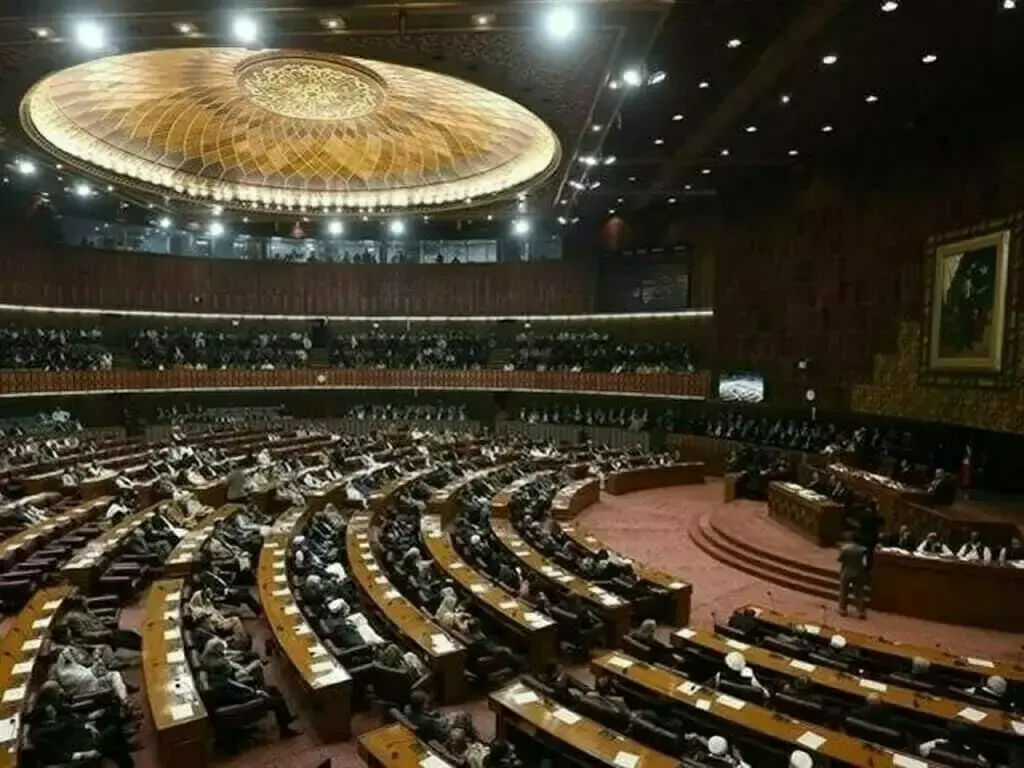
Pakistan’s National Assembly on Wednesday approved several important economic and financial reform bills aimed at improving fiscal discipline, strengthening debt management, promoting exports, and modernising the country’s financial system.
The lower house of parliament passed the Fiscal Responsibility and Debt Limitation (Amendment) Bill, 2026, the Export-Import Bank of Pakistan (Amendment) Bill, 2026, the Special Economic Zones (Amendment) Bill, 2026, and the Netting of Financial Arrangements Bill, 2026.
The bills received majority support during the National Assembly session.
State Minister for Finance Bilal Azhar Kiani presented the four economic bills before the House. Meanwhile, Federal Minister for National Health Services Syed Mustafa Kamal tabled the Pakistan Nursing and Midwifery Council Bill, 2026, while Federal Minister for Housing and Works Riaz Hussain Pirzada introduced the Islamabad Capital Territory Condominium (Ownership and Management) Bill, 2026.
The House also introduced the Pakistan Air Safety Investigation Amendment Bill 2026 and the Customs Amendment Bill 2026 for further consideration.
Fiscal Responsibility Bill Focuses on Debt Management
The Fiscal Responsibility and Debt Limitation (Amendment) Bill, 2026 seeks to strengthen Pakistan’s debt management framework and improve fiscal oversight.
According to the statement of objects and reasons attached to the bill, the existing Fiscal Responsibility and Debt Limitation Act, 2005 already provides a framework for reducing the federal fiscal deficit and maintaining public debt at a prudent level in relation to the country’s Gross Domestic Product (GDP).
The amendment aims to further strengthen the Debt Management Office (DMO), which plays a critical role in supporting the government’s debt management operations.
Officials said the proposed changes will provide the DMO with additional resources and authority to improve planning, coordination, and execution of public debt management functions.
Under Clause 2 of the amendment bill, the Director General and Directors of the DMO will be appointed on a contract basis for three years. Their contracts may be extended after performance evaluations. The appointments will depend on prescribed academic qualifications, professional expertise, and relevant experience.
The government believes the move will improve institutional efficiency and create a more professional debt management structure.
EXIM Bank Amendment Aims to Improve Governance
Lawmakers also approved the Export-Import Bank of Pakistan (Amendment) Bill, 2026 to improve governance standards and operational efficiency at the state-owned financial institution.
The amendment seeks to align the operations of the Export-Import Bank with the broader legal and regulatory framework governing state-owned enterprises in Pakistan.
According to the official statement attached to the bill, the reforms are designed to ensure transparency, accountability, and sound corporate governance practices.
The government said the changes will strengthen the bank’s compliance with the State-Owned Enterprises (SOE) Act while supporting broader national economic and trade objectives.
Officials believe improved governance at the EXIM Bank could help facilitate exports, encourage investment, and support Pakistan’s external trade sector.
Financial Sector Reforms Through Netting Law
The National Assembly also passed the Netting of Financial Arrangements Bill, 2026, which seeks to reduce risks in Pakistan’s growing financial markets.
The government stated that Pakistan’s financial sector has evolved significantly over the years with the introduction of new financial products and increased exposure among banks and financial institutions.
The bill aims to provide legal clarity for netting arrangements used by banks and financial counterparties to reduce credit and settlement risks.
Netting arrangements allow financial institutions to offset mutual obligations and exposures under financial contracts. These mechanisms help institutions optimise regulatory capital and improve financial stability.
The statement of objects and reasons noted that such arrangements are already commonly used globally through privately negotiated agreements and international standards like International Swaps and Derivatives Association (ISDA) Master Agreements.
However, uncertainty regarding the enforceability of these arrangements during bankruptcy, insolvency, or termination events has limited the growth of Pakistan’s domestic financial markets.
The new legislation aims to remove those legal ambiguities and encourage both local and international financial counterparties to engage more confidently in Pakistan’s financial sector.
Government Pushes Broader Economic Reforms
The passage of these bills reflects the government’s broader efforts to strengthen economic governance and modernise Pakistan’s fiscal and financial systems amid ongoing economic challenges.
Analysts say the reforms could improve investor confidence, enhance institutional transparency, and support long-term financial stability if implemented effectively.
The government has increasingly focused on fiscal reforms, debt sustainability, export promotion, and regulatory improvements as part of its wider economic agenda.