
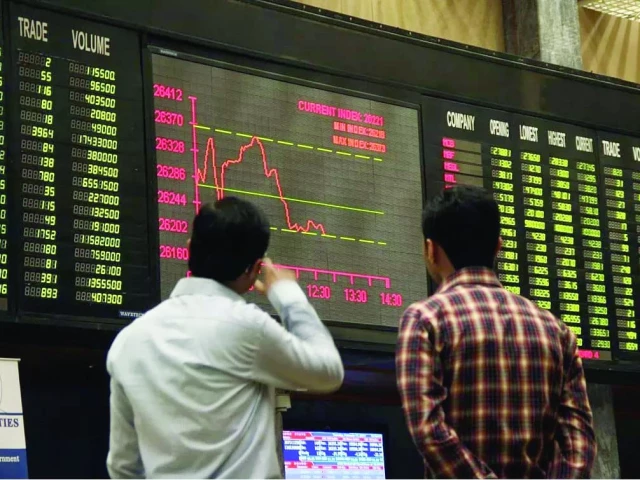
The KSE-100 Index Rebound unfolded dramatically on Friday, turning early market jitters into a powerful rally that reignited investor confidence at the Pakistan Stock Exchange (PSX).
After days of turbulence, investors rushed in at market open to grab blue-chip stocks at what many saw as discounted valuations. The result? A rollercoaster trading session that kept traders glued to their screens.
The benchmark index surged to an intraday high of 174,148 points before profit-taking pulled it down to 169,592 points. By closing bell, however, the market had staged a firm recovery, settling at 173,169 points up 999 points or 0.58 percent.
Total trading volume reached 245 million shares, signaling renewed participation despite global uncertainty.
What Triggered the KSE-100 Index Rebound?
The KSE-100 Index Rebound wasn’t driven by domestic factors alone. Global developments added fuel to the market’s volatility.
Oil prices jumped sharply amid escalating tensions between the United States and Iran.
US President Donald Trump warned that Tehran had only 10 to 15 days to reach a nuclear deal, while Washington reportedly deployed its largest military buildup in the Middle East since 2003. Reports of a potential limited strike kept global investors on edge and energy-linked stocks highly active.
For Pakistan’s market, higher oil prices often create a dual impact: boosting exploration companies while raising concerns over import costs. This push-and-pull dynamic was clearly visible during Friday’s session.
Sector Winners and Losers in the KSE-100 Index Rebound
The strength of the KSE-100 Index Rebound was uneven across sectors, reflecting selective investor optimism.
The Oil & Gas Exploration sector provided the biggest boost, contributing over 333 index points. Cement followed closely, adding nearly 191 points as investors bet on infrastructure and construction momentum. Technology, Commercial Banks, and Pharmaceuticals also supported the rally.
Major companies that lifted the index included OGDC, MLCF, PPL, SYS, and FFC — collectively adding significant upward momentum.
However, not all sectors participated in the rebound. Automobile Assemblers, Insurance, Chemicals, and Leather stocks faced pressure, highlighting lingering caution in consumer and cyclical segments.
Market Breadth: A Mixed Picture Beneath the Rally
Out of 100 index companies, 58 closed in positive territory, 40 declined, and 2 remained unchanged.
In the broader market, the All-Share Index gained 476 points to close above 103,952. Yet overall activity cooled compared to the previous session. Total market volume fell to 537 million shares from over 905 million earlier, while traded value declined to Rs23.79 billion a drop of nearly Rs24 billion.
Among the most actively traded stocks were K-Electric (over 73 million shares traded), WorldCall Telecom, Bank of Punjab, and Pakistan Telecommunication Company Limited (PTC). The heavy volumes in power and telecom stocks suggest retail investors remain highly engaged.
Fiscal Year Performance: A Bigger Picture
The KSE-100 Index Rebound is not an isolated event. During the current fiscal year, the benchmark has surged by 47,542 points an impressive 37.84 percent gain. However, calendar year growth has been more modest at 1.42 percent so far.
This divergence highlights how quickly sentiment can shift depending on macroeconomic developments, political signals, and global risk factors.
What Should Investors Watch Next?
The sustainability of this KSE-100 Index Rebound will largely depend on global oil trends, geopolitical developments, and domestic economic policy direction.
If tensions ease and oil stabilizes, Pakistan’s equity market could see further upside. But if geopolitical risks intensify, volatility may return just as swiftly.
For now, one thing is clear: Friday’s session proved that when opportunity knocks, investors at the Pakistan Stock Exchange respond fast and decisively.