
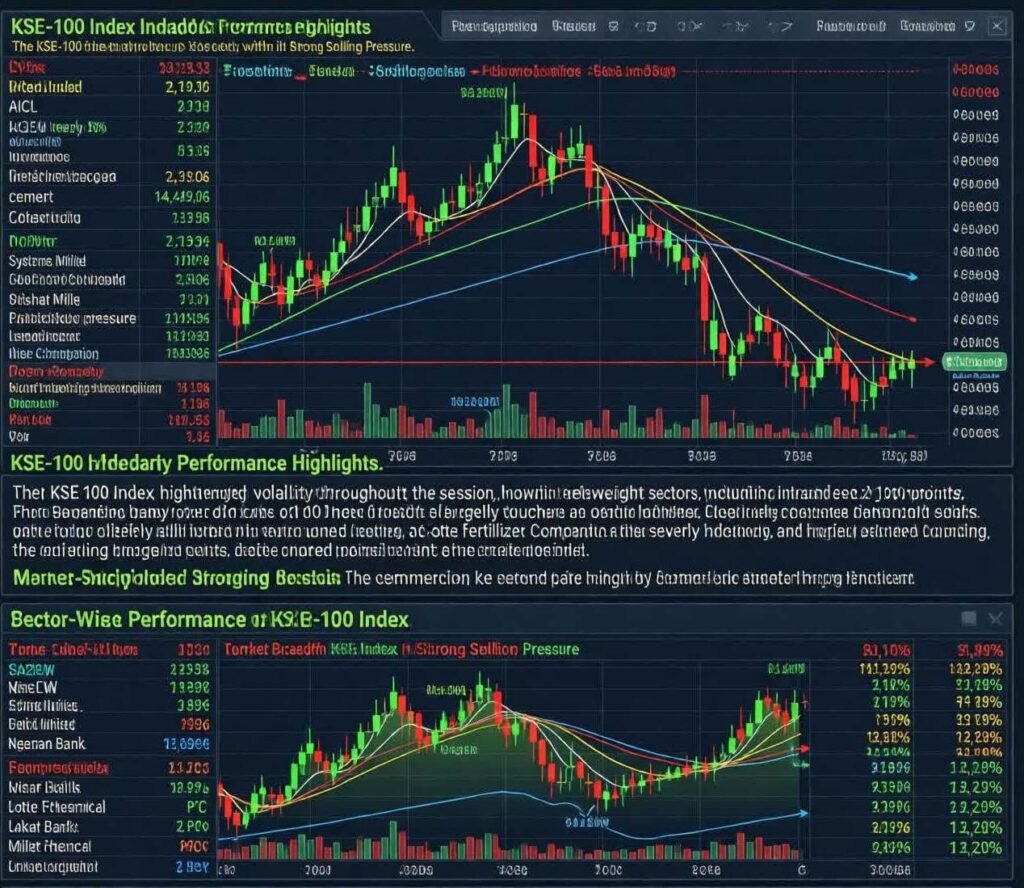
KSE-100 Index Performance weakened during Wednesday’s trading session as sustained selling pressure across key sectors pushed the benchmark index lower, despite selective gains in oil and gas exploration stocks. The Pakistan Stock Exchange (PSX) witnessed heightened volatility, reflecting cautious investor sentiment and sector-specific headwinds.
The benchmark KSE-100 Index closed at 182,569.81 points, marking a decline of 1,381.69 points or 0.75% compared to the previous session. The market traded in a wide intraday range, highlighting uncertainty among investors.
KSE-100 Index Performance: Intraday Movement and Market Breadth
During the session, the index fluctuated within a 2,356-point range, touching an intraday high of 184,726.60 points and a low of 182,369.86 points. This volatility underscores profit-taking after recent rallies and cautious positioning ahead of upcoming economic triggers.
In terms of market breadth, selling pressure dominated the session. Out of the 100 index constituents, 81 stocks closed in the red, while 19 managed to end higher, indicating a broadly negative tone across the benchmark.
KSE-100 Index Performance Impacted by Heavyweight Stocks
The decline in KSE-100 Index Performance was largely driven by losses in major index-heavy stocks. United Bank Limited (UBL), MCB Bank, Fauji Fertilizer Company (FFC), Lucky Cement, and Hub Power Company (HUBC) collectively shaved significant points off the index.
In explanatory terms, banking stocks alone pulled the index down by over 576 points, while cement and fertilizer sectors further amplified downside pressure. These heavyweight sectors often dictate short-term market direction due to their large index weightings.
Top Gainers and Losers in KSE-100 Index Performance
Despite the overall downturn, select stocks posted notable gains. LOTCHEM led gainers, supported by strong buying interest, followed by Atlas Honda-related entities and key oil and gas stocks such as OGDC and PPL. These gains, however, were insufficient to offset losses elsewhere.
On the losing side, Pakistan Telecommunication Company Limited (PTC), Ibrahim Fibres, and several mid-cap stocks faced aggressive selling, reflecting sectoral weakness and profit-taking.
Sector-Wise Breakdown of KSE-100 Index Performance
Sector-wise analysis shows that Commercial Banks, Cement, Fertilizer, Technology & Communication, and Power Generation were the main drags on the index. Investors appeared to rotate out of interest-rate-sensitive sectors amid valuation concerns.
Conversely, Oil & Gas Exploration Companies provided meaningful support, contributing nearly 291 points to the index. Chemical, refinery, transport, and cable & electrical goods sectors also closed marginally positive, signaling selective buying interest.
Broader Market Snapshot and Trading Activity
The broader market mirrored the benchmark’s weakness. The All-Share Index closed at 109,674.47 points, down 729.71 points or 0.66%. Market participation remained healthy, with over one billion shares traded, while total traded value rose to Rs65.96 billion, indicating active positioning despite declining prices.
Out of 483 traded companies, only 90 closed higher, while 352 declined, reinforcing the bearish undertone across the broader market.
High-volume stocks such as K-Electric, WorldCall Telecom, PIBTL, and PACE dominated turnover, suggesting continued speculative interest in low-priced and momentum-driven stocks.
KSE-100 Index Performance: Fiscal and Calendar Year Perspective
From a longer-term perspective, KSE-100 Index Performance remains strong. The index has gained 56,942 points or 45.33% during the ongoing fiscal year, reflecting robust investor confidence and improving macroeconomic indicators.
On a calendar-year basis, the benchmark is up 8,515 points or 4.89%, indicating that despite short-term volatility, the broader trend remains constructive.
Market Outlook
Looking ahead, market participants are likely to remain selective, focusing on fundamentally strong sectors such as energy and export-oriented industries. Short-term volatility may persist, but sustained earnings growth and macroeconomic stability could support KSE-100 Index Performance in the medium term.