
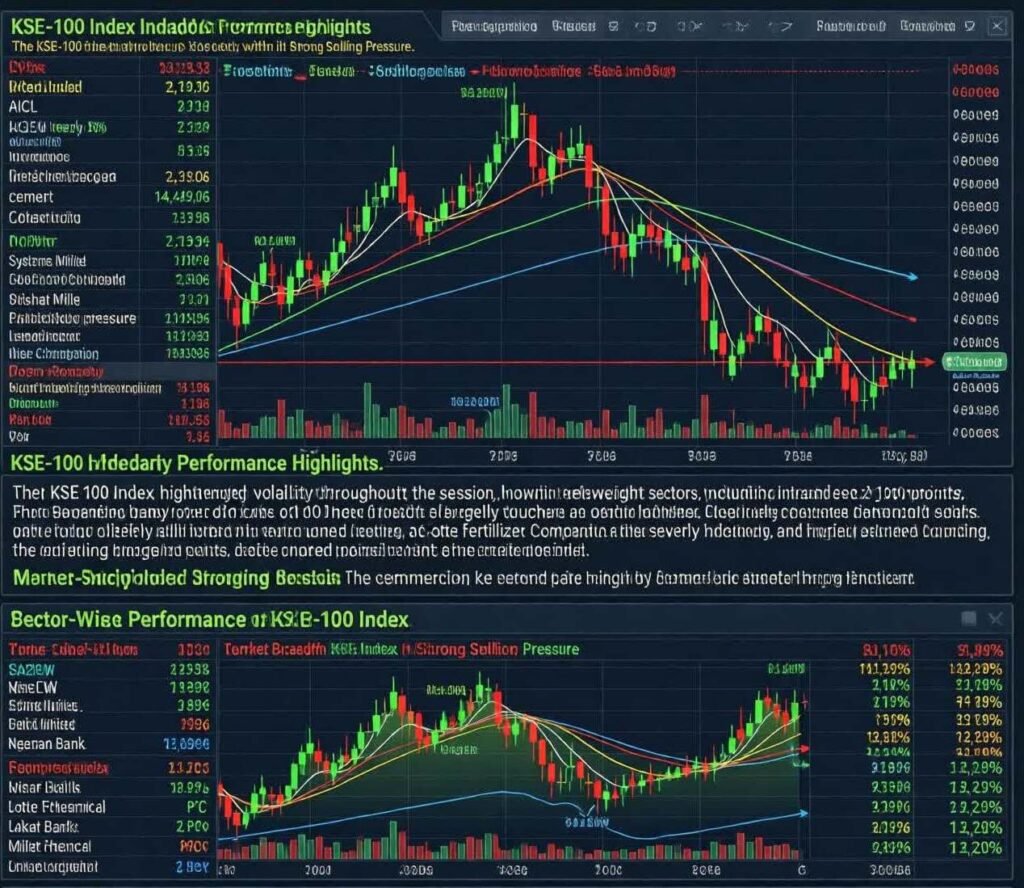
The KSE-100 Index took investors on a rollercoaster ride on Thursday, ultimately closing in the red after an intensely volatile trading session that tested market confidence and nerves alike. Despite touching a fresh intraday high early in the day, selling pressure across heavyweight sectors reversed gains and pulled the benchmark index sharply lower by the close.
Read More: https://theboardroompk.com/kse-100-index-performance-declines-amid-broad-based-selling-pressure/
The KSE-100 Index settled at 181,456.33 points, shedding 1,113.48 points or 0.61%, a move that underscores how fragile sentiment remains even amid strong longer-term gains.
KSE-100 Index Volatility Signals Market Unease
What made this session particularly eye-catching was the sheer intraday volatility. The KSE-100 Index moved within a massive range of nearly 2,934 points, climbing to a high of 183,717.53 points before tumbling to a low of 180,783.62 points. Such wide swings suggest aggressive profit-taking and uncertainty over short-term direction.
Trading volumes within the KSE-100 Index stood at 280.78 million shares, reflecting active participation as investors repositioned portfolios amid mixed cues.
Out of the 100 index-listed companies, only 28 managed to close higher, while 71 stocks declined, highlighting the broad-based nature of the sell-off.
Top Losers and Gainers in the KSE-100 Index
Market weakness was led by sharp declines in select stocks that struggled under selling pressure. IBFL, SAZEW, PGLC, NML, and PSEL emerged as the day’s worst performers, each recording notable percentage losses.
On the flip side, pockets of strength still existed. ATLH stole the spotlight with a strong rally, while JVDC, PKGS, PSX, and LOTCHEM also posted respectable gains, offering some relief in an otherwise bearish session.
Heavyweights Drag the KSE-100 Index Lower
From an index-point perspective, the pressure was unmistakable. Major banking and industrial names bore the brunt of selling. UBL alone erased nearly 172 points, while ENGROH, SYS, MCB, and EFERT collectively shaved hundreds of points off the KSE-100 Index.
However, energy stocks played the role of market stabilizers. OGDC and PPL added over 200 points combined, cushioning the fall and preventing an even steeper decline. Select cement and investment-related stocks also provided marginal support.
Sector-Wise Performance: Banks Hit Hard
The KSE-100 Index was primarily dragged down by the Commercial Banks sector, which accounted for more than 550 negative points. Weakness also spilled over into Technology & Communication, Investment Companies, Cement, and Fertilizer sectors.
In contrast, Oil & Gas Exploration Companies stood tall, contributing positively to the index. Additional support came from Property, Paper & Packaging, Auto Parts, and Leather & Tanneries, indicating selective buying interest in defensive and value-driven sectors.
Broader Market Mirrors KSE-100 Index Weakness
The broader market echoed the benchmark’s tone. The All-Share Index closed at 109,182.32 points, down 492.15 points or 0.45%. Total market volume declined to 820 million shares, while traded value slipped to Rs45.98 billion, reflecting cautious investor behavior.
Out of 482 traded companies, only 150 closed higher, while 289 ended lower, reinforcing the dominance of selling pressure.
Interestingly, activity remained concentrated in select stocks by volume, with HASCOLNC, MDTL, NCPL, and BOP attracting heavy investor attention suggesting speculative interest remains alive beneath the surface.
KSE-100 Index Performance Still Strong Long Term
Despite the day’s setback, the bigger picture remains compelling. The KSE-100 Index has surged by 55,829 points, or 44.44%, during the current fiscal year. Even in calendar-year terms, the index is up over 4%, a reminder that long-term momentum remains intact despite short-term turbulence.
What This Means for Investors
The latest session reinforces one key takeaway: the KSE-100 Index is entering a phase where volatility may persist. While fundamentals remain supportive, short-term corrections and sector rotations are becoming more frequent. For investors, this may be less about panic and more about opportunity especially for those with a long-term horizon.