
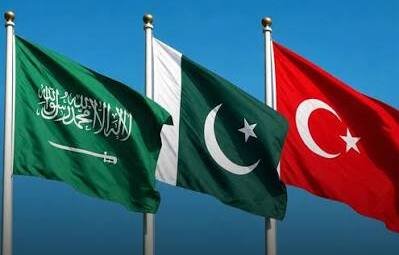
Iran has played down concerns that the new Pakistan Turkey Saudi Arabia security pact is aimed at containing Tehran, even as the agreement signals a potentially significant shift in the Middle East and South Asian security landscape.
Iranian Foreign Ministry spokesman Esmaeil Baghaei said on Monday that Tehran saw no reason to believe the agreement between Pakistan, Turkey and Saudi Arabia was directed against Iran. His comments suggest that Tehran is closely watching the emerging security arrangement but is not, at least publicly, treating it as an immediate strategic threat.
The Pakistan Turkey Saudi Arabia security pact has attracted attention because it brings together three influential Muslim-majority countries with significant military, economic and geopolitical interests. While the stated purpose of the arrangement may be broader regional security, its timing and the countries involved could have implications far beyond traditional defence cooperation.
Pakistan Turkey Saudi Arabia Security Pact Signals Regional Security Shift
Baghaei described the agreement as evidence of a changing approach to regional security. According to the Iranian official, countries in the region are increasingly looking toward their own capabilities instead of depending heavily on external powers to provide security.
This interpretation is particularly important for Pakistan, Saudi Arabia and Turkey, which have each maintained relationships with major global powers while also seeking greater strategic autonomy.
For Pakistan, closer security coordination with Saudi Arabia and Turkey could strengthen its diplomatic and defence position in a region where rivalries involving Iran, Israel and other major powers continue to reshape strategic calculations.
Saudi Arabia, meanwhile, has been pursuing a broader effort to diversify its international partnerships. Turkey has also expanded its regional diplomatic and defence relationships, making the three-way arrangement particularly significant.
Why Iran Is Not Calling the Pact a Threat
Baghaei’s remarks indicate that Tehran may prefer to avoid immediately framing the agreement as an anti-Iran alliance.
He said Iran would welcome regional security initiatives if they were based on the geopolitical and historical realities of the region, were comprehensive and inclusive, and correctly identified what he described as the major threats to regional stability.
His position leaves an important question unanswered: whether Iran would maintain the same assessment if the new security cooperation develops into deeper military coordination.
That uncertainty could become important because security agreements often begin with broad political objectives before expanding into intelligence sharing, defence cooperation, military exercises or coordinated responses to regional crises.
The Real Test Will Be What the Pact Delivers
The biggest weakness in the current public narrative is the lack of clarity over the practical scope of the agreement.
Calling the pact a major regional security development may attract headlines, but its strategic importance will ultimately depend on what Pakistan, Turkey and Saudi Arabia actually commit to doing. Without clearly defined mechanisms, joint operations, intelligence arrangements or institutional structures, the agreement could remain more political than operational.
This is where governments will face scrutiny. Regional security arrangements can create confidence among partners, but they can also increase suspicion if neighbouring countries believe they are being excluded from a new strategic bloc.
For Pakistan, the balancing act could be especially difficult. Islamabad has historically maintained important relations with both Saudi Arabia and Iran. Deeper security cooperation with Riyadh and Ankara therefore requires careful diplomacy to ensure that Pakistan does not become trapped between competing regional interests.
Iran’s Response Could Shape the Pact’s Future
Iran’s relatively measured response gives the three countries diplomatic space to develop their cooperation without immediately triggering a confrontation with Tehran.
However, the situation could change if the Pakistan Turkey Saudi Arabia security pact becomes explicitly focused on military deterrence or develops into a framework that Iran considers hostile.
For now, Tehran appears to be testing the intentions behind the agreement rather than openly challenging it. That cautious response may reflect Iran’s broader interest in preventing another regional security divide at a time when tensions involving Israel and its regional allies remain high.
The pact therefore deserves attention not simply as a defence agreement, but as a potential indicator of a wider transformation in how regional powers intend to manage their own security.
The critical question is no longer whether Iran is worried about the agreement. The more important question is whether Pakistan, Turkey and Saudi Arabia can turn their emerging partnership into a credible security framework without creating another fault line in an already deeply divided region.