
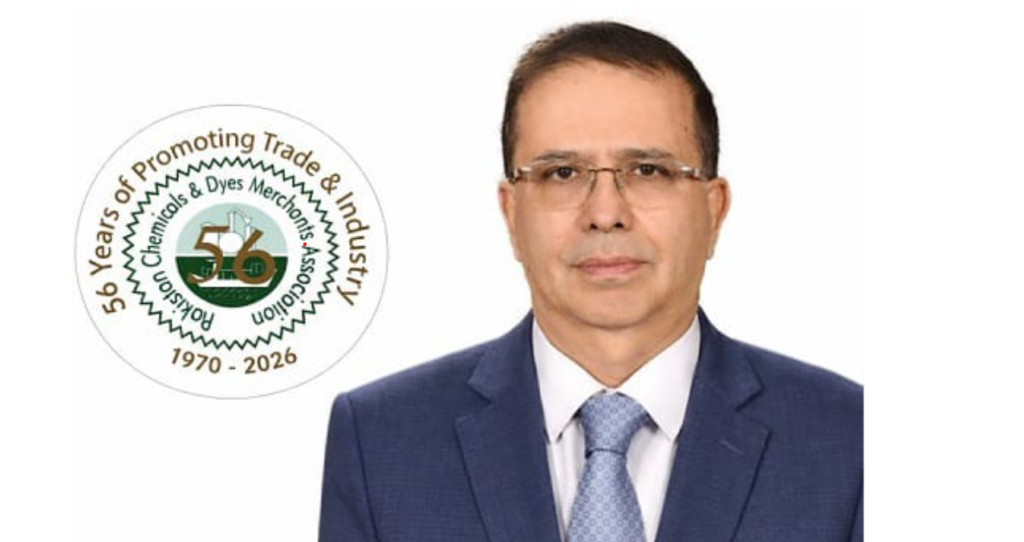
The Pakistan Chemicals & Dyes Merchants Association (PCDMA) has expressed serious reservations over the federal government’s decision to allow manufacturers to sell up to 50% of imported raw materials in the local market without value addition, arguing that the measure effectively legitimizes the misuse of export-related industrial concessions.
In a statement, PCDMA Chairman Salim Valimuhammad said that raw materials imported under concessionary tax and duty schemes meant exclusively for export-oriented production should, under no circumstances, be allowed to enter the domestic market.
PCDMA Opposes Sale of Concessionary Raw Materials in Local Market
He said the new provision introduced through the Sales Tax Act in the federal budget, permitting manufacturers to sell up to 50% of imported raw materials without processing, runs contrary to the very objective of export facilitation.
Instead of curbing abuse, the policy effectively grants legal cover to the diversion of concessionary imports into the local market, undermining genuine commercial importers that pay the full spectrum of applicable taxes, duties, and levies.
“Raw materials imported under export incentive schemes must be used solely for value addition and subsequent exports. Allowing even 50% of such imports to be sold domestically defeats the purpose of these incentives and creates an uneven playing field,” Mr. Valimuhammad said.
Complete Ban on Domestic Sale Urged
He maintained that the issue was not the percentage allowed for resale but the principle itself.
“There should be no permission whatsoever to sell concessionary imported raw materials in the local market. If imports are allowed under special incentives for export production, they must be utilized exclusively for that purpose,” he added.
The PCDMA chairman urged the government to replace the 50% resale cap with a complete prohibition on the domestic sale of concessionary imported raw materials and called upon the Federal Board of Revenue (FBR) to launch an impartial crackdown against all those misusing industrial concessions under the guise of manufacturing.
Tax Disparity Distorts Competition
Mr. Valimuhammad further said that the long-standing disparity in the tax treatment of commercial importers and industrial manufacturers has severely distorted competition in Pakistan’s chemicals and dyes sector.
While commercial importers supplying raw materials to small and medium-sized enterprises (SMEs) are required to pay higher withholding tax and value-added tax (VAT) at the import stage, some industrial units continue to benefit from concessionary imports and subsequently divert part of those consignments into the domestic market without any value addition.
“This practice not only harms tax-compliant commercial importers but also deprives the national exchequer of legitimate revenue while weakening market discipline,” he observed.
Calls for Uniform Import Tax Regime
Rejecting the argument that the newly introduced 50% cap would resolve the issue, Salim Valimuhammad stressed that sustainable reform could only be achieved through a uniform import tax regime applicable to all importers without discrimination.
Such a system, he said, would eliminate tax distortions, ensure equal business opportunities, strengthen the supply chain for SMEs, and promote fair competition in the chemicals and dyes market.
PCDMA Seeks Comprehensive Tax Reforms
The PCDMA chief called upon the federal government and the FBR to immediately implement comprehensive reforms, including uniform taxation at the import stage, strict enforcement against the misuse of industrial concessions, and effective regulatory oversight to safeguard the interests of the trading community and strengthen Pakistan’s documented economy.