
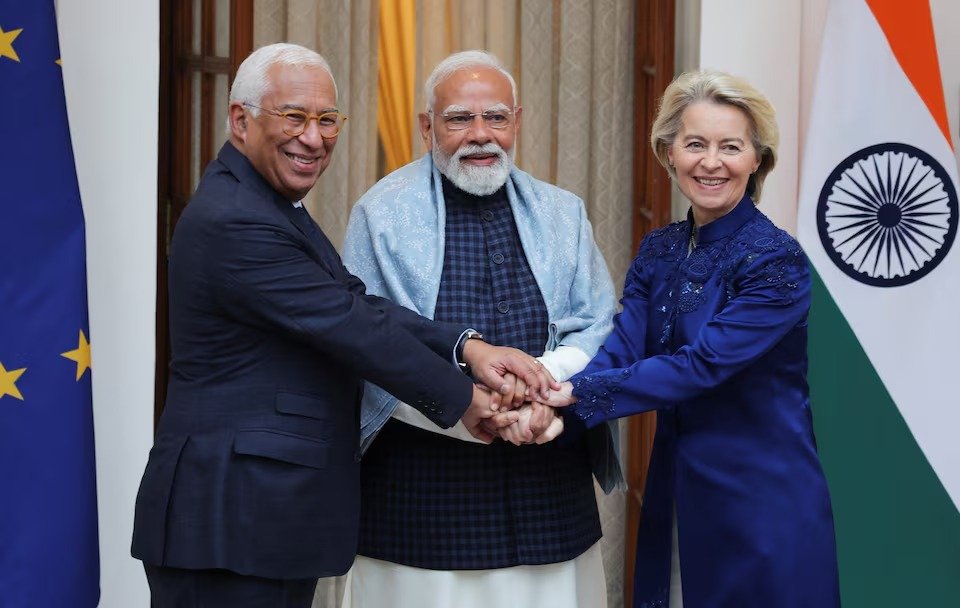
After nearly two decades of stalled negotiations, India and the European Union officially finalized a landmark Free Trade Agreement (FTA) on Tuesday. Prime Minister Narendra Modi, alongside European Commission President Ursula von der Leyen, hailed the pact as a transformative milestone that creates a free trade zone for over two billion people.
Described by both leaders as the “mother of all deals,” the agreement is expected to represent roughly 25% of global GDP and one-third of world trade, providing a strategic hedge against growing global economic volatility and shifting alliances.
A Strategic Shift in Global Commerce The deal comes at a critical time as both New Delhi and Brussels navigate a turbulent international environment, particularly regarding trade tensions with the United States. By deepening economic integration, the pact seeks to diversify supply chains and reduce reliance on single-market dependencies.
Prime Minister Modi noted that the agreement serves as a “global double engine of growth,” signaling to the world that cooperation remains the most effective response to geopolitical challenges. The timing is seen as a decisive move to strengthen the strategic partnership between the world’s second and fourth-largest economies.
Immediate Gains and Market Access Under the terms of the agreement, the European Union will eliminate or significantly reduce tariffs on 99.5% of Indian exports, with many duties dropping to zero immediately. This provides a massive boost to India’s labor-intensive sectors, including textiles, leather, and gems.
Conversely, India will open its guarded market by slashing tariffs on European machinery, chemicals, and automobiles. Notably, import duties on European cars will be reduced from 110% to just 10% over five years, while tariffs on wines and spirits will also see significant cuts, marking the most substantial market opening India has ever offered a trading partner.