
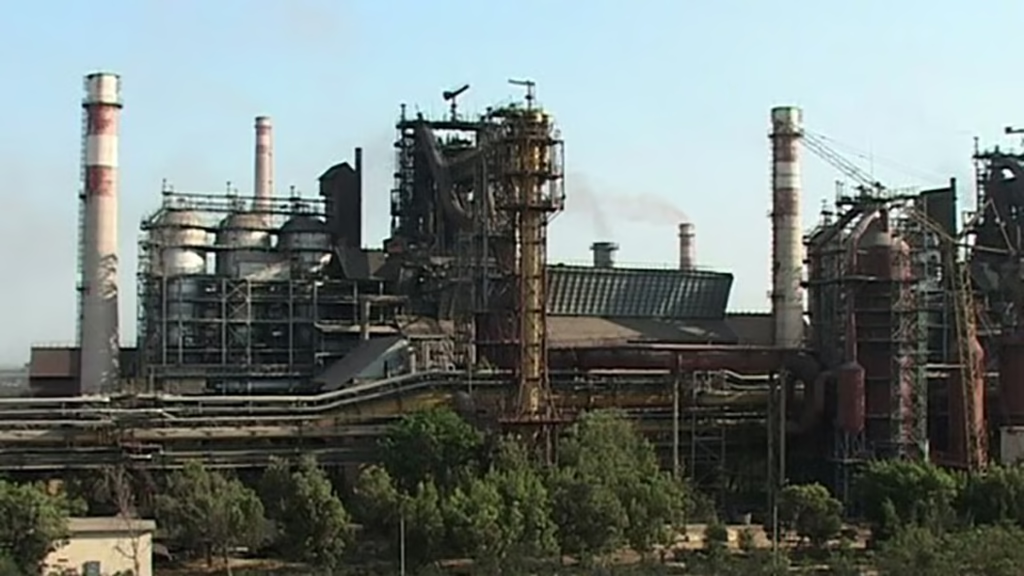
The government has decided to move towards the Pakistan Steel Mills revival, effectively reversing its earlier decision to liquidate the state-owned steel producer after international investors showed interest in restoring and modernising the dormant industrial giant.
Well-informed sources said the government has initiated consultations with Russian company Industrial Engineering LLC for the revival, modernisation and restructuring of Pakistan Steel Mills (PSM).
The development marks a significant shift in the government’s approach towards the loss-making state-owned enterprise. The Special Investment Facilitation Council (SIFC) had decided in May 2024 to scrap PSM, while the Cabinet Committee on Rightsizing subsequently approved the liquidation of the existing mill in August 2024.
However, the government has now begun exploring a revival plan, with international cooperation emerging as a potential route for restoring the mill to operational status.
Pakistan, Russia Sign Protocols For PSM Revival
According to sources, two protocols have already been signed between Industrial Engineering LLC of Russia and Pakistan Steel Mills under the Ministry of Industries and Production.
The first protocol was signed in Moscow on July 10, 2025. It covers cooperation between the two sides for the revival, modernisation and restructuring of PSM.
The second protocol was signed during the 10th session of the Pakistan-Russia Intergovernmental Commission on November 26, 2025.
The second agreement focuses on determining the operational and capital expenditure requirements needed for manufacturing activities at the steel mill.
The agreements provide a framework for assessing the condition of the existing facility, determining investment requirements and examining the feasibility of restoring production.
Sources said an exercise has already been carried out to determine production costs and assess market feasibility.
The findings of this exercise are expected to play an important role in determining whether the mill can be restored on a commercially sustainable basis.
Govt To Seek Approval To Stop PSM Liquidation
The concerned authority is expected to submit recommendations to the Cabinet Committee on State-Owned Enterprises (SOEs) seeking an end to the liquidation process.
The proposed move is based on the expectation that PSM can be revived with support from international investors and technical partners.
A formal summary regarding the revival has also been submitted to the Ministry of Industries and Production for consideration, according to sources.
The new policy direction indicates that the government no longer intends to proceed with the earlier plan to dispose of the existing mill.
A parliamentary secretary also stated that the government’s policy direction was now clear and that authorities intended to restore Pakistan Steel Mills to operational status.
He added that the timeline agreed with the Russian company would be followed and that further measures would be taken accordingly.
The government will now need to determine the investment required, production capacity, operating costs and potential market for locally manufactured steel before finalising the revival framework.
Awais Leghari Signals Fresh Revival Efforts
Minister for Power Sardar Awais Ahmad Khan Leghari has also indicated that recommendations for reviving Pakistan’s dormant steel giant will soon be presented to policymakers.
Speaking during a webinar titled “Pakistan-Russia: Strengthening Trade, Education and Energy Collaboration,” jointly organised by the University of World Civilizations Moscow and the Institute of Regional Studies, Leghari highlighted the improving relationship between Pakistan and Russia.
He said bilateral relations had gained positive momentum over the past two decades, supported by mutual trust, respect and a shared commitment to regional stability.
The minister’s remarks reinforce the government’s renewed interest in using cooperation with Russia to support major industrial and economic projects.
For Pakistan Steel Mills, Russian technical and investment expertise could potentially play a role in modernising outdated facilities and establishing a commercially viable production model.
PSM Liquidation Plan Had Earlier Been Approved
Pakistan Steel Mills has remained dormant for years, creating a significant financial burden for the government.
The government had previously decided to scrap the entity after failing to find a buyer for the mill. The SIFC approved the decision to scrap PSM in May 2024, followed by approval from the Cabinet Committee on Rightsizing for liquidation in August 2024.
Since then, the government has continued to bear the cost of salaries for the remaining employees.
Meanwhile, bills and other expenses have reportedly been supported through proceeds generated from the sale of scrap from the mill.
The proposed reversal therefore represents a major change in policy.
Instead of proceeding with liquidation and disposing of the remaining assets, authorities are now examining whether the country’s largest integrated steel production facility can be restored through foreign investment, restructuring and modernisation.
Revival Could Support Industrial Development
A successful Pakistan Steel Mills revival could have wider implications for the country’s industrial sector.
A functioning integrated steel mill could potentially reduce reliance on imported steel products, support downstream industries and create employment opportunities.
It could also provide domestic industries with a larger source of locally produced steel for construction, engineering, manufacturing and infrastructure projects.
However, experts are likely to closely examine the financial feasibility of any revival plan. PSM has faced years of operational, financial and management problems, while much of its infrastructure requires substantial investment and modernisation.
The government’s ongoing assessment of production costs, capital expenditure and market feasibility will therefore be critical.
The involvement of an international technical partner could help address some of these challenges, but the final structure of investment, management, financing and ownership will determine whether the revival can become sustainable.