
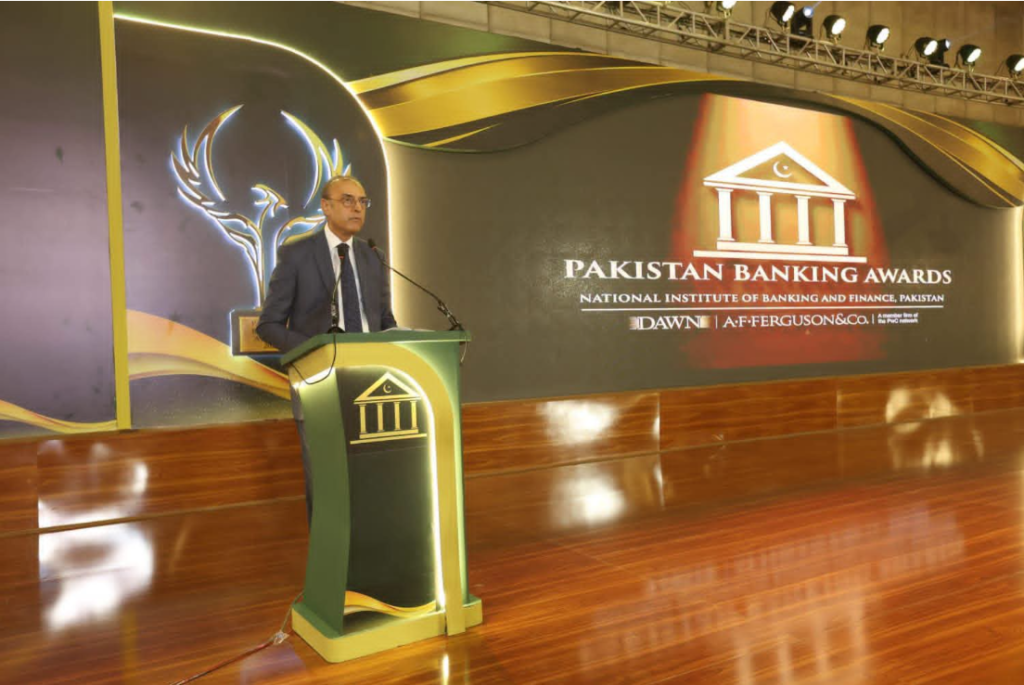
State Bank of Pakistan Governor Jameel Ahmed has delivered a pointed message to the country’s banking industry: Pakistan cannot achieve sustainable economic growth if banks continue to rely heavily on traditional business models and government financing.
Addressing the 11th Pakistan Banking Awards 2026 in Karachi, Governor Jameel Ahmed said the banking sector must become more aggressive in mobilizing retail deposits and extending credit to the private sector.
His remarks come at a critical stage for Pakistan. While macroeconomic stabilization has reduced some immediate pressures, the economy still faces the harder challenge of generating investment, employment and productivity-led growth.
Governor Jameel Ahmed acknowledged that Pakistan had demonstrated resilience during FY26 despite severe floods, geopolitical tensions and an uncertain global trade environment. Inflation remained broadly aligned with the medium-term target, inflation expectations stayed relatively anchored and the current account deficit remained near the lower end of the projected range.
Foreign exchange reserves also continued to improve, exceeding the end-June target of 18 billion dollars. Importantly, Ahmed highlighted that reserve accumulation was increasingly supported by State Bank foreign exchange purchases rather than debt-driven inflows.
Governor Jameel Ahmed Highlights Rs69 Trillion Banking Sector
Pakistan’s banking industry has expanded considerably. Governor Jameel Ahmed said total banking-sector assets reached Rs69 trillion by the end of June 2026, while deposits stood at Rs43 trillion.
Banks also remain well capitalized, with the sector’s Capital Adequacy Ratio comfortably above both international benchmarks and domestic regulatory requirements.
However, the headline numbers hide a deeper structural problem.
Pakistan’s banking assets and deposits remain relatively small compared with GDP when measured against several emerging-market economies. The country’s high currency-to-deposit ratio also indicates that a significant amount of economic activity remains outside the formal banking system.
This is where Governor Jameel Ahmed’s call for stronger retail deposit mobilization becomes particularly important.
Banks need to compete for household deposits through better returns, improved customer service and more accessible financial products. Simply accumulating large balance sheets is not enough if the financial system fails to channel savings into productive investment.
Private Sector Credit Becomes the Bigger Challenge
The most important part of Governor Jameel Ahmed’s message was his call for greater private-sector financing.
Pakistan’s private-sector credit penetration remains significantly below that of many emerging-market peers. More concerning is the long-term decline in the ratio of bank credit to the private sector relative to GDP.
The Governor rejected the idea that government borrowing alone fully explains this weakness. He pointed out that some emerging economies with substantial domestic government debt still maintain much higher levels of private-sector credit.
This raises an uncomfortable question for Pakistan’s banking industry: if banks have strong deposits, substantial assets and healthy capital positions, why is productive private-sector lending still relatively weak?
The answer requires more than blaming fiscal policy. Banks must also reconsider their risk appetite, lending models and customer acquisition strategies.
Pakistan Needs Banks to Finance Businesses, Not Just Balance Sheets
The shift demanded by Governor Jameel Ahmed could have major implications for Pakistan’s businesses, particularly small and medium-sized enterprises, exporters, manufacturers and agriculture-related companies.
Greater private-sector credit can help businesses expand capacity, purchase machinery, invest in technology and create employment. But this will only happen if banks develop lending products that reflect the realities of Pakistani businesses rather than relying excessively on conventional collateral-based lending.
The government, regulators and banks therefore share responsibility.
If banks are encouraged to lend more but businesses continue to face weak documentation, informality and governance problems, credit growth will remain difficult. Conversely, if banks remain excessively conservative, Pakistan risks trapping capital in low-risk government financing while productive sectors struggle to obtain funding.
Pakistan Banking Awards 2026 Recognize Industry Leaders
The 11th Pakistan Banking Awards were organized by NIBAF Pakistan in collaboration with Dawn Media Group and A. F. Ferguson & Co.
Meezan Bank Limited received the Best Bank award.
Bank of Punjab won recognition for Best Bank for Women Inclusion, Best Bank for Small and Medium Enterprises and Best Bank for Agriculture Inclusion. ASA Microfinance Bank Limited was named Best Microfinance Bank, while Bank Alfalah Limited received the Best Bank for Digital Excellence award.
Meezan Bank also won Best Bank for Customer Engagement. Askari Bank Limited and Faysal Bank Limited shared the Best Mid-Sized Bank award.
HBL received the Best Bank for ESG award, while Pakistan Microfinance Investment Company Limited was recognized for Best Contribution by a Non-Bank Entity.
The awards celebrate banking achievements, but Governor Jameel Ahmed’s broader message points toward a more demanding benchmark for the industry.
The Real Test for Pakistan’s Banks Starts Now
Pakistan’s banking sector has achieved scale, profitability and capital strength. The next question is whether it can convert that financial strength into broader economic value.
Governor Jameel Ahmed’s message effectively shifts the debate from banking stability to banking usefulness.
A stronger deposit culture, deeper financial inclusion and significantly greater private-sector lending could help Pakistan move from stabilization toward sustainable growth. But achieving that transition will require banks to take calculated risks, innovate their lending models and compete for customers beyond traditional corporate and government business.
For Pakistan, the stakes are much larger than banking-sector profits. If financial institutions cannot effectively channel domestic savings into productive private investment, economic stabilization may prove to be only the beginning rather than the foundation of lasting growth.