
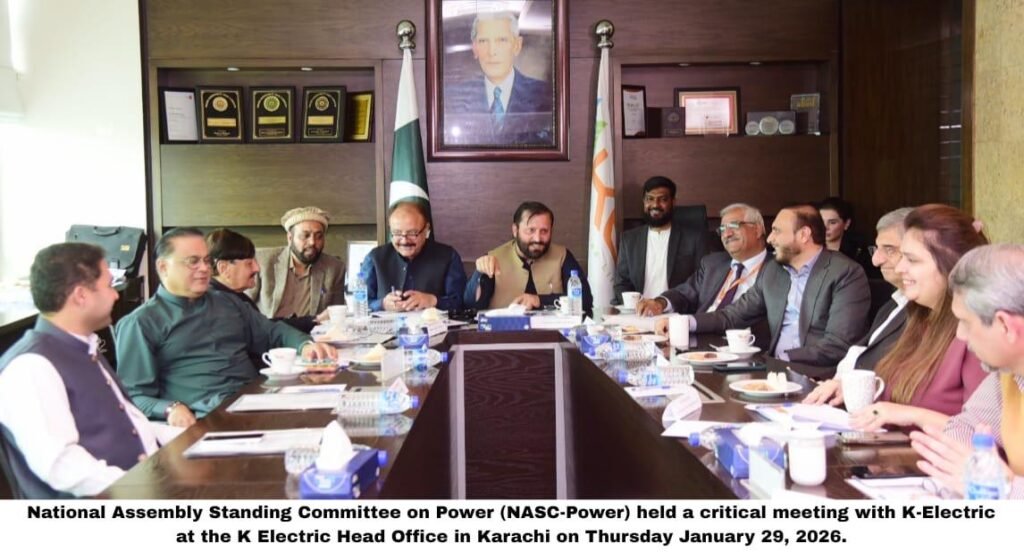
KARACHI: Pakistan- January 29– The National Assembly Standing Committee on Power Division (NASC-PD). held a critical meeting with K-Electric today to address escalating concerns over power outages, load-shedding, and electricity theft affecting millions of Karachi residents.
Read More: https://theboardroompk.com/sindh-govt-rolls-out-rs19bn-for-karachi-roads-and-gul-plaza-relief/
The session, chaired by Muhammad Idrees, Chairman of the National Assembly Standing Committee on Power Division, brought together committee members and senior K-Electric officials to deliberate on service delivery failures disproportionately impacting paying customers across Pakistan’s largest metropolis.
Citizens’ grievances took centre stage
as The committee strongly articulated public dissatisfaction with discriminatory load-shedding patterns and persistent outages affecting law-abiding, bill-paying citizens. “Residents paying thousands of rupees monthly have every right to expect reliable service,” committee members emphasized. “The current practice of collective punishment through load-shedding in areas with theft problems is unacceptable.”
The committee stressed that unreliable electricity undermines power distribution efforts, as power outages directly impact livelihoods, education, healthcare access, and water supply for vulnerable populations served by government programs including the Benazir Income Support Programme (BISP), which assists over 9 million families nationwide.
K-Electric sought legislative support to criminalize electricity theft by converting an existing ordinance into permanent law. “Electricity theft affects every honest consumer in Karachi,” officials stated. “We need robust legal frameworks with meaningful penalties.”
The company also presented infrastructure achievements, noting transmission capacity expansion from 200 MW to over 500 MW, and interconnection capacity with the National Grid enhanced to 2,000+ MW with federal government support.
The NASC-Power Division pledged unwavering support for anti-theft legislation while demanding immediate accountability from K-Electric. The committee proposed piloting tamper-proof cable technology in selected Union Councils to prevent the notorious “kunda system” of electricity theft.
The committee established three non-negotiable priorities. Eliminate discrimination against paying customers through fair load-management policies. Ensure 24-hour supply for compliant consumers without collective punishment. Deploy advanced technologies to systematically eliminate electricity theft. They also stressed that K-Electric must submit a comprehensive action plan within 30 days detailing measures to reduce load-shedding for compliant customers
National Assembly will prioritize electricity theft criminalization legislation. They further suggested K Electric to roll out a Pilot project for tamper-proof cables to counter the “Kunda System ailment,” be implemented in a selected Union Council in order to test out its effectiveness and potential for replication throughout the city.
NASC advised Quarterly follow-up sessions to monitor progress and ensure accountability. The meeting underscored the critical link between reliable electricity access and Pakistan’s broader development objectives, particularly affecting economic opportunities, education, healthcare, and water supply for low-income households.
In attendance were Muhammad Idrees Chairman, National Assembly Standing Committee (NASC) on Power, Members of NASC on Power alongside high-level representatives from K Electric.