
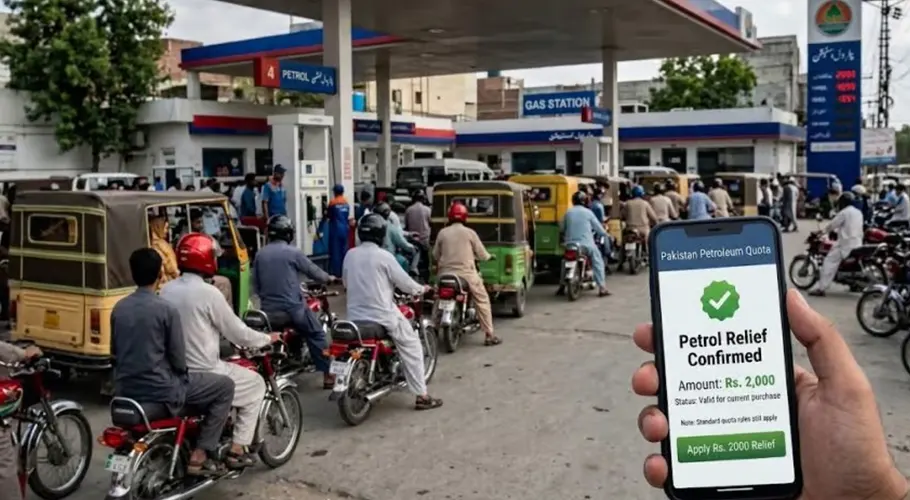
Government Approves Three-Month Motorcyclist Relief
The government has approved a monthly relief payment for motorcyclists as rising petrol and diesel prices put increasing pressure on household budgets.
Prime Minister Shehbaz Sharif has approved a scheme providing around Rs2,000 per month to eligible motorcyclists. The relief will initially run for three months, with officials indicating that it could be extended if funds are available and tensions in the Middle East do not ease.
The move comes after a sharp increase in domestic fuel prices and growing public pressure for the government to provide relief to consumers.
Petrol and Diesel Prices Reach New Highs
Petrol is currently selling at around Rs376 per litre, while diesel has reached close to Rs403 per litre.
Petrol prices increased by Rs30 per litre this week, while diesel prices rose by Rs25 per litre.
The government continues to collect a substantial petroleum levy from fuel consumers. Petrol carries a levy of Rs106 per litre, equivalent to roughly 28% of its current retail price. Diesel is subject to a Rs101-per-litre tax.
The sharp increases have intensified concerns about the impact of fuel costs on commuters, particularly motorcyclists who rely on two-wheelers for daily travel and work.
Fuel Levy Faces Growing Public Pressure
The petroleum levy has also become a focus of political and public criticism.
Jamaat-e-Islami has announced a long march to Islamabad on September 20, with a reduction in the petroleum levy among its key demands.
The pressure comes as households face higher transportation costs and businesses absorb increased expenses linked to fuel and logistics.
How the Rs2,000 Relief Scheme Will Work
The Ministry of Information Technology is developing the payment mechanism for the scheme.
IT Minister Shaza Fatima Khawaja said details of the system are being finalised to ensure that the relief reaches eligible people in accordance with the prime minister’s directions.
The Rs2,000 monthly figure was also used in an earlier relief scheme. However, the final payment amount remains subject to the prime minister’s decision.
The government has yet to disclose all operational details, including the final eligibility criteria and disbursement process.
Why the Government Did Not Cut the Petroleum Levy
The decision to provide targeted relief instead of reducing the petroleum levy reflects a broader disagreement within the government over how to manage the impact of higher fuel prices.
Some cabinet ministers had proposed cutting the petroleum levy and suggested that the Rs430 billion contingency budget could be used to cover any resulting revenue shortfall.
The finance ministry opposed the proposal, arguing that a reduction in the levy could create risks for Pakistan’s IMF programme.
The debate highlights the government’s competing priorities: protecting consumers from rising fuel costs while maintaining revenue targets and commitments under the IMF programme.
Rs2,000 Relief Offers Limited Purchasing Power
At current petrol prices, Rs2,000 buys only around five litres of petrol.
For a motorcycle user travelling regularly for work, the amount may provide some short-term assistance but is unlikely to fully offset the impact of the latest price increases.
The scheme also leaves out other groups facing higher transportation costs, including small-car owners and people who depend on buses, vans and other forms of public transport.
The limited size of the payment means the government is offering targeted support rather than addressing the broader increase in fuel costs.
Contingency Funds Add Another Layer to the Debate
The government’s decision also comes amid questions over the use of contingency funds.
Last year, Rs113 billion from a similar contingency pool reportedly went unused. At the same time, additional petroleum levy collections accumulated as consumers continued to face higher pump prices.
This has strengthened calls for a closer look at whether available fiscal resources could be used to provide broader relief.
For the finance ministry, however, maintaining petroleum revenue remains important for meeting fiscal and IMF-related targets.
Bigger Question Over Fuel Taxes Remains
The Rs2,000 monthly payment could provide temporary relief for motorcyclists, but it does not resolve the underlying issue of high fuel taxation.
With petrol near Rs376 per litre and diesel approaching Rs403, the cost of transportation is likely to remain a major concern for households and businesses.
The government’s immediate response is therefore focused on targeted cash support rather than reducing the petroleum levy.
Whether fuel taxes should ultimately be lowered — and how any resulting revenue gap would be financed — remains the larger unanswered question.